Writers who keep notes alongside their manuscript
If you want to read your draft and revision notes at the same time, check that both windows remain easy to read at your preferred text size. The screen’s diagonal measurement alone won’t tell you.


If you want your manuscript and revision notes visible at the same time, choose a monitor based on the width the two windows actually need at your preferred text size. For long stretches of text, extra screen height or a pivot function may matter more. Then check the scaling, desk space and, if you use a laptop, its video output and charging requirements separately. Neither a higher resolution nor USB-C alone determines whether a monitor is right for you.
If you want to read your draft and revision notes at the same time, check that both windows remain easy to read at your preferred text size. The screen’s diagonal measurement alone won’t tell you.
For long passages, it’s worth weighing extra screen height against the width needed for side-by-side windows. The best format depends on which part of your workflow matters most.
If you want to adjust the monitor to suit your workspace and eyesight, check the stand and screen position. The Federal Institute for Occupational Safety and Health looks at how screen position, individual visual characteristics and body measurements work together.
| What you need | What to look for | Who is it important to? |
|---|---|---|
| Manuscript and notes side by side | Try using two windows at your preferred text size; check resolution and desk space separately. | If I want to read my manuscript and notes side by side, both windows need to work at my preferred text size. Around 36% of consumers put this side-by-side view first. |
| Long passages of text | Compare your preferred line length and text scaling across the formats you’re considering. | For long passages, I want to know how much text stays visible vertically without losing sight of my preferred line length. About 29% of consumers prioritise continuous text views. |
| Adjustable setup | Check the stand, height and tilt adjustment, and reflections in your workspace. | I want to check that the screen position, text size and reflections suit my workspace. Around 21% of consumers prioritise an adjustable setup that’s easy to read. |
| Laptop connectivity | Compare your laptop’s video output and port features with the monitor’s charging power. | When using a laptop, I want to keep cables to a minimum, but I also need to check that the monitor’s video output and charging meet my device’s needs. Around 14% of consumers prioritise this type of connectivity. |
Screen size and native resolution describe different things. Whether two views work for you also depends on text size and how you arrange the windows.
Before you buy, set up the manuscript and notes view you have in mind, using scaling that keeps the text easy to read.
More room for continuous text won’t necessarily meet your need for two side-by-side windows.
Try a long chapter and a side-by-side notes view separately, then choose based on the workflow you use more often.
The charging power listed varies between monitors. Your laptop’s port also needs to support the video output you require.
Check the video output, port features and power requirements for both devices. Otherwise, you may still need a separate power adapter or another video connection.
The Consumer Advice Centre distinguishes statutory consumer rights from a voluntary warranty and explains that the retailer is responsible for dealing with faults (as at 13 August 2026).
Read the warranty terms separately. If a product is faulty, contact the retailer to exercise your statutory rights.
The P2725D is a 27-inch QHD office monitor, with a resolution that matters when arranging text windows.
The RD280U and GW2790QT offer different approaches to long text views and laptop setups.
The FlexScan EV2490 is a compact office monitor with USB-C docking.
The ProArt PA279CRV is a 27-inch 4K model with pivot. Its creative features aren’t automatically a reason to buy if you’ll mainly use it for text.
This Joybuy selection includes monitors for side-by-side text windows, including QHD models, a wide UWQHD display and a 4K model with pivot.
 No image available
QHD resolution provides a native pixel base for working with a manuscript and notes in multiple windows.
27 inches; 2560 × 1440 pixels; the listed stand offers height adjustment, tilt, swivel and pivot.
 No image available
The 27-inch QHD specification is relevant when planning a side-by-side manuscript and notes view. Check that the text is easy to read at your chosen scaling.
27 inches; QHD at 2560 × 1440 pixels; multi-direction adjustable stand.
 No image available
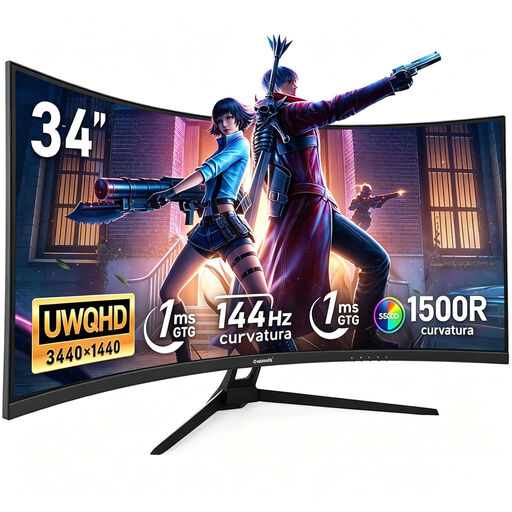
The wide display is an option if you want to arrange your manuscript and notes side by side. Check that the format and footprint suit your desk.
34 inches; UWQHD at 3440 × 1440 pixels; curved display.
 No image available
QHD resolution can provide a basis for working with a manuscript and notes in side-by-side windows. Set up the view using your preferred text size.
27 inches; 2560 × 1440 pixels; according to the product description, the stand is height-adjustable, tilts and swivels.
 No image available
Pivot lets you switch to portrait orientation. Check beforehand that you have enough space and that the scaling works for you.
27 inches; 3840 × 2160 pixels; pivot and height adjustment; USB-C with 90 W Power Delivery; PIP and PBP.
No. Decide based on how easy your two windows are to read at your preferred text size and operating system scaling. For the 27-inch examples considered here, manufacturers list 2560 × 1440 and 3840 × 2160 pixels respectively. The pixel count alone doesn’t determine the right window layout.
Adjust the screen position, lighting and text size to suit your eyesight. The Federal Institute for Occupational Safety and Health describes how the workstation, glasses and screen position work together for office screen work; this doesn’t mean that any particular monitor is guaranteed to prevent discomfort.
Only if your particular laptop can output video through the relevant port and the monitor’s power delivery meets its requirements. EIZO lists a maximum of 70 W for the EV2490 and BenQ lists 65 W for the GW2790QT. Check the ports on both devices too.
Not in every case. The Federal Institute for Occupational Safety and Health lists workplaces and teleworking spaces as areas of application, and excludes private use outside teleworking spaces. Whether your particular setup counts as a teleworking space depends on your work situation.
The European Commission includes computer monitors among the electronic displays covered by energy labels and describes the A-to-G scale. Compare the label and the details for each model; the label doesn’t tell you how easy your manuscript view will be to read.