Strategy gamers and keen readers
If you spend a lot of time looking at map labels, menus and documents, the text should be clear at your usual screen size and scaling. RTINGS notes that judging text clarity is also subjective.


If you work and play turn-based strategy games at the same desk, start by checking how easy it is to read game interfaces and documents, along with screen size and how much you can adjust your setup. A QHD IPS monitor can work well for both, while VA or OLED may be worth considering if dark gaming scenes matter most to you and you’re happy to weigh up the trade-offs. A high refresh rate alone won’t tell you how practical a monitor is for everyday use.
If you spend a lot of time looking at map labels, menus and documents, the text should be clear at your usual screen size and scaling. RTINGS notes that judging text clarity is also subjective.
If you use the same space for work and gaming, connectivity and a suitable screen position are important things to consider. The BAuA distinguishes between the scope of ASR A6 for screen-based work and private screen use outside a teleworking arrangement.
If dark gaming scenes matter most to you, weigh up contrast against any drawbacks for day-to-day text work. DisplayNinja says VA panels typically offer higher contrast than IPS, while RTINGS highlights the risk of burn-in on OLED screens when static elements remain visible for long periods.
First, check how text looks at your usual scaling, then consider the screen’s position on your desk and whether it’s compatible with your devices. Assess the panel type and refresh rate in the context of how you split your time between work and gaming.
| Priority | What to check before buying | Who is it important to? |
|---|---|---|
| Readability | Consider screen size and native resolution together; check how text looks at your usual scaling. | If I spend a long time reading maps, menus and documents, clear text is my top priority. Around 36% of consumers put readability first. |
| Ergonomics | Check that the height and tilt adjustments, as well as the stand’s footprint, work with your desk. | If I use the same desk for work and gaming, I want to be able to position the screen comfortably. Around 29% of consumers prioritise an adjustable setup. |
| Connectivity | Check the inputs on your monitor and computer, and confirm the resolution and refresh rate supported by each input. | If I want to connect a laptop and a PC, I check the features I need for each device and the input I plan to use. Around 21% of consumers prioritise connection compatibility. |
| Contrast and atmosphere | Compare IPS, VA and OLED on the specific model; with OLED, also consider static elements that remain visible for long periods. | If dark gaming scenes matter more to me than an especially high refresh rate, I weigh up contrast and any drawbacks for work. Around 14% of consumers put picture quality and atmosphere first. |
Refresh rate and advertised response time alone don’t tell you how easy text is to read on a particular model.
Check text clarity and scaling separately from the gaming specifications.
According to RTINGS, static work screens that remain visible for long periods can pose a risk of burn-in.
Consider OLED in light of how you actually work, and check the warranty terms for the specific model before you buy.
Supported resolution and refresh rate can vary depending on the input and the connected device.
Check the specifications for your computer, cable and the monitor input you’ll be using. Depending on the connection, you may also need a cable or dock.
The Dell S2725DSM is an example of a 27-inch QHD IPS monitor, which Dell lists with a 144 Hz refresh rate and height-adjustable stand.
The LG 27BA75QB-B and 27GS60QX-B illustrate two different approaches: office connectivity on one, gaming features on the other.
The MSI G274QPF E2 is an example of a QHD gaming monitor with a Rapid-IPS panel.
The Joybuy products below include QHD IPS and curved VA gaming monitors. Check that each model’s text clarity, connections and stand suit your workspace.
 No image available
The listed QHD resolution and height-adjustable stand are worth considering if you plan to use the monitor for both gaming and work.
The product title lists 27 inches, 2560 × 1440, Fast IPS, 144 Hz, 1 ms MPRT, FreeSync, HDMI and DisplayPort.
 No image available
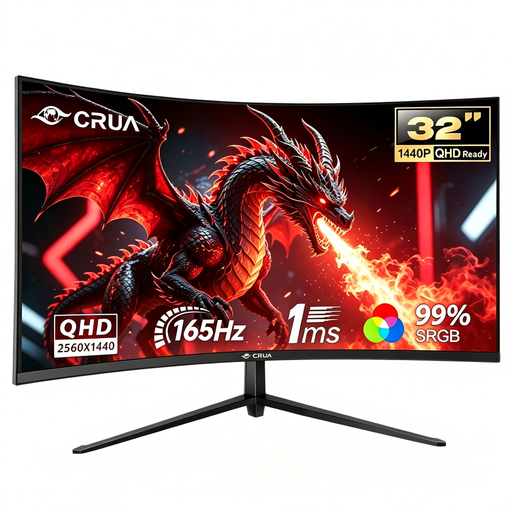
This curved 32-inch VA display could suit you if you prefer a larger, curved screen for gaming and work.
The product title lists QHD, 165 Hz, 1 ms GTG and 1500R curvature.
 No image available
The 34-inch ultrawide format is an option if you prefer a wide, curved display; make sure you have enough desk space for it, too.
The product title lists UWQHD, a VA panel, 165 Hz and 1500R curvature.
 No image available
This curved QHD model could be worth considering if you prefer a VA display; check text clarity separately for the way you plan to use it for work.
The product title lists 27 inches, 180 Hz and AMD FreeSync.
 No image available
The IPS technology and QHD resolution listed in the product title make this a possible option for a mix of game interfaces and office work.
The title lists 2560 × 1440, SuperSpeed IPS, 260 Hz and up to 275 Hz in OC mode.
No. A high refresh rate for its own sake shouldn’t drive this buying decision. Start by checking readability, your workspace and connectivity. Whether smoother motion matters to you in other games depends on how you use the monitor.
Check the dimensions and adjustment options of the specific model against your desk. Also make sure your computer, monitor and chosen input support the resolution and refresh rate you want; these can vary depending on the connection.
Check how text looks on the specific model at your usual scaling. RTINGS notes that, alongside resolution and pixel density, text clarity can also be a matter of personal perception.
According to DisplayNinja, VA typically offers higher contrast than IPS, but pixel transitions can be slower. RTINGS notes that OLED carries a risk of burn-in if static elements remain visible for long periods; weigh this up against how you work.
No. The BAuA lists workplaces and teleworking workstations as areas covered by the regulation, while excluding private screen use outside such teleworking arrangements. So don’t assume its guidance is a general buying requirement without first checking how your workspace is classified.