A 27-inch QHD monitor is a suitable option for viewing teaching materials side by side, provided the screen and stand fit on your shared desk; PRAD notes that it takes up more space than 23- to 25-inch models. If space is tight, a more compact office monitor is a better choice. USB-C docking is only worthwhile if the notebook in question supports the required video output and, where needed, power delivery.
Who are these monitors suitable for?
Teachers who review several resources at once
If you often switch between teaching documents and files, clear text and room for several windows are important. Cornelsen describes the desk at home as another place where teachers work, while PRAD also recommends more compact monitors for small desks.
Teachers who share their workstation
If several people use the same desk or monitor, you should be able to adjust the screen position. When different notebooks are used, it’s also important to check whether they support the required video output and, where needed, charging through the monitor. The BAuA explains the scope of ASR A6, while VESA/DisplayPort describes video transmission over USB-C.
Teachers with limited desk space
If you need room for papers alongside your monitor, you’ll need to balance screen size against the space taken up by the monitor and its stand. PRAD points out that a 27-inch model takes up more space than a more compact monitor.
What should you consider when choosing?
First, measure the available space, including the stand. Then compare the resolution, adjustment options and connections your notebooks actually support.
| Priority |
What to look for when buying |
Who will value this? |
| Viewing teaching materials side by side |
Measure the space needed, including the stand; check the native resolution and the text scaling you’ll need. |
If I want to read several documents side by side, I need a clear overview without losing space for papers. Around 31% of consumers put this first. |
| Adjusting the screen position |
Check the height adjustment and tilt on the specific model; allow for the space taken up by the stand or monitor arm. |
When different people use the monitor, I want to be able to adjust its position easily. Around 25% of consumers prioritise adjustability in a shared workspace. |
| Switching between notebooks and accessories |
Check the notebook’s video output and the monitor’s supported inputs, as well as USB-C charging power or KVM functionality if needed. |
If I use different notebooks with shared accessories, I want to avoid unnecessary cable swapping. Around 25% of consumers say switching between devices is their main priority. |
| Power consumption and features |
Compare the EU energy label for the specific model; only factor in docking or KVM features if you’ll use them. The European Commission rates electronic displays on a scale from A to G. |
If ongoing power consumption and the right features matter more to me than extra screen space, I want to avoid functions I don’t need. Around 19% of consumers put these points first. |
Avoid common buying mistakes
-
Comparing screen size alone
According to PRAD, a 27-inch monitor takes up more desk space than a more compact office model. A larger screen could therefore leave less room for papers on a shared desk.
Before choosing a larger screen, measure the available desk space, including the stand, and allow for the distance you want between the monitor and your papers.
-
Assuming USB-C guarantees a one-cable setup
A USB-C connector alone doesn’t guarantee that the notebook supports video output or that the charging power is right. The notebook and monitor need to support the functions you require.
For each notebook you use, check its supported video output and charging requirements against the specifications of the specific monitor.
If the features aren’t compatible, you may also need an adapter or a separate charger.
-
Confusing a warranty with your statutory rights
For a consumer purchase, your statutory rights are against the seller. A warranty is a separate, voluntary offer and is subject to its own terms.
Keep your proof of purchase and warranty terms, and check who to contact if there’s a fault.
Key brands at a glance
EIZO
The FlexScan EV2740X is a 27-inch 4K office monitor with USB-C docking and KVM. These features may be useful if you need to connect several computers or want a higher resolution.
- EIZO lists KVM, LAN and up to 94 W of USB-C power delivery for this model.
- Check that the specific model is compatible with your notebook and will fit your desk; these features aren’t standard across all FlexScan monitors.
Dell
The Dell Pro P2725DE is a 27-inch QHD office monitor with a USB-C hub, designed for a workstation with a notebook and external screen.
- Dell lists a resolution of 2560 × 1440 pixels, a height-adjustable stand and up to 90 W of power delivery for this model.
- Check that the connections and charging power suit your notebook; these specifications apply to the P2725DE.
Lenovo
The ThinkVision T27h-30, part number 63A3GAT1EU, is a 27-inch QHD office monitor with USB-C docking, a USB hub and Ethernet.
- Lenovo also lists a DisplayPort output for connecting additional displays on this model.
- The manufacturer’s claims about reduced eye strain aren’t an independently verified buying benefit. Check that the specific model has the connections you need.
Philips
The 27E1N5600AE/00 from the 5000 Series is a 27-inch QHD monitor with USB-C for a compatible notebook.
- Philips describes video, data and power transmission over USB-C for compatible devices.
- Whether this makes it easier to switch between notebooks depends on their connection features. Check separately whether you need a KVM function for your setup.
Joybuy monitors for teaching materials
This selection features 27-inch QHD monitors for viewing teaching materials side by side. Some models also offer USB-C features; how useful these are depends on compatibility with your notebook.
 No image available
TCL 27P2A Pro, 27-inch, QHD, Mini LED
With a 27-inch screen and a resolution of 2560 × 1440 pixels, this is an option for viewing several documents at once, provided the screen and stand fit on your desk.
View at Joybuy
 No image available
KTC H27D9, 27-inch, QHD, IPS
The listed resolution of 2560 × 1440 pixels makes this an option if you want to view several teaching resources at once. The product name lists HDMI, DisplayPort and VESA mounting; check that these suit your setup.
View at Joybuy
 No image available
Philips 276B9, 27-inch, QHD, IPS
The 2560 × 1440-pixel resolution is worth considering if you want to view documents side by side. The product name lists USB-C with up to 65 W Power Delivery, a USB hub and a height-adjustable stand; check your notebook’s video output and charging requirements.
View at Joybuy
 No image available
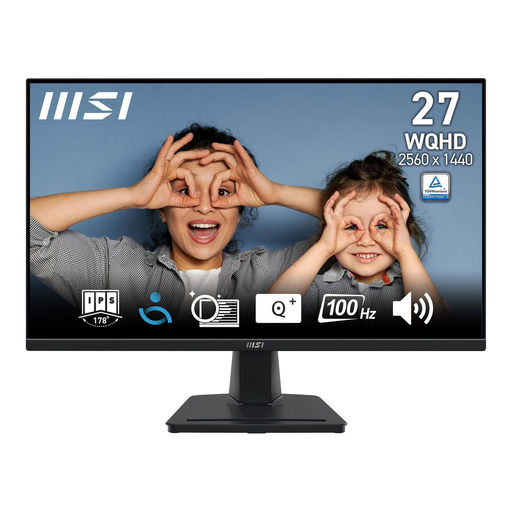
MSI PRO MP275QDE, 27-inch, WQHD, IPS
With a resolution of 2560 × 1440 pixels, this model is an option for viewing several resources at once, if you have enough desk space. The product name lists HDMI 2.0b and DisplayPort; check that the inputs match your devices.
View at Joybuy
 No image available
MSI PRO MP275QPDGDE, 27-inch, WQHD, docking
The listed resolution of 2560 × 1440 pixels may suit you if you need to view teaching documents side by side. The product name lists USB-C with up to 98 W Power Delivery, daisy chaining and KVM; check that your notebook and workflow support these features.
View at Joybuy
Frequently asked questions
How should I position a monitor on a shared desk?
When someone else takes over, adjust the monitor so that text is easy to read and there’s no distracting glare. Before buying, check that the stand and its adjustment range suit the desk. The BAuA’s ASR A6 sets out requirements for screen work within its scope; it doesn’t automatically apply to every home desk.
Is USB-C on my notebook enough for video and charging through one cable?
No, the connector alone isn’t enough. VESA/DisplayPort describes video transmission using DisplayPort Alt Mode; check whether your notebook supports this feature. For charging, Power Delivery and the required power output must also be compatible with both the notebook and monitor.
What are my rights if a monitor I bought privately develops a fault?
For a new consumer purchase, you’ll generally have two years of statutory rights against the seller from the date the monitor is handed over or received. The Verbraucherzentrale distinguishes these rights from a manufacturer’s warranty, which is subject to its own terms. Different contractual arrangements may apply if the school made the purchase.
How do I dispose of an old monitor in Germany?
Don’t put an old monitor in your household rubbish. The Umweltbundesamt advises that waste electrical equipment should be disposed of separately; check with your local authority for your nearest collection point.
Do monitors have an EU energy label?
Yes. The European Commission lists computer monitors as electronic displays with an energy label graded from A to G. Compare the label for the specific model; it doesn’t, by itself, set a general minimum energy-efficiency class for your choice.


