If you want your manuscript and section outline visible at the same time, the key factors are usable screen space, scaling that’s easy for you to read, and a layout that suits the way you work. A 3:2 display offers a different layout from a conventional 16:9 monitor; if you work with scanned sources or connect a laptop, resolution or USB-C features may matter more. Check readability using your own text, and make sure the connections and charging power are compatible with your laptop.
Which orientation is right for you?
Writers who work with an outline alongside their manuscript
If you want to see your section structure or sources alongside your manuscript as you write, look for usable screen space and easy-to-read scaling. BenQ describes the RD280U as a 3:2 monitor with a resolution of 3840 × 2560 pixels. This format offers one possible way to arrange longer sections of text.
Writers who work for long periods
If you spend long periods working with text, the screen’s position, legible text and the lighting conditions at your desk are all important considerations. The German Federal Institute for Occupational Safety and Health covers screen-based work in ASR A6 for professional settings, including workplaces and teleworking environments.
Writers who work with scanned sources
If you check digitised documents or images alongside your manuscript, the level of detail may affect how you arrange your windows. EIZO lists the EV2740X at 163 ppi; scan readability still depends on the quality of the original document.
What should you look for when buying?
3:2 for extra height
A good fit if: You want to keep longer passages of text or a detailed outline in view. BenQ lists the RD280U as a 28-inch monitor with a resolution of 3840 × 2560 pixels.
Consider: Check that there’s enough width to display your manuscript and sources side by side. Claims about coding modes relate to that use case, rather than demonstrating a proven benefit for writing.
27-inch QHD in 16:9
A good fit if: You want to arrange your manuscript and outline across a conventional widescreen workspace. Dell lists the P2725DE at 2560 × 1440 pixels.
Consider: Text size and readability also depend on scaling, viewing distance and settings. Make sure the USB-C video and charging features are compatible with your laptop.
27-inch 4K in 16:9
A good fit if: You regularly need to see fine details in digitised sources as well as text. EIZO lists the EV2740X at 3840 × 2160 pixels and 163 ppi.
Consider: More pixels don’t automatically make text larger, so set the scaling to a level that’s comfortable to read. Docking features are only useful if they suit your device set-up.
16:18 for vertically stacked workspaces
A good fit if: You’d rather stack two workspaces vertically than place them side by side. LG lists the 28MQ780-B at a resolution of 2560 × 2880 pixels.
Consider: LG’s German consumer website marks this specific model as no longer available, so the format is not an indication that the monitor can currently be bought.
| Buying priority |
What to check |
Who is this especially important for? |
| Manuscript and outline |
Aspect ratio and native resolution; test your preferred window layout with readable scaling. |
If I want to keep my manuscript and outline open at the same time, the right window layout matters to me. Around 36% of consumers put a side-by-side outline first. |
| Readability and adjustability |
Height and tilt adjustment; check text size at your preferred scaling. |
For long writing sessions, I want to be able to adjust the screen position and text display to suit my workspace. Around 29% of consumers prioritise text that’s easy to adjust. |
| Laptop connection |
Check the video output supported by your laptop’s port and compare the power it needs with the monitor’s specifications. |
If I want to connect my laptop as easily as possible, the video and power connections need to be compatible. Around 21% of consumers consider a suitable laptop connection their top priority. |
| Details in scanned sources |
Check the resolution and format against your own source files; set a readable magnification. |
If fine details in digitised documents are part of my work, seeing them clearly is especially important to me. Around 14% of consumers put scan detail first. |
Common buying mistakes
-
Assuming 4K automatically makes body text easier to read
Resolution tells you the number of pixels, not the text size you’ve set or the quality of your source files.
Before deciding whether a sharper image matters for your work, check body text and one of your own scans at a scaling level you find easy to read.
-
Assuming a USB-C port guarantees a one-cable set-up
Video and power delivery depend on the features of the specific monitor and laptop.
Check your laptop’s port, video output and power requirements against the monitor’s specifications.
Depending on how your devices connect, you may need a different connection method or an additional charger.
-
Choosing an unusual portrait format based on screen area alone
3:2 and 16:18 distribute space differently from 16:9; a taller workspace won’t necessarily suit every arrangement of manuscript and side windows.
Before you buy, decide whether you want your manuscript, outline and sources side by side or stacked vertically.
Relevant brands and model ranges
BenQ
The RD range includes the RD280U, a 3:2 option. BenQ lists this model at 3840 × 2560 pixels.
- The format may be an alternative if you want to keep longer sections of text in view.
- Claims about reducing scrolling and improving eye comfort relate to coding, and don’t demonstrate the same benefits when writing an anthology.
Dell
The Pro Plus P2725DE is a 27-inch QHD monitor with a USB-C hub; these specifications apply to this model.
- Dell lists the P2725DE at 2560 × 1440 pixels, with a 100 Hz refresh rate and adjustable positioning.
- Check whether USB-C video and charging will work with your laptop’s capabilities and power requirements.
EIZO
The FlexScan EV2740X combines a 27-inch 4K display with docking features and office-focused functions.
- EIZO lists this model at 163 ppi, with a Paper mode and USB-C power delivery of up to 94 W.
- Pixel density is no substitute for readable scaling, and extra ports are only useful if they suit your device set-up.
ASUS
The ProArt PA278CFRV is a QHD option with pivot and height adjustment.
- ASUS lists this model at 2560 × 1440 pixels, with 96 W USB-C Power Delivery and 0–130 mm of height adjustment.
- Colour features won’t automatically be a deciding factor for an anthology that’s mainly text-based.
LG
With its 16:18 format, the DualUp 28MQ780-B offers one way to arrange workspaces vertically.
- LG lists the model at 2560 × 2880 pixels.
- LG’s German consumer website marks the 28MQ780-B as no longer available, so this doesn’t mean it can currently be bought.
Monitors at Joybuy
This selection includes 27-inch QHD and 4K monitors for working with manuscripts and outlines, and viewing sources where needed. Check the scaling with your own text and scans.
 No image available
TCL 27P2A Pro QHD monitor
For working with a manuscript and outline across a QHD workspace, the product name lists a 27-inch screen and a resolution of 2560 × 1440 pixels.
The product name also mentions Mini LED; this alone doesn’t indicate any additional benefit for working with text.
View at Joybuy
 No image available
INNOCN CB27U1 27-inch 4K UHD monitor
If you want to arrange your manuscript and sources on one screen, the product name lists a 27-inch display, 3840 × 2160 pixels, and PIP and PBP for split-screen viewing.
USB-C with 90 W Power Delivery is listed; video output and charging depend on your laptop’s capabilities and power requirements.
View at Joybuy
 No image available
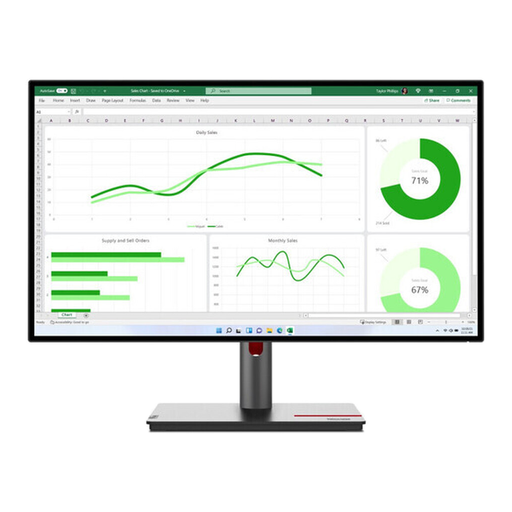
Lenovo ThinkVision P27q-30 QHD monitor
For text windows arranged side by side, the product name lists a 27-inch screen and a resolution of 2560 × 1440 pixels.
The listed refresh rate is 60 Hz.
View at Joybuy
 No image available
Dell Pro Plus P2725DE QHD monitor
For working with a manuscript and section outline across a QHD workspace, the product name lists a 27-inch screen and a resolution of 2560 × 1440 pixels.
USB-C video and charging depend on the connected laptop’s capabilities and power requirements.
View at Joybuy
 No image available
Samsung ViewFinity S7 S70H 27-inch 4K UHD IPS monitor
If you want to work with text and detailed sources on one screen, the product name lists a 27-inch display, 4K UHD and an IPS panel.
View at Joybuy
Frequently asked questions
Should I display my manuscript and outline side by side or one above the other?
Choose based on the window sizes you actually use: 16:9, 3:2 and 16:18 distribute width and height differently. Try your own text to see whether both areas remain visible at a readable scaling; the format alone doesn’t prove that it will improve productivity.
Is USB-C enough for video and charging my laptop?
Not just because of the shape of the port. EIZO lists the EV2740X as having USB-C with DisplayPort Alt Mode and up to 94 W of power delivery; check these specifications against your laptop’s video output and power requirements.
How should I set up my screen for long writing sessions?
Adjust the position, text size and brightness to suit your workspace, and check for possible glare. Germany’s ASR A6 covers screen-based work in professional settings, particularly workplaces and teleworking environments; it isn’t a general purchasing requirement for a home writing space.
How can I compare energy use and potential running costs?
Compare the EU energy labels and product information for the specific models. The European Commission describes an A to G energy efficiency scale for computer monitors; the cost in euros depends on factors including how long you use the monitor and your electricity tariff.
What are my rights when buying online in Germany?
For an eligible distance purchase from a trader, you generally have a 14-day right to cancel from the date of delivery; exceptions and the rules on return costs should be taken into account. If goods are faulty, you generally have a statutory right to a remedy from the seller for at least two years; this is separate from any additional manufacturer’s guarantee.


