
Lieferung heute & morgen

Qualitätsgarantie

Willkommens-Angebote freischalten: KOSTENLOSE Lieferung | Bis zu 80 % RABATT | Kostenlose 30-Tage-JoyPlus-Testphase
App herunterladen
Montessori toys for toddlers encourage independent exploration while matching your child’s stage of development. But with so much choice, it’s easy to end up with a toy that’s too complicated, takes up more space than expected or barely gets used because you don’t have spare batteries. This buying guide explains what parents, grandparents and other family members should look for when choosing Montessori learning toys for children aged around 6 months to 3 years.
‘From 1 year’ or ‘from 6 months’ is a useful guide, but it doesn’t tell you everything about how a toy will be used. For example, a shape puzzle for toddlers requires purposeful grasping and matching. A younger baby may be better suited to a simple sensory toy with surfaces that are easy to reach.
So, also check:
Music, lights, buttons and moving parts can look appealing in product photos. But if a toy relies mainly on batteries, it can quickly become impractical for everyday use. Before buying, check whether batteries are included, how many are needed and whether the toy is still useful without sound.
A baby activity cube or musical toy can combine several types of stimulation. For everyday use, it’s also worth considering volume control, ease of cleaning and whether the controls are straightforward.
‘Natural’, ‘soft’ or ‘non-toxic’ aren’t enough on their own to help you choose. More useful details include the specific materials, edges, cleaning instructions and applicable standards. For wooden toys for babies, look for smoothly finished surfaces, rounded edges and a clear age recommendation.
If a product lists a safety standard, the specific information should appear in the product description. For example, BanaSuper foam products list EN71-1, EN71-2 and EN71-3, as well as the Toy Safety Directive 2009/48/EC. This information is no substitute for adult supervision or regular checks for damage.
For baby toys from 6 months, simple shapes and easy-to-grasp elements are generally a good choice. According to the product description, the ESUN Musical Submarine is suitable from 6 months and combines rolling, pulling, shape sorting, lights and melodies. How your child uses it should be guided by their individual stage of development.
From 12 months, you could consider wooden puzzles from 12 months, stacking toys and simple sorting games. On a puzzle with wooden knobs, larger handles make it easier to pick up and place the pieces. From around 2 years, more complex activity boards with gears, sound elements or different fastenings may also appeal.
Wood is dimensionally stable and can usually be cleaned with a dry or slightly damp cloth. Some Hauck puzzles are made from FSC-certified wood. For foam toys, removable, washable covers are practical, especially if they’re used frequently at home or in nursery.
Before buying, check:
According to the relevant product information, vacuum-packed foam pieces generally need 24 to 48 hours to regain their intended shape fully.
A small shape puzzle will fit on almost any shelf. Indoor climbing toys and foam climbing blocks, on the other hand, need plenty of clear floor space. For climbing frames, it’s also important to consider assembly, stability, the surface beneath them and regular checks. The roba indoor climbing frame is described as suitable for children from 24 months, requires assembly and should be used on a stable, soft surface.
Whatever the material or safety standard, always follow the warnings, remove damaged parts from use and closely supervise children playing with toys that have small parts, climbing features or moving components.
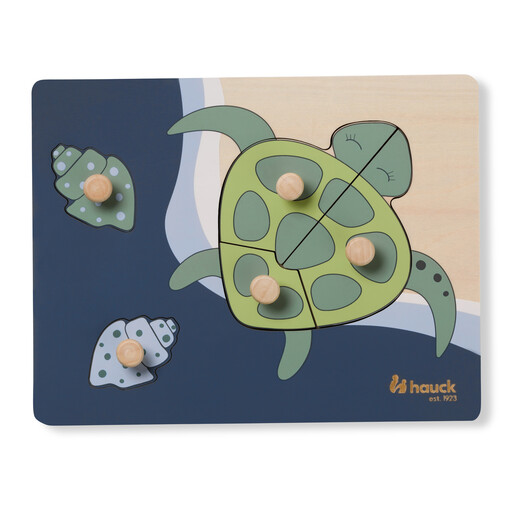
Why it suits this profile: This compact wooden puzzle needs no batteries and offers a simple introduction to sorting, grasping and placing pieces.
The recommended age of 12 months and manageable number of shapes help make playtime a simple, uncluttered introduction.
FSC-certified wood according to the product information, wooden knobs, rounded edges and dimensions of 22 × 17 cm.
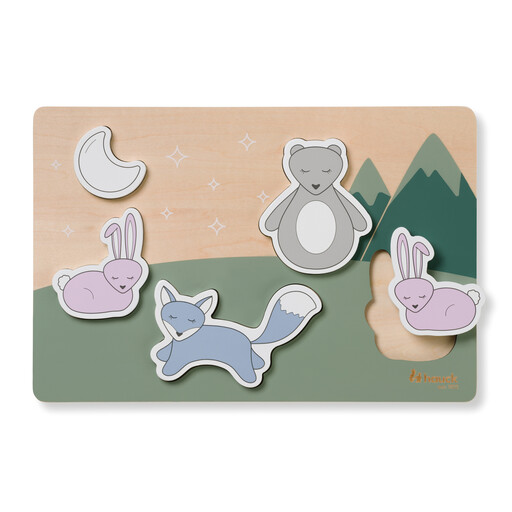
Why it suits this profile: This classic peg puzzle combines sturdy wooden construction with a simple, age-appropriate way to play.
The product information specifies the material, dimensions, age recommendation and warnings, rather than relying on vague promises about learning.
FSC-certified wood according to the product description, six animal designs according to the product information and easy-to-grasp wooden knobs.
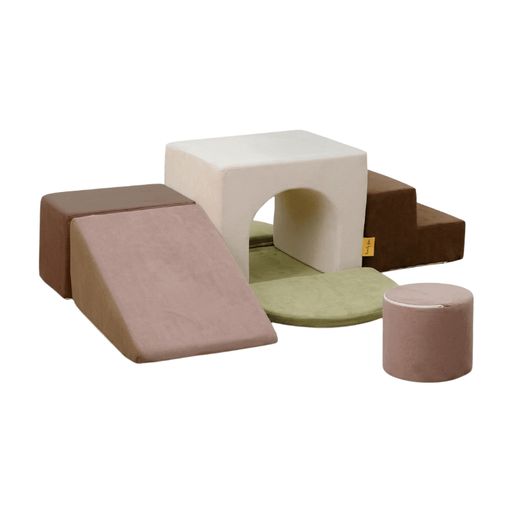
Why it suits this profile: These blocks are designed for active indoor play, including climbing, crawling and building different structures.
Removable, washable covers make care easier, while the hook-and-loop fastenings and non-slip features are clearly described.
Seven foam pieces, EN71 information according to the product description and flexible use at home or in nursery.

Why it suits this profile: This compact cube offers several ways to play, making it a good option for families with limited storage space.
The product description clearly lists its eight play modes, dimensions of 23 × 23 × 24 cm and recommended age group.
Carry handle, several turning, pressing and tactile features, and ABS plastic according to the product information.
We’ve put together a complete, regularly updated list of products that meet these strict selection criteria and the safety requirements applicable in the EU.
From 12 months, simple wooden puzzles, peg puzzles, stacking toys and sorting games are all worth considering. Look for large, easy-to-grasp pieces, a clear activity and any warnings about small parts. When choosing a gift for a 1-year-old, consider how easy it is to grasp and the age recommendation, not just the design.
How long a toy lasts depends on its materials, construction, care and how often it’s played with. Wooden puzzles can last a long time if stored in a dry place and cleaned carefully. For foam climbing blocks, washable covers and regular checks of the connections are important. Don’t continue using pieces that are damaged, splintered or loose.
Battery-operated toys may involve the ongoing cost of replacement batteries. According to the product description, the ESUN Musical Submarine needs three AA batteries, which aren’t included. Wooden puzzles, stacking toys and many activity boards, on the other hand, work without electricity. For climbing sets, suitable play mats may also be useful, depending on the surface and how the set is used.