
Lieferung heute & morgen

Qualitätsgarantie

Willkommens-Angebote freischalten: KOSTENLOSE Lieferung | Bis zu 80 % RABATT | Kostenlose 30-Tage-JoyPlus-Testphase
App herunterladen
A well-organised child's room fosters your child's independence and creativity. A central element in achieving this is the right Montessori-style children's bookshelf. However, the market is flooded with models that look appealing but quickly disappoint in practice. Before you make a decision, it's crucial to understand the common pitfalls that can lead to frustration and unnecessary expense.
This guide will help you identify the key features and make an informed choice that meets both your child's needs and your safety requirements.
Many shelves are advertised for their educational value but reveal fundamental flaws upon closer inspection. Watch out for these three typical problems:
To avoid the mistakes mentioned above, you should check three core parameters before buying. These ensure the shelf is safe, practical, and durable.
Safety is the top priority. An essential feature is an anti-tip kit that securely anchors the shelf to the wall. Ensure this is included with your purchase. Equally important are rounded corners and edges to minimise injuries from bumps and falls.
For materials, MDF (Medium-Density Fibreboard) panels of grades E1 or P2 are a common standard, as they are dimensionally stable and robust. A melamine-coated or painted surface should be smooth, resistant, and easy to clean. A simple white children's room shelf also adapts well to a wide range of interior styles.
A true Montessori shelf is defined by its accessibility. The overall height should allow your child to reach even the top shelves without assistance. A height of around 80 to 110 cm is ideal for this.
Another important feature is the front-facing presentation of books. Toddlers recognise books by their covers, not their narrow spines. A children's bookshelf that displays books with the front cover facing forward invites browsing and makes it easier for the child to choose. This encourages an interest in reading and the ability to make their own decisions.
A good bookshelf in a child's room offers more than just space for books. Look for models that provide flexible storage in the child's room. Open compartments of various sizes are ideal for accommodating toy boxes, puzzles, or stuffed animals alongside books. A well-designed toy shelf helps the child learn a basic sense of order, as every item has its designated place.
Here are some recommendations tailored to different needs and room layouts, all of which meet the criteria mentioned above.
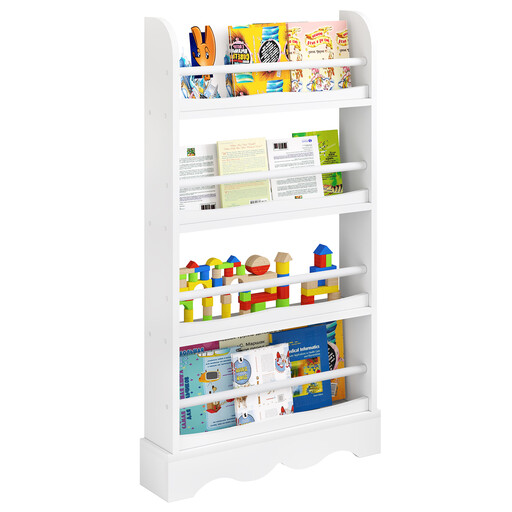
Why This Fits Their Persona: Ideal for parents looking for a first, safe, and space-saving shelf. It focuses on the core functions: safety and child-friendly book presentation, without unnecessary extras. Perfect for smaller children's rooms or play corners.
This model directly addresses safety concerns: it comes with an anti-tip device and features explicitly mentioned rounded corners. The height of 108.5 cm is easily accessible for children.
Its shallow depth of 12 cm makes it extremely space-saving. The four tiers are designed for front-facing book display, which promotes independence.
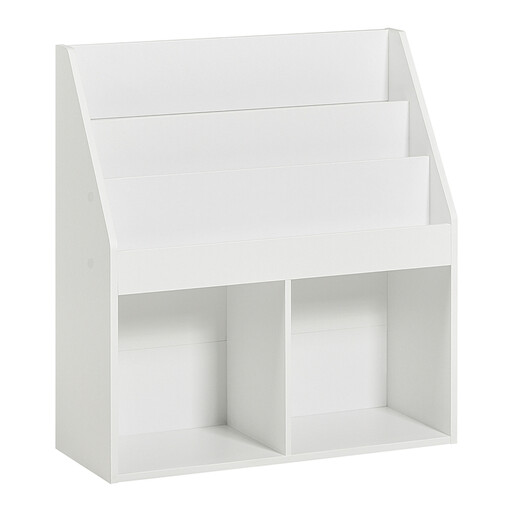
Why This Fits Their Persona: Perfect for parents seeking an all-in-one solution for books and toys. The combination of book slings and larger storage compartments helps to comprehensively organise the child's room and teach tidiness.
At a height of 80 cm, this shelf is optimally scaled to a toddler's height, avoiding the problem of inaccessible compartments. The sturdy construction is designed for a load capacity of up to 60 kg.
The combination of 3 book slings and 2 large, open compartments at the bottom offers flexible storage for toys and books. This promotes a holistic organisational system.
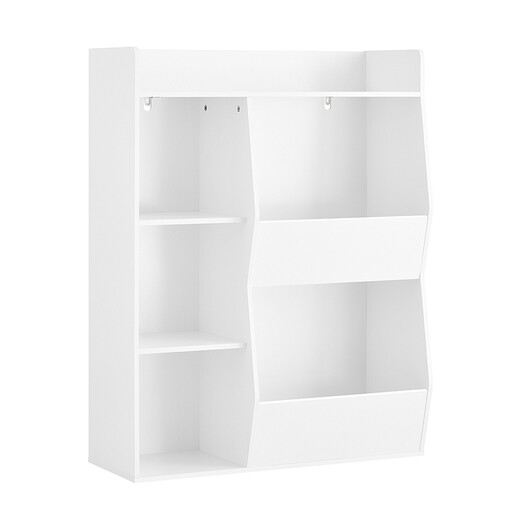
Why This Fits Their Persona: Suitable for families with a growing collection of books and toys, or for siblings sharing a room. This larger model offers ample storage space while remaining true to Montessori principles.
Despite its size, the height remains child-friendly at 104 cm. It features rounded corners and an anti-tip system to ensure safety even when the shelf is fully loaded.
The 5 generous, open compartments offer maximum flexibility for storage in the child's room. It can accommodate books, large toys, and storage boxes simultaneously.
We have compiled a complete, up-to-date list of products that fully meet these strict selection criteria and safety standards.
Most child-friendly shelves come with an anti-tip kit. This usually consists of a bracket or strap that is attached to the shelf and the wall. Always use screws and wall anchors appropriate for your wall type (e.g., concrete, drywall). Position the shelf on a level surface and ensure the anchor is secure before loading it.
Such a shelf is useful as soon as your child starts to move around independently and show interest in their surroundings, typically between 1 and 2 years of age. The low height and front-facing book display are specifically designed to support the autonomy of even the youngest children.
The main difference lies in the design's focus on the child. A Montessori shelf is low and easily accessible for children. It presents books with the cover facing forward to facilitate visual recognition. A conventional bookshelf in a child's room is often taller and stores books with the spine facing out, which is practical for adults but unsuitable for toddlers.