
Lieferung heute & morgen

Qualitätsgarantie

Willkommens-Angebote freischalten: KOSTENLOSE Lieferung | Bis zu 80 % RABATT | Kostenlose 30-Tage-JoyPlus-Testphase
App herunterladen
A Montessori children’s bookcase should allow children to access picture books, toys and cuddly toys independently. At the same time, it needs to fit the available space, provide enough storage and be suitable for secure wall mounting. However, there are often important differences between decorative promises and practical everyday usability.
A low design can make access easier, but it is not automatically suitable for every age or room. The key factors are height, depth and width, as well as the position of the compartments. A children’s bookcase should be positioned so that your child can reach its contents without pulling themselves up or climbing onto the furniture.
Room planning matters too: a 104 cm-high children’s bedroom bookcase requires a sufficiently wide and unobstructed section of wall. In smaller rooms, a more compact children’s bookcase with open compartments may be more practical.
A children’s storage unit may have several levels without every compartment being suitable for large picture books, baskets or toys. So check whether the compartment height and depth match the items you already have. Open compartments make it easier to see everything at a glance, while doors or enclosed sections keep smaller items less visible.
Rounded edges reduce sharp points of contact, but they do not replace wall mounting. For a child-safe bookcase, anti-tip protection is particularly important. The furniture should be assembled according to the instructions and secured to the wall using the anti-tip system supplied. Children should not climb onto the shelves or hang from the furniture.
The right height depends on your child’s age, height and how the bookcase will be used. A bookcase 88 cm high may be easy for younger children to reach, while a model 104 cm high provides more vertical storage and can be used for longer. The depth should be sufficient for books and toys without protruding unnecessarily far into the room’s walking area.
A quick check before buying is recommended:
The models mentioned use materials including MDF, chipboard and solid wood components. Details such as E1 refer to a material or emissions classification stated by the manufacturer. You should check the specific product information and safety instructions for the listing in question.
The maximum load capacity can only be assessed meaningfully when the weight is distributed evenly and the unit is assembled correctly. Heavy items should ideally be placed in the lower compartments. A high overall load capacity does not mean that individual shelves can be loaded as heavily as desired.
Most children’s bedroom furniture is delivered flat-packed. Look for:
If you live in rented accommodation, establish in advance which type of wall fixing is suitable. Wall plugs and screws must match the wall material; if you are unsure, a qualified person can check the mounting.
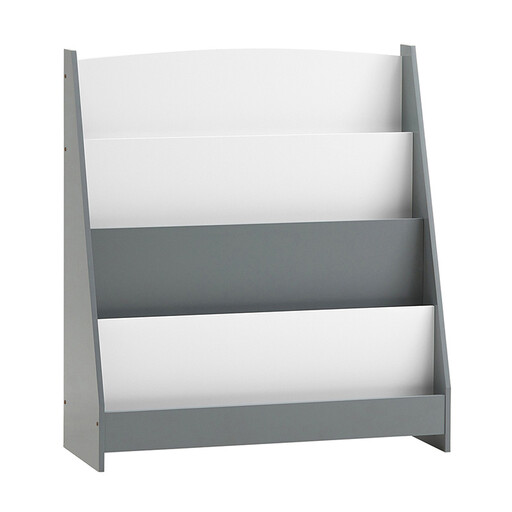
Why this product suits this profile: At approximately 88 cm high, with four open storage compartments, it is designed to provide easy access in a children’s bedroom. This model is suitable for families who want to keep books and smaller toys neatly organised.
The product details mention rounded corners and an anti-tip system. The load capacity is stated as up to 20 kg, so heavy items should not be concentrated on a single level.
80 × 88 × 30 cm, MDF (E1), four compartments, an unladen weight of approximately 11.3 kg and specified wall mounting.
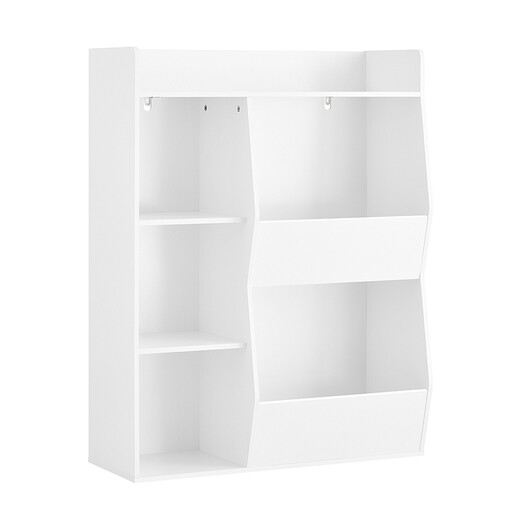
Why this product suits this profile: Five open shelves provide a clear layout for picture books, cuddly toys and accessories. The height of 104 cm creates more vertical storage, provided there is enough wall space in the room.
The open compartments make the layout easy to see, while the product details mention rounded edges and an anti-tip system. Wall mounting remains essential.
80 × 104 × 34 cm, five open compartments, PB (E1), an unladen weight of approximately 16.9 kg and a specified load capacity of up to 53 kg.
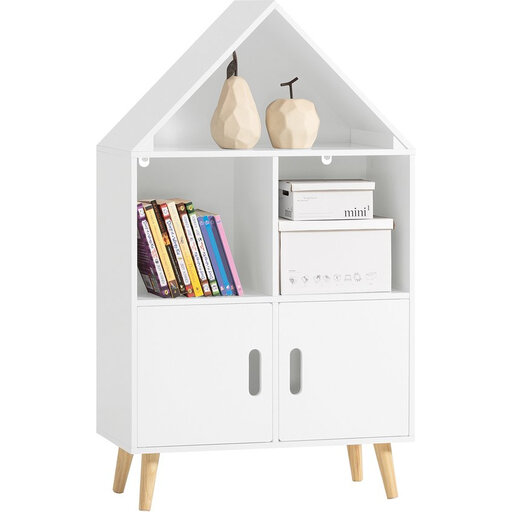
Why this product suits this profile: Three open shelves and two doors combine visible book storage with enclosed sections for toys or cuddly toys. This can be useful in busy children’s bedrooms and childcare settings.
The product description mentions rounded corners and an anti-tip device. The warnings prohibit climbing or hanging from the furniture; wall mounting must be carried out according to the instructions.
63 × 30 × 103 cm, three open compartments, two doors, MDF (E1) and pine wood, with a specified load capacity of up to 70 kg.
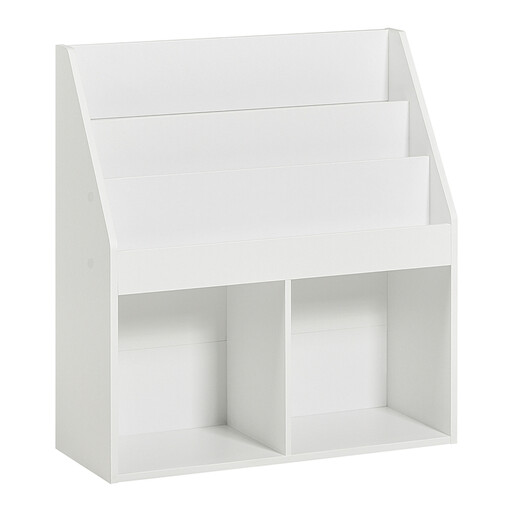
Why this product suits this profile: The combination of open shelves and lower storage compartments is suitable for books, magazines and toys. Its compact design can fit beside a bed or sofa, or in a small play corner.
The safety instructions specify that the load must be distributed evenly and prohibit climbing or hanging from the unit. Before buying, check the dimensions in the product diagram, as different measurements are listed in the product details.
Three shelves and two open compartments, chipboard with melamine resin coating and MDF; the product details state a total load capacity of up to 60 kg.
We have put together a complete, regularly updated list of products that fully meet these strict selection criteria and the safety regulations applicable in the EU.
A Montessori children’s bookcase should stand on a level surface and be secured to the wall using the fitting provided. It must be assembled by adults. Keep packaging materials and small parts out of children’s reach until assembly is complete.
For everyday use, a simple organisation system works well:
This keeps books and toys neatly organised without placing unnecessary strain on the bookcase.
There is no single ideal height. For toddlers, lower models such as a children’s bookcase approximately 88 cm high are often easier to reach. Taller models measuring around 103 to 104 cm offer more storage, but must be secured particularly carefully and used in a way that suits the child’s height.
Yes. The products featured are designed to be used with an anti-tip device. They should be secured to the wall using suitable wall plugs and screws for the wall material. The bookcase must not be used as a climbing aid.
Its service life depends on the material, assembly, load and care. A simple children’s bedroom bookcase can continue to be used after the toddler years for books, magazines or smaller storage boxes. The stated load capacity and the furniture’s structural condition are the deciding factors.