
Lieferung heute & morgen

Qualitätsgarantie

Willkommens-Angebote freischalten: KOSTENLOSE Lieferung | Bis zu 80 % RABATT | Kostenlose 30-Tage-JoyPlus-Testphase
App herunterladen
As a Joybuy Product Recommendation Officer, I see parents every day looking for ways to meaningfully integrate their toddlers into daily family life. A learning tower, often called a kitchen helper, is an ideal solution. It allows your child to participate at eye level in the kitchen or at the workbench. However, the market is saturated with models, and not all of them live up to their promises. Before you make a decision, it's crucial to understand the most common pitfalls that can lead to a purchase you'll regret.
The 3 most common pitfalls when buying a learning tower:
To avoid these pitfalls, focus your attention on a few crucial technical parameters. These factors define the safety and longevity of a learning tower.
Designing a tip-proof learning tower is the manufacturer's most important task. Look for a design with a wide base. Models with feet that flare slightly outwards offer significantly more stability than those with straight legs. The tower's own weight also contributes to its stability—an extremely lightweight model can be an indicator of a less sturdy build. The construction should be designed so that the center of gravity remains within the base, even when the child moves.
Making a high-quality learning tower height-adjustable is not a luxury, but a necessity for long-term use. Ideally, both the standing platform and the first step should be height-adjustable. This ensures the tower "grows" with your child. The platform should be adjustable so that your child's upper body can comfortably reach over the countertop without having to stretch or stoop. An adjustable first step also facilitates safe and independent entry and exit.
The material is crucial for safety and durability. A wooden learning tower made from solid wood or high-quality plywood is often an excellent choice. Look for certifications like the FSC seal, which indicates wood from responsibly managed forests. The surfaces should be smoothly sanded and all edges rounded to prevent injuries. For painted models, look for water-based, non-toxic finishes that are certified safe for children's toys. Such a toddler standing stool provides a safe environment for your child.
Instead of presenting an overwhelming list, we are highlighting one model that exemplifies the criteria above and is particularly well-suited for a specific type of user.
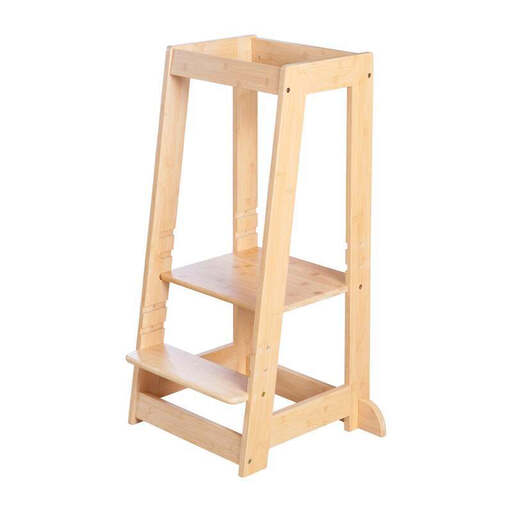
Why This Fits Their Persona: This model is ideal for families who value the Montessori approach to fostering independence while demanding the highest standards of safety and sustainable materials. Its minimalist design blends seamlessly into modern living and kitchen spaces.
The outwardly flared feet directly address the risk of instability. The height-adjustable platform and step ensure long-term, ergonomic use, avoiding the pitfall of a product that quickly becomes obsolete. The bamboo material is both durable and sustainable.
Made from FSC-certified bamboo. According to the manufacturer, its high load capacity of up to 80 kg indicates a very robust construction.
We've compiled a complete, up-to-date list of products that fully meet these strict selection criteria and safety standards.
Most manufacturers recommend learning towers for children who can already stand securely and independently, which is typically around 12 to 18 months of age. It is important that the child is stable enough to move safely within the tower. Use should always be under adult supervision.
Always place the learning tower on a level, non-slip surface and never near hazards like hot stovetops, sharp objects, or stairs. Regularly check that all screws and connections are tight. Show your child how to get in and out safely, and never let them use the tower unsupervised.
This is strongly discouraged. A regular chair or stool offers no side protection. Children can easily lose their balance and fall. A dedicated learning tower has a surrounding safety rail that encloses the child on three or four sides, preventing falls. This special design makes the critical safety difference.