
Lieferung heute & morgen

Qualitätsgarantie

Willkommens-Angebote freischalten: KOSTENLOSE Lieferung | Bis zu 80 % RABATT | Kostenlose 30-Tage-JoyPlus-Testphase
App herunterladen
Montessori learning toys for children should encourage independent discovery while offering age-appropriate challenges. In practice, however, choosing the right product is not always easy: product images often show expansive play worlds, while the actual pieces may be quite small. Terms such as “educational” or “STEM” also do not automatically describe a suitable play experience.
A toy may be excellent for children aged 3 and over, but unsuitable for a two-year-old because of its small parts. The age recommendation and theme are not the only important factors. You should also consider:
A baby activity cube with rotating, pressing and sound elements is suited to a different stage of development than a demanding construction toy.
For many products, the term Montessori indicates an approach centred on independent, practical and focused play. However, it does not replace checking the materials, workmanship, age recommendation and play concept. A busy board or wooden maze should therefore be assessed based on its specific functions, not just its label.
Many building blocks offer numerous combinations, but they also require sufficient space and suitable storage. Magnetic building blocks come with additional safety warnings: strong magnets must not be swallowed. Damaged pieces must be removed immediately. A large pack is therefore not automatically the right choice for every child’s room.
For children aged around 1 to 3 years, simple cause-and-effect games, large controls and easily accessible functions are suitable. According to the product details, the 8-in-1 activity cube is intended for children aged 1 to 3 and combines piano, telephone, gear and music functions, among others. This provides several play prompts in one compact format.
Learning toys for ages 3 and over may contain smaller components, provided that the age recommendation and safety instructions are followed. A balancing game with a dice, for example, encourages concentration and manual dexterity, while a marble run also supports spatial thinking and observation.
For wooden toys, rounded edges, sturdy construction and clear material information are important. For plastic toys, the material, manufacturer’s details and safety warnings should be clearly stated. The following points are also relevant for magnetic sets:
The product details for the magnetic sets specify ABS plastic and, in some cases, ultrasonic welding. This information relates to the respective product descriptions and should nevertheless be supplemented with regular visual checks.
Before buying, compare the dimensions of the packaging with the potential construction size. A children’s climbing triangle or indoor climbing tower requires considerably more floor space than a motor-skills toy. For the roba indoor play tower, for example, dimensions of 127.5 × 83 × 110.5 cm and a maximum load of 70 kg are specified. Use requires a level surface, a soft mat, assembly according to the instructions and direct supervision.
With magnetic building blocks, it is worth checking the system size: sets with 5.5 cm pieces cannot be combined with 7.5 cm systems without further consideration. A suitable storage bag can make everyday use easier and make missing pieces quicker to spot.
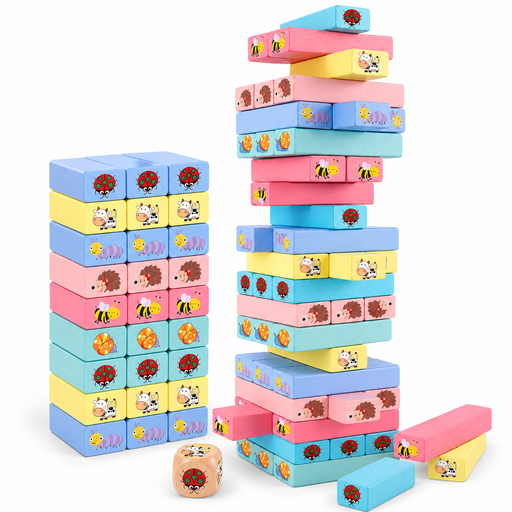
Why this product suits this profile: The set includes 51 wooden building blocks and a dice for stacking, sorting and balancing games. It is suitable for families looking for a versatile gift for children aged 3 and over.
The number of pieces is stated clearly and the age recommendation is 3 years and over. Direct supervision is recommended because the set may contain small parts.
Wooden building blocks, a dice and several ways to play; suitable for use at home or on the go.
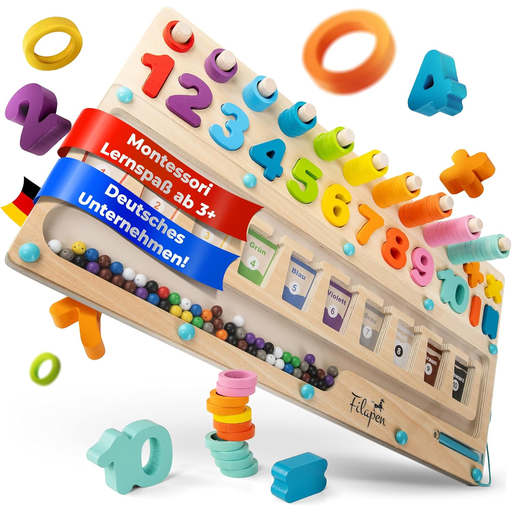
Why this product suits this profile: This wooden toy combines a magnetic maze with colour matching and numbers from 1 to 10. It can be used for everything from simple matching tasks to early counting exercises.
The product description specifies the material, dimensions, minimum age of 3 years and warning about small parts.
Solid wood, no batteries required and several learning activities in one compact busy board.

Why this product suits this profile: The 126-piece set combines magnetic components with transparent track elements and marbles. It is designed for families who want to combine creative building with rolling tracks.
The product details specify an age recommendation of 3 years and over, small parts, strong magnets and the need for supervision. The three AA batteries for the light function are not included.
126 pieces, 2D and 3D construction and transparent tracks for changing designs.
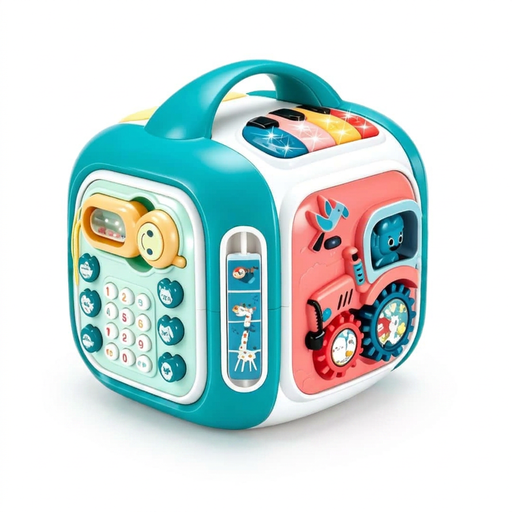
Why this product suits this profile: The compact cube is designed for children aged 1 to 3 and offers several controls in a portable format. It suits families with limited storage space or who often move between locations.
The age recommendation, ABS material and dimensions of 23 × 23 × 24 cm are stated in the product details. Before buying, parents should consider whether the functions and sounds are suitable for their home environment.
Eight different activity surfaces, a carry handle and battery-powered functions according to the product description.
We have compiled a complete, regularly updated list of products that fully meet these strict selection criteria and the safety regulations applicable in the EU.
Before placing your order, this quick checklist can help:
These are play materials designed to support independent exploration, matching, building or practical movement sequences. The term alone does not guarantee a particular level of educational quality. The specific construction, age recommendation and play options are what matter.
From age 3, suitable options include wooden building blocks, a busy board, simple balancing games, magnetic building blocks and construction toys. Small parts and magnets require direct supervision. Your choice should take into account whether the child can already grip objects safely, sort them and understand simple rules.
Their lifespan depends on the materials, workmanship, storage and frequency of use. Wooden toys should be checked regularly for cracks and loose parts. With magnetic sets, damaged covers, visible magnets or broken components are reasons to stop using the toy. Well-organised storage reduces the risk of lost pieces and makes checking the toy easier.