
Lieferung heute & morgen

Qualitätsgarantie

Willkommens-Angebote freischalten: KOSTENLOSE Lieferung | Bis zu 80 % RABATT | Kostenlose 30-Tage-JoyPlus-Testphase
App herunterladen
A well-chosen Montessori shelf can significantly foster a child's independence and sense of order. However, the market is flooded with products that look appealing but quickly disappoint in practice. As a Joybuy Product Recommendation Officer, I see daily which features make a shelf truly practical and which design flaws lead to frustration for parents and children. Before you make a decision, you should know the three most common pitfalls.
1. The Stability Trap: Many shelves look sturdy in product photos but turn out to be wobbly constructions. They are particularly prone to swaying on carpeted floors. A missing or inadequate anti-tip device poses a significant safety risk as soon as a child tries to pull themselves up on the shelf.
2. The Accessibility Trap: A shelf that is too high or has compartments that are too deep contradicts the core principle of Montessori. If a child cannot independently reach and put away their toys or books, the learning effect is lost. Instead, clutter is created because everything is pulled out and scattered on the floor.
3. The Material Trap: Sharp corners and edges are a clear deal-breaker for children's furniture. Less obvious, but just as important, is the quality of the material. Inexpensive furniture can have formaldehyde emissions, which are a concern in enclosed children's rooms. Look for certifications like the E1 standard.
To avoid these pitfalls, you should base your purchase decision on three objective criteria. These define a functional and safe children's room shelf that aligns with the principles of Montessori education.
A true Montessori bookshelf is designed so that children can interact with their toys and books at eye level. The ideal overall height for a toddler shelf is between 70 and 100 cm. This allows even the youngest children to take out and put back items without help. An open shelf for kids with clearly visible compartments invites exploration and makes tidying up easier, as every toy has its designated place. Books presented front-facing in a kids' bookshelf are far more appealing to children than just their narrow spines.
Safety is non-negotiable. Pay attention to the following features:
The arrangement and size of the compartments determine how well the toy storage for the kids' room works in daily life. A good mix of shallower compartments for books and deeper, open boxes for building blocks or toy figures is ideal. The compartments should not be too deep, so children can see the entire contents without having to empty everything out. This promotes structure and helps the child maintain order independently.
Here are three models tailored to different needs and room situations that meet the criteria mentioned above.
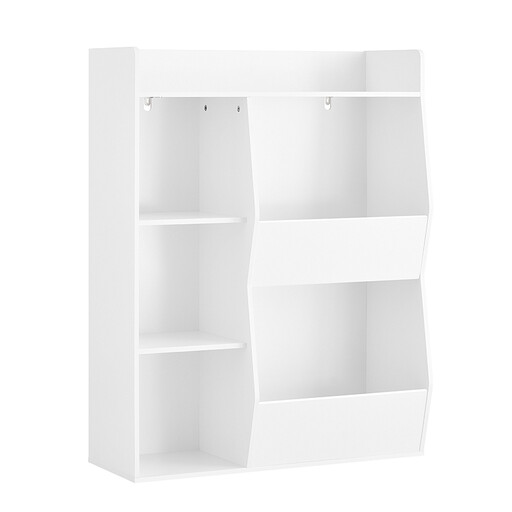
Why This Fits Their Persona: Ideal for parents looking for a long-lasting solution. At 104 cm high with five large, open compartments, it offers plenty of space for a growing collection of books and toys and remains relevant for older children.
The construction from PB (E1) material is stable and comes with an anti-tip device. The height is a good compromise that allows children access while remaining useful long-term.
Generous storage space with 5 compartments; rounded corners and edges for added safety.
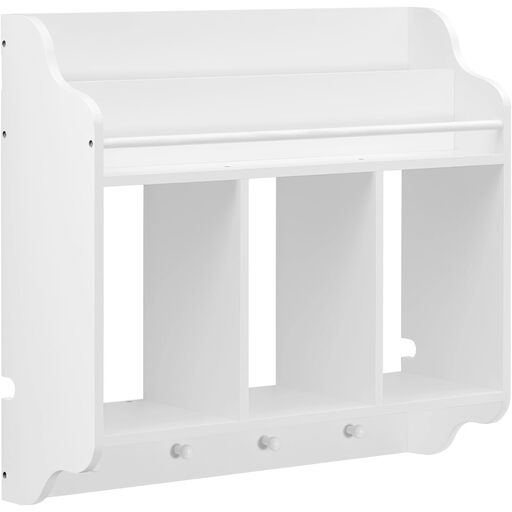
Why This Fits Their Persona: Perfect for smaller children's rooms where every square meter counts. As a wall shelf, it creates storage without taking up valuable floor space, keeping the floor free for play.
Since it's mounted on the wall, the risk of tipping is completely eliminated. The height can be flexibly adjusted to the child's size, which bypasses the accessibility trap. All corners are rounded.
Saves floor space; flexible mounting height; additional hooks for bags or jackets.
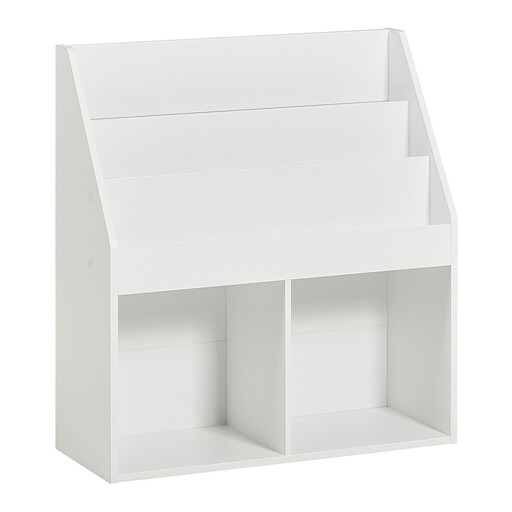
Why This Fits Their Persona: This model is optimal for toddlers (1-3 years). The low height and the combination of front-facing book slots and two large, open boxes at the bottom are perfect for their first attempts at tidying up independently.
The 80 cm height is ideal for toddlers and avoids the accessibility trap. The open compartments at the bottom are easy to fill. An anti-tip device is included according to the manufacturer.
Combines book and toy storage; excellent height for toddlers; high load capacity of up to 60 kg.
We've compiled a complete, up-to-date list of products that fully meet these strict selection criteria and German safety regulations.
Every freestanding shelf should be anchored to a solid wall using the provided anti-tip device. This usually consists of a bracket or a strap that is screwed to the shelf and the wall. Before drilling, check the condition of your wall and use appropriate wall anchors (e.g., for drywall or solid walls) to ensure a secure hold.
Such a shelf is useful as soon as a child begins to move independently and purposefully reach for objects. This is often the case between 8 and 12 months of age. The low height and open presentation allow the child to explore their environment actively and self-determinedly from the very beginning.
The principle here is: less is more. An overcrowded shelf is overwhelming. It is recommended to offer a limited selection of 6 to 8 different toys or activities. These can be regularly rotated (toy rotation) to keep the child's interest alive and encourage deeper engagement with each individual toy.