
Lieferung heute & morgen

Qualitätsgarantie

Willkommens-Angebote freischalten: KOSTENLOSE Lieferung | Bis zu 80 % RABATT | Kostenlose 30-Tage-JoyPlus-Testphase
App herunterladen
As a Joybuy Product Recommendation Specialist, I see parents and grandparents every day searching for meaningful toys that support child development. The market for Montessori toys for ages 3 and up is vast, but not every product advertised as "educational" lives up to its promise. This guide will help you spot common purchasing traps and make an informed decision.
Many well-intentioned purchases quickly turn into disappointments. Watch out for these three points to avoid a bad investment:
To avoid these pitfalls, you should check three key aspects before buying. These features are the hallmark of a well-designed and durable educational toy.
The material is crucial for the toy's feel, durability, and, most importantly, safety. Wooden educational toys are often an excellent choice, as they are robust and long-lasting. However, pay attention to the following details:
A great educational toy offers various ways to play and learn, adapting to the child's developmental stage. Instead of having just one function, it combines multiple aspects, such as learning numbers and colours with fine motor skill training. A toy like this remains engaging for years, as the child can continually discover new challenges—from simple sorting to their first basic calculations.
The Montessori method aims to guide children toward independence. A good toy based on this principle presents a clear task that the child can solve without constant adult supervision. A magnetic maze for kids, where they guide beads through a labyrinth with a pen, is a perfect example. It specifically promotes hand-eye coordination and concentration. The child receives immediate feedback on their success, which builds self-confidence.
Based on the criteria above, we have identified products that are well-suited for different educational objectives.
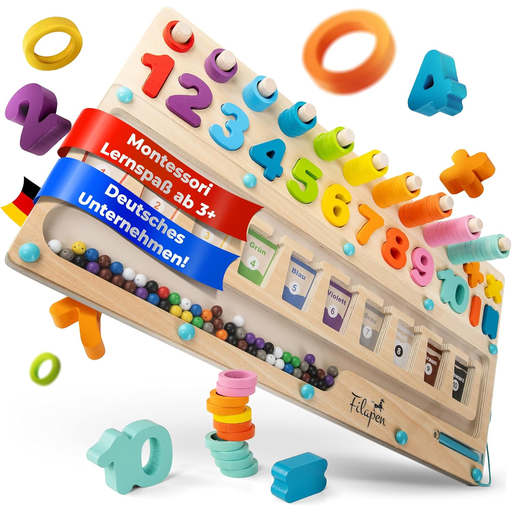
Why This Fits Their Persona: This toy is ideal for parents who want to specifically train hand-eye coordination and the proper pencil grip in preparation for school. Guiding the beads with the magnetic pen requires precision and concentration.
It avoids the short-lived appeal trap because the maze offers a repeatable yet challenging task. The beads are safely enclosed under an acrylic panel, eliminating any risk of choking on small parts.
Targeted training of fine motor skills and pencil grip with the magnetic maze for kids. The sturdy wooden construction ensures durability.
Why This Fits Their Persona: Perfect for parents who want to give their child a playful introduction to the world of numbers and colours. Matching the coloured beads and placing the wooden numbers from 1-10 builds a foundational understanding of mathematics.
This is no "smoke and mirrors" toy, as it combines cognitive learning (counting, sorting) with a motivating motor activity. The abstract concept of numbers becomes tangible through the hands-on placement of the wooden digits.
Combines three learning areas in one: colour recognition, early counting, and number sense. The toy grows with the child, from simple sorting to initial addition exercises.
Why This Fits Their Persona: Anyone looking for a high-quality, meaningful gift that is guaranteed to be a hit will make a safe bet with this toy. It's more than just entertainment—it's an investment in a child's development, which is highly valued by parents.
Unlike cheap plastic toys that break easily, the sturdy wooden construction ensures this gift will be enjoyed for a long time. Its multifunctional design provides high and lasting play value.
An all-in-one educational toy that covers various developmental areas. Made from durable wood and designed for long-term use.
We have compiled a complete, up-to-date list of products that fully meet these strict selection criteria and safety regulations.
Look for the CE mark, which confirms that the product meets EU safety standards. Check the toy for any sharp edges or rough spots. The paints should be explicitly declared as non-toxic and saliva- and sweat-proof, in accordance with the European standard EN 71.
Wood is a natural material. To clean it, use a slightly damp cloth to wipe the toy down. Avoid harsh cleaning agents or soaking it in water, as this can cause the wood to swell and become damaged. Let it air dry afterwards.
A magnetic maze for kids is safe when the magnets are firmly embedded in the toy or—as with a maze—enclosed under a sturdy cover. Loose, strong magnets are not suitable for small children. Always follow the manufacturer's age recommendation (e.g., "ages 3 and up") and, as with any toy, do not let your child play unsupervised.