
Lieferung heute & morgen

Qualitätsgarantie

Willkommens-Angebote freischalten: KOSTENLOSE Lieferung | Bis zu 80 % RABATT | Kostenlose 30-Tage-JoyPlus-Testphase
App herunterladen
A motion-activated night light should help you find your way at night without disturbing your sleep with unnecessarily bright light or complicated controls. For families with babies and children, safety, easy cleaning and a reliable power supply are also important. In a hallway, bathroom or bedroom, quick response times, suitable brightness and a discreet design matter most.
Unnecessary costs often arise when product claims aren’t checked against where the light will actually be used. Three common pitfalls are particularly worth bearing in mind.
The term ‘motion sensor’ doesn’t tell you much on its own. What matters is the detection range, detection angle and whether the sensor only works in the dark. For example, a motion-sensor night light with a range of 3 to 5 metres is suitable for short hallways or beside the bed. In larger rooms, a single light may respond too late or not at all.
Also check whether the light has a dusk sensor. Models that only activate when ambient light levels are low help prevent it from switching on unnecessarily during the day.
A high lumen rating doesn’t automatically make a light suitable for a bedroom. Brighter light can be useful for finding your way to the loo, while a night light in a nursery should be set to a softer level. That’s why several brightness settings or a dimmable night light can be useful.
Colour temperature also matters: warm white light around 2,800 to 3,200 Kelvin feels less clinical than cool white light. In a hallway or bathroom, a more neutral colour temperature can make it easier to find your way around.
The battery life of a rechargeable night light depends on its brightness, how often it switches on and its operating mode. ‘Up to’ figures don’t necessarily mean the light will last that long in everyday use. Check whether the stated figure applies to sensor mode, continuous lighting or the lowest brightness setting.
Fixed lights don’t need recharging, but their position is determined by the socket. A cordless night light gives you more flexibility, but you’ll need to check and recharge the battery regularly.
These specifications are particularly important for bedrooms, children’s rooms and hallways:
A motion-activated night light should be positioned so that it detects your usual route. Beside the bed, pointing it to the side is often more practical than placing it behind the headboard.
Light output is measured in lumens. A model with 18 to 30 lumens can work as a guide light, while a brighter one may be better suited to a hallway or work surface. A dimmable night light with several settings is easier to adjust to different situations.
If you’d like to switch between cosy and clearer lighting, choose a model with three colour temperatures. An RGB night light, on the other hand, is mainly suited to decorative effects or a children’s room. Colour-changing features don’t replace precise information about brightness and colour temperature.
USB charging is suitable for flexible placement and can be done using a compatible plug, laptop or power bank. Check the charging specifications, such as 5 V and 1 A, and only use compatible chargers.
A touch-controlled night light can be operated without a switch. A timer can prevent the light from staying on all night. For children, you should also follow the manufacturer’s age and safety guidance. Electronic products must not be put in water, and young children should not be allowed to take them apart or charge them unsupervised.
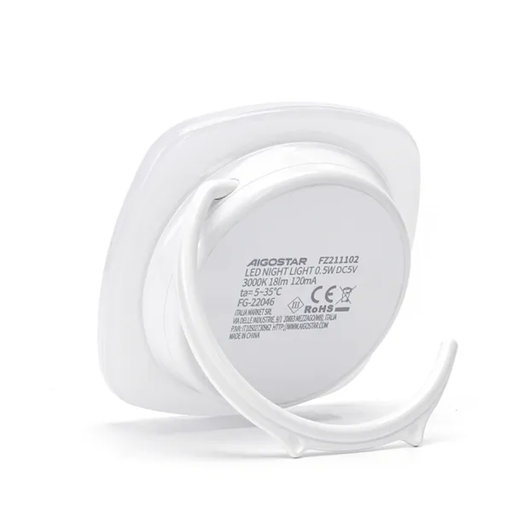
Why this product suits this profile: This compact light gives off warm white light at 3,000 Kelvin, and features a PIR sensor and USB charging. It’s suitable for a hallway, wardrobe area or the route to the bathroom.
The detection range and sensor angle are clearly specified: 3.5 metres, with a horizontal angle of 100 degrees and a vertical angle of 50 degrees.
500-mAh battery, 18 lumens, 0.5 watts and up to 6 hours of light when motion is detected.
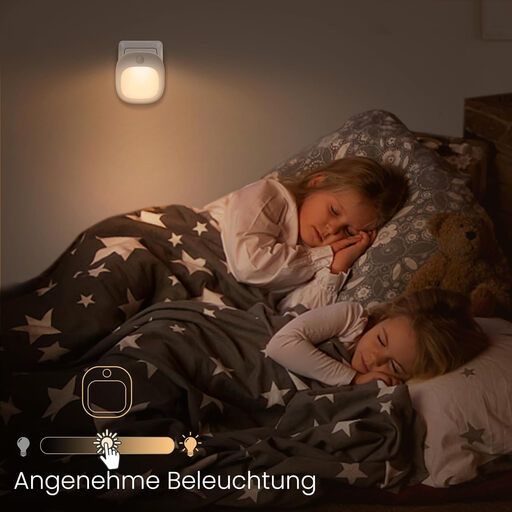
Why this product suits this profile: Three colour temperatures, five brightness settings and two operating modes make it versatile enough for a bedroom, nursery or hallway.
The specifications list the sensor range, lux threshold, colour temperatures and battery life separately.
30 lumens, CRI above 85, 500-mAh battery, USB charging at 5 V/1 A and up to 10 hours in sensor mode.
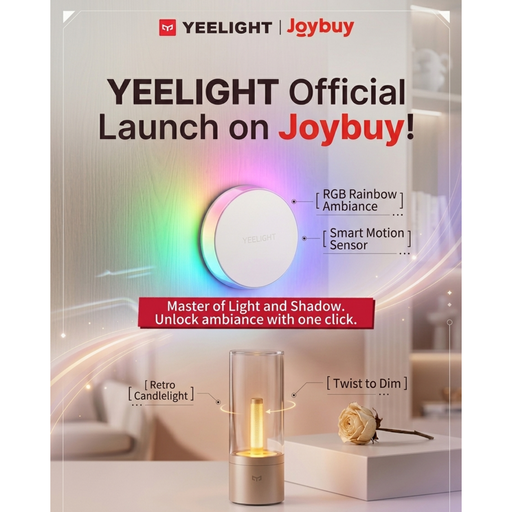
Why this product suits this profile: For a living room, bedroom or games room, this RGB night light combines motion sensors, magnetic mounting and USB-C charging.
The product description specifies 11 preset effects and a motion sensor, rather than simply mentioning colour-changing lights.
USB-C battery, magnetic design and several preset lighting effects for use in different locations.
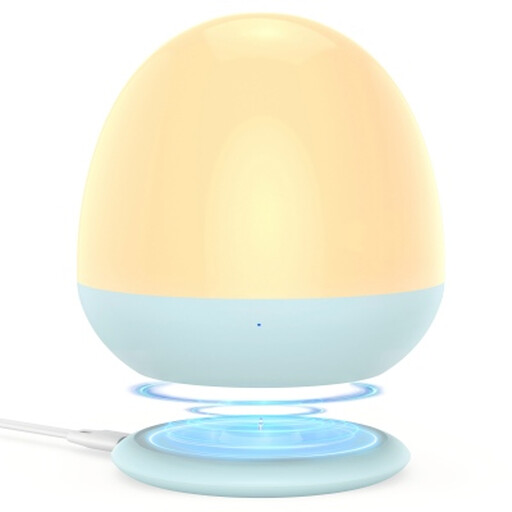
Why this product suits this profile: This egg-shaped light features touch controls, a timer and a charging station. It can be used as a night light in a children’s room or as a portable bedside lamp.
The timer and charging options are clearly specified. The manufacturer also advises that the light should be used under supervision and highlights the age limit.
USB and cordless charging via the supplied charging station, plus touch controls and an automatic shut-off function.
We’ve put together a complete, regularly updated list of products that meet these strict selection criteria and fully comply with the safety regulations in force in the EU.
Position the light so it doesn’t shine directly at eye level. In a hallway, the sensor should detect your route without being blocked by doors or furniture. In a nursery, place the light out of your child’s reach. For plug-in lights, make sure cables can’t be pulled or trapped.
Clean the casing with a soft, dry cloth. Rechargeable lights should be charged according to the manufacturer’s instructions. Stop using the light if it becomes unusually hot, has damaged cables or a misshapen casing.
A PIR sensor detects changes in heat radiation caused by moving people. Many models only switch on when ambient light levels are low. Detection range and lux threshold vary between products, so check them before you buy.
Battery life depends on brightness, how often the light switches on and its operating mode. The models featured here, for example, are specified to last up to 6 or up to 10 hours in their respective sensor modes. These are manufacturer’s figures, not a guarantee for every situation.
An LED night light rated at 0.5 to 1 watt uses little power when it’s on. In sensor mode, it also only lights up when it detects movement in the dark. Actual running costs depend on how long it’s used, your electricity tariff and charging losses.