
Lieferung heute & morgen

Qualitätsgarantie

Willkommens-Angebote freischalten: KOSTENLOSE Lieferung | Bis zu 80 % RABATT | Kostenlose 30-Tage-JoyPlus-Testphase
App herunterladen
A motion-activated night light can automatically illuminate dark paths without you having to search for a switch or keep a socket permanently occupied. However, models vary considerably for bedrooms, children’s rooms, hallways, stairs and cupboards. If you focus solely on a high lumen rating or a low price, you may end up with a product that does not work reliably in its intended location.
The range of a PIR sensor is often stated without providing sufficient context. A motion-sensor night light with a detection range of 3 to 5 metres will not automatically respond equally in every direction. Walls, furniture, doors and installation height all affect detection. The detection angle is also important: a 120-degree model covers a different area from a sensor with a narrower field of view.
Before buying, check:
An LED night light for finding your way to the toilet at night does not need to provide the same brightness as an under-cabinet light for the kitchen. Light that is too bright can be disturbing in a bedroom or children’s room. For cupboards and work surfaces, however, a low light output may not be sufficient.
The unit lumens (lm) describes the total luminous flux. Colour temperature is given in Kelvin (K). Warm white light in the range of around 2,700 to 3,200 K is often used in bedrooms, while more neutral or cooler light may be more suitable for hallways, kitchens and cupboard areas.
A battery-powered night light is quick to install, but it creates ongoing costs through battery replacement. Check whether batteries are included. The VIVREAL model, for example, requires three AAA batteries, which are not included.
A rechargeable night light with USB charging reduces the need to buy batteries regularly. However, battery life depends on brightness, how often the light is activated and sensor operation. Claims such as ‘up to 10 hours’ should be understood as the manufacturer’s figure under specific conditions, not as guaranteed everyday battery life.
Several brightness levels are useful for a night light in a bedroom or children’s room. This allows you to set the light lower when getting up than when searching inside a cupboard. Models with several colour temperatures also allow you to adapt the light to the room.
Look out for:
The 2-pack with a rechargeable battery, for example, specifies 30 lm, three colour temperatures and five brightness levels. The stated CRI value of over 85 describes colour rendering under the manufacturer’s conditions, but says nothing about sensor quality or actual service life.
For rented homes, adhesive solutions, magnetic mounts or hooks are often more practical than drilling. The surface should be clean, dry and able to support the product. On rough plaster, wallpaper or damp tiles, an adhesive strip may not hold as securely.
As an LED cupboard light, slim fittings measuring 20, 30 or 40 cm in length are suitable. A 20 cm light fits smaller compartments, while a 40 cm light can cover a larger area beneath a wall cupboard. Before ordering, measure the inside width of the cupboard and the distance to the door.
The models provided are primarily intended for dry indoor areas. Even a bathroom night light should not automatically be considered water-resistant. Check the product description for information about moisture and the installation location. Electrical devices should not be operated in direct contact with water.
For USB models, pay attention to the stated charging specification, such as 5 V and 1 A or 5 V and 0.5 A. The casing and electronics should not be opened or modified. If the device is visibly damaged or the battery is swollen, stop using it.
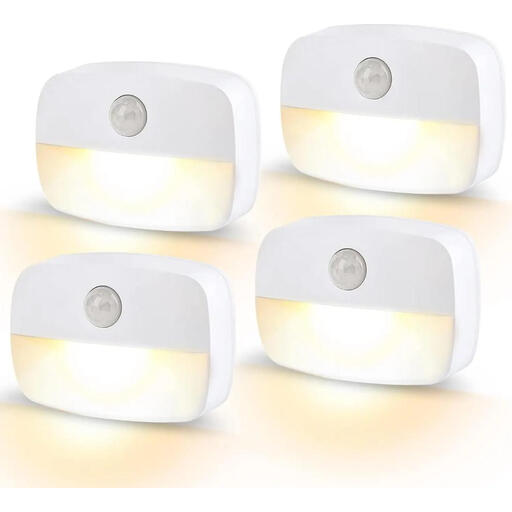
Why this product suits this profile: The 4-pack distributes several automatic lights around hallways, cupboards, stairs or bathroom areas. Tool-free adhesive installation makes it suitable for rented homes.
A range of up to 13–20 feet, a 120-degree angle and switch-off after 20 seconds are clearly specified. The required AAA batteries need to be purchased separately.
Four lights, 35 lm and warm white light at 3,200–2,800 K; installed using double-sided adhesive tape.

Why this product suits this profile: Three colour temperatures and five dimming levels allow precise adjustment for bedrooms, nurseries, hallways or bathrooms.
The brightness is not limited to a single setting. According to the product information, the sensor operates in darkness down to 20 lux and at a distance of 3–5 metres.
Built-in 500-mAh battery, USB charging at 5 V/1 A, stated sensor operating time of up to 10 hours and 30 lm.

Why this product suits this profile: Its slim design is intended for kitchen wall cupboards, wardrobes and shelving. Two lights can cover several areas.
The dimensions of 300 × 38 × 10 mm help with planning. The PIR sensor and USB power supply are clearly specified; according to the product information, this model is not intended for damp environments.
41 LEDs, three colour temperatures from 2,800 to 7,000 K and a built-in 1,100-mAh battery.

Why this product suits this profile: The plug-in model is suitable for children’s rooms, hallways and stairs when you do not want to charge batteries or replace disposable batteries.
According to the product description, the motion and dusk sensors operate only in darkness. The light switches off after 60 seconds without movement.
Five brightness levels from 20 to 100 per cent, warm white light at 2,700 K and no battery operation.
We have put together a complete, regularly updated list of products that fully meet these strict selection criteria and the safety regulations applicable in the EU.
For a hallway light with motion sensor, the sensor should face the expected route and should not be positioned directly behind a door or piece of furniture. In the bedroom, a low brightness setting is recommended. In a children’s room, install the device so that cables, adhesive strips and the light itself do not create a tripping hazard.
When using a sensor light for a cupboard, clean the installation surface before attaching it. After installation, check whether opening the door triggers the sensor and whether the light distributes sufficient illumination when the door is opened. For kitchen areas, an under-cabinet light with motion sensor is practical, provided it is protected from splashes and is not installed directly above a sink.
Most devices use a PIR sensor that detects changes in heat radiation caused by movement. Some models combine this with a dusk sensor and switch on only when ambient light levels are low. Range, angle and switch-off time vary from one product to another.
This depends on battery capacity, brightness and the number of activations. Product specifications may state, for example, 500 mAh with up to 10 hours in sensor mode or 1,100 mAh for longer lights. These figures are provided by the manufacturer and should not be treated as a guaranteed operating time.
In sensor mode, the device lights up only when movement is detected and then switches off again. Models with a 0.5 W power rating or USB battery can help limit energy consumption compared with a light that remains on continuously. Battery-powered models also incur the cost of replacement batteries, while rechargeable models require charging.