
Lieferung heute & morgen

Qualitätsgarantie

Willkommens-Angebote freischalten: KOSTENLOSE Lieferung | Bis zu 80 % RABATT | Kostenlose 30-Tage-JoyPlus-Testphase
App herunterladen
Dark cabinets and cluttered drawers are a daily frustration. A motion-sensor cabinet light promises a simple and elegant solution: light exactly when you need it, with no switches or wires. However, the market is flooded with products whose real-world performance often falls short of their promises. Before you make a decision, it's crucial to understand the typical weaknesses that can quickly turn a practical aid into a technical nuisance.
This guide will walk you through the three most common pitfalls to avoid when buying and highlight the key technical features you should look for to find a reliable and long-lasting solution for your home.
Many budget-friendly options quickly prove to be impractical. Pay close attention to these three points to avoid buyer's remorse:
To steer clear of these problems, you should check three technical specifications before you buy. These are the primary determinants of your new light's functionality and durability.
Battery life is directly dependent on its capacity, measured in milliampere-hours (mAh).
Also, look for a modern USB-C port. It is more robust and allows for faster, more convenient charging than the outdated Micro-USB standard.
Most models use a PIR (Passive Infrared) sensor, which reacts to body heat. The crucial factors here are the range and the detection angle. A range of 3 to 5 metres and an angle of about 120 degrees are practical benchmarks. Some lights also offer different operating modes:
A good wireless LED strip with a sensor should, at a minimum, master the AUTO mode reliably.
The flexibility of installation is a major advantage. The most common methods are:
The housing material also plays a role. Aluminium dissipates heat more effectively than plastic, which can extend the life of the LEDs, and it also has a more premium feel.
Based on the criteria above, we have identified a few products that are well-suited for different needs and locations.

Why This Fits Their Persona: Ideal for users who want to affordably illuminate several small areas like drawers, shoe racks, or medicine cabinets. The 2-pack offers excellent value for money for getting started.
With 800 mAh, the battery offers a solid capacity for this compact size, sidestepping the trap of extremely short runtimes common in many no-name products.
Three adjustable colour temperatures (cool, neutral, and warm white) allow you to adapt the lighting to any environment. The set includes two lights for versatile applications.
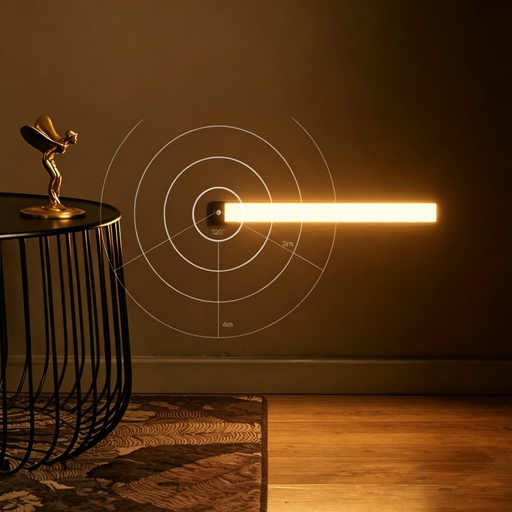
Why This Fits Their Persona: Perfect for users seeking an aesthetic and high-performance solution for visible areas like an open wardrobe or as a battery-powered under-cabinet kitchen light. The 60 cm length ensures even illumination.
The sturdy magnetic mount and high-quality aluminium housing counteract the problem of poor adhesion. Yeelight is also known for its reliable sensor technology.
Its ultra-slim design (just 4.9 mm thick, according to the manufacturer) integrates discreetly into any piece of furniture. The magnetic mount makes it easy to detach for recharging via USB-C.
Why This Fits Their Persona: For users who need a versatile solution for high-traffic areas. The combination of a large battery capacity and 30 cm length makes it ideal for battery-operated wardrobe lighting or kitchen counters.
With a 1100 mAh battery, this model directly addresses the main pain point of short runtimes, offering significantly longer use between charges than many competing products.
The high battery capacity, combined with three selectable colour temperatures, offers maximum flexibility and endurance for demanding locations. The 2-pack allows you to outfit multiple areas.
We've compiled a complete, up-to-date list of products that meet these strict selection criteria and comply with current safety regulations.
The runtime heavily depends on the battery capacity (in mAh) and the frequency of use. As a rule of thumb, models with a capacity of 1000 mAh or more can last several weeks to months with average use in a wardrobe or kitchen. Lights with less than 800 mAh typically need to be charged more often, sometimes weekly.
Yes, these lights are very well-suited as a battery-powered under-cabinet kitchen light. Look for a model with a secure, preferably magnetic, mount to easily remove the light for charging. An aluminium housing is beneficial as it is robust. Models with adjustable colour temperature are particularly practical, as you can choose a bright, neutral white light for cooking and a warm white light for a cosy atmosphere.
Yes, the installation is typically drill-free. Most products use one of two methods: either a self-adhesive metal plate is attached to the desired spot, to which the magnetic kitchen light then adheres, or the light is attached directly with double-sided tape. For a permanent hold, it is crucial that the surface is clean, dry, smooth, and grease-free before application.