
Lieferung heute & morgen

Qualitätsgarantie

Willkommens-Angebote freischalten: KOSTENLOSE Lieferung | Bis zu 80 % RABATT | Kostenlose 30-Tage-JoyPlus-Testphase
App herunterladen
By Joybuy Product Recommendation Officer, July 29, 2026
Stop fumbling in the dark. A motion-sensor cabinet light is a simple and effective solution for bringing light to cluttered wardrobes, deep kitchen drawers, or dark pantries. However, the market is flooded with models of widely varying quality. Before you make a decision, it's crucial to understand the common weaknesses that can quickly turn a convenient helper into a daily annoyance.
This guide will walk you through the key features to look for, helping you find a solution that works reliably without needing constant adjustments.
Many products promise easy installation and automatic functionality. In practice, however, flaws often emerge that severely limit their usefulness. Pay special attention to these three points:
To avoid these problems, you should carefully examine three technical aspects before buying. These factors are crucial in determining the functionality and longevity of your cabinet lighting.
Most models are designed as wireless cabinet lighting. There are two main types: battery-operated and rechargeable.
For renters and anyone who wants to avoid damaging their furniture, a drill-free kitchen light is essential. The most well-designed solution is a combination of a magnet and an adhesive strip. A thin metal plate is attached to the desired spot with the adhesive. The light itself then attaches magnetically to this plate. This offers two key advantages: the light can be easily detached for charging, and the adhesive bond isn't stressed by repeated removal and reattachment.
A good motion detector is the heart of the light. A PIR (Passive Infrared) sensor is the standard. Key metrics to look for are:
Based on the criteria above, we have identified several products that provide a suitable solution for different user profiles and use cases.

Why This Fits Their Persona: Ideal for users seeking a straightforward and cost-effective solution for multiple small areas like drawers or small cabinets. The 2-pack offers excellent value for money to get started.
The magnetic mount with an adhesive pad is more stable than an adhesive-only solution and makes recharging easy. The three selectable colour temperatures prevent the pitfall of being stuck with an unsuitable light.
USB rechargeable (800mAh battery) and three colour temperatures (2800K-7000K) in a compact, ultra-thin design. Comes in a convenient 2-pack.
Why This Fits Their Persona: Perfect for illuminating longer areas like kitchen countertops or large wardrobes. The greater length and more powerful battery are designed for more intensive use.
With 1100mAh, the battery offers significantly longer runtime, thus avoiding the 'low battery trap'. The 61 LEDs provide bright, even illumination that is also suitable for work surfaces.
40 cm length for wide areas and a powerful 1100mAh battery. Also offers three colour temperatures and simple magnetic mounting.
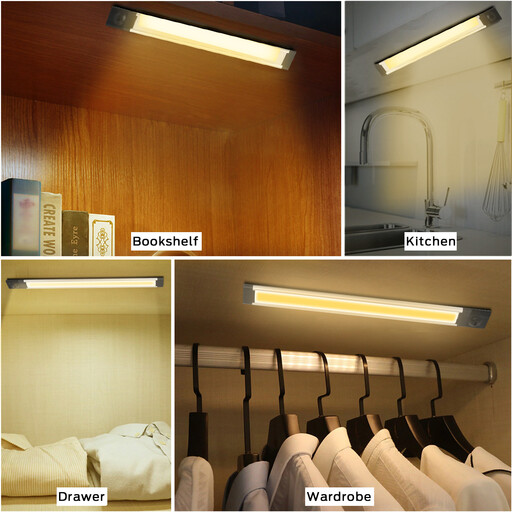
Why This Fits Their Persona: For users who value high-quality materials, advanced features, and maximum control. The gesture control and stepless dimming offer a superior level of convenience.
Gesture control with stepless dimming solves the problem of inaccurate sensors by giving the user precise control over brightness and status. The aluminium and ABS housing is also more robust than all-plastic models.
Innovative gesture control, stepless dimming, and a wide colour temperature range (2800K-6500K). High-quality materials (aluminium, ABS) and flexible mounting options.
We've compiled a complete, up-to-date list of products that fully meet these strict selection criteria and safety standards.
1. How long does the battery of a wireless cabinet light last? The battery life depends heavily on the frequency of use, the set brightness level, and the battery capacity (mAh). With average use (a few times a day), a light with an 800-1100 mAh battery can last for several weeks to months before needing to be recharged via USB.
2. Will the adhesive mount hold up in a kitchen with steam and heat? For a reliable installation in the kitchen, surface preparation is key. The surface must be thoroughly cleaned with a degreaser and be completely dry before applying the adhesive pad. Models with a magnetic mount have an advantage here, as the adhesive bond is not stressed by removing the light for charging, making it more stable over time.
3. Can you adjust the sensitivity of the motion sensor? Most standard models have a fixed sensor sensitivity. However, some more advanced lights offer different operating modes (e.g., a day mode and a night mode) that indirectly influence when the sensor activates. Models with gesture control or manual switches offer the most control, as they can bypass purely automatic activation.