
Lieferung heute & morgen

Qualitätsgarantie

Willkommens-Angebote freischalten: KOSTENLOSE Lieferung | Bis zu 80 % RABATT | Kostenlose 30-Tage-JoyPlus-Testphase
App herunterladen
By the Joybuy Product Recommendation Officer, August 28, 2026
Reaching into a dark wardrobe in the morning or searching for spices in a poorly lit kitchen corner—these are familiar situations for many. A motion sensor cabinet light promises a simple and effective solution. However, the market is flooded with products whose real-world performance often fails to live up to their claims. Before you make a purchase, it's crucial to understand the typical weaknesses that can lead to frustration and unnecessary expense.
This guide reveals the three most common pitfalls when buying sensor lights and explains which technical features you should look for to find a reliable and long-lasting lighting solution for your home.
Many products advertise impressive features, but the devil is in the details. Pay close attention to these three points to avoid a regrettable purchase.
wireless lamp that's constantly tethered to a charging cable defeats its purpose. Furthermore, models that rely on disposable batteries (battery-operated cabinet lighting) can lead to higher long-term running costs.To avoid the problems mentioned above, you should base your decision on objective technical data. The following three criteria are central to the function and longevity of a cabinet light.
Most cabinet lights use a PIR (Passive Infrared) sensor, which reacts to changes in heat caused by body movement. Pay attention to two key metrics:
wardrobe light or under-cabinet kitchen light, a range of 3 to 5 metres is ideal.A good LED strip with sensor combines these two features to ensure reliable, on-demand activation.
The type of power supply determines user convenience and running costs.
USB rechargeable are generally the more sustainable and cost-effective choice. They don't require replacement batteries and can be conveniently charged with a standard USB cable.The lighting effect has a major impact on atmosphere and functionality.
night light with motion sensor in a bedroom or hallway. Neutral White (approx. 4500 K) resembles daylight and is a great all-round option. Cool White (approx. 6500 K) provides clear, bright illumination, making it ideal for work areas in the kitchen or for display cabinet lighting.Based on the criteria above, we have identified several products suited for different user profiles and requirements.

Why This Fits Their Persona: Ideal for users looking for an affordable and flexible starter kit. The 2-pack allows for illuminating two smaller areas, like a shoe cabinet and a drawer, without a high initial investment.
The integrated 800mAh battery is USB rechargeable, bypassing the running costs and waste of disposable batteries (Pitfall #2). The three adjustable colour temperatures offer a versatility not often found in this price range.
Excellent value for money with the 2-pack. Three colour temperatures (Warm, Neutral, and Cool White) for different locations. Compact and discreet design.
Why This Fits Their Persona: For users who value aesthetic integration, high functionality, and long runtimes. The ultra-slim design blends seamlessly into modern kitchens or wardrobes without being obtrusive.
With a battery capacity of 1100 mAh, this model directly addresses the problem of short runtimes (Pitfall #2). The long operating life significantly reduces the need for frequent recharging, greatly enhancing convenience.
High battery capacity for long usage intervals. Three adjustable colour temperatures for flexible lighting moods. Very slim profile (10 mm) for an unobtrusive installation.
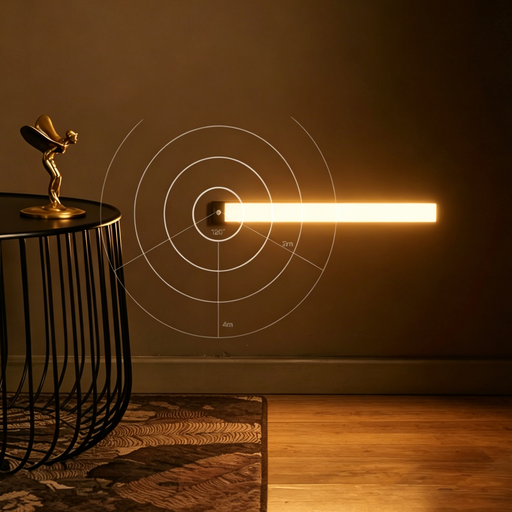
Why This Fits Their Persona: Perfect for fully illuminating large areas like walk-in wardrobes, long kitchen worktops, or garages. The 60 cm length ensures wide and shadow-free light distribution.
Its generous length prevents the formation of dark "light islands," a common problem when using lights that are too short for large areas. The Yeelight brand is well-established in the lighting sector, suggesting more reliable sensor calibration and build quality (Pitfall #1).
Large 60 cm length for even and wide illumination. Slim, high-quality housing. Reliable sensor function for daily use.
We have compiled a complete, up-to-date list of products that fully meet these strict selection criteria and all relevant safety regulations.
1. How long does the battery last on a USB-rechargeable cabinet light? Battery life depends heavily on the battery capacity (mAh) and frequency of use. With average use (activated a few times a day), a model with a capacity of 800-1100 mAh can last for several weeks or even months. Lights in continuous-on mode or with very frequent activation will need to be charged more often.
2. Can I adjust the light colour on LED cabinet lights? Many modern LED cabinet lights offer this feature. You can switch between different colour temperatures, such as Warm White, Neutral White, and Cool White, at the touch of a button. This allows you to adapt the lighting to the specific room and desired atmosphere. Look for this feature in the product description.
3. Will the adhesive mount hold up in a kitchen or bathroom? The durability of an adhesive mount depends on the quality of the adhesive strip and the nature of the surface. For areas with high humidity or temperature fluctuations, such as kitchens and bathrooms, it is advisable to look for products with high-quality brand-name adhesive strips (e.g., from 3M). Thoroughly clean and dry the surface before application to ensure optimal adhesion. Magnetic mounts offer the added advantage that the light can be easily detached for charging.