
Lieferung heute & morgen

Qualitätsgarantie

Willkommens-Angebote freischalten: KOSTENLOSE Lieferung | Bis zu 80 % RABATT | Kostenlose 30-Tage-JoyPlus-Testphase
App herunterladen
Dark cabinets and drawers are a daily frustration. Whether you're searching for spices in the kitchen, choosing an outfit in your wardrobe, or navigating a hallway, fumbling in the dark is cumbersome and inefficient. Motion-sensor cabinet lighting promises a simple and elegant solution. However, the market is flooded with products of widely varying quality. Before you make a decision, it's crucial to understand the common pitfalls that can lead to buyer's remorse.
Many lights prove to be impractical after only a short time. The most common problems include:
This guide will help you navigate these issues and make an informed decision based on objective criteria.
To find a durable and functional solution, you should examine three core technical aspects. These are the primary determinants of your new lighting's real-world usability.
The heart of any automatic cabinet light is the Passive Infrared (PIR) sensor. It reacts to the thermal radiation emitted by people. Look for the following specifications to ensure reliable performance:
The flexibility of a cordless under-cabinet LED light is directly tied to its power supply. A USB-rechargeable cabinet light is the most practical option here.
Easy installation is a major selling point for this product category. A magnetic mount is the superior solution.
Based on the criteria above, we have identified a few products that are well-suited for specific user groups and their requirements.

Why it's a great fit: Ideal for users who want to equip multiple areas like the kitchen and wardrobe at the same time. The 2-pack offers a cost-effective starter kit without compromising on core features.
The light features a solid 800mAh battery, avoiding the pitfall of short runtime. The PIR sensor, with a range of 3-5 metres, ensures reliable activation.
Offers three adjustable colour temperatures (cool, neutral, and warm white), allowing for flexible adaptation to any environment and task.
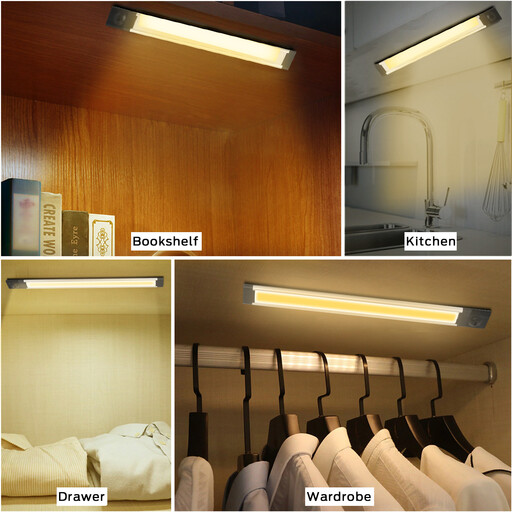
Why it's a great fit: For users who value high brightness, premium build quality, and advanced control features. Ideal for workshops, large wardrobes, or as an under-cabinet light in the kitchen.
The housing, made of aluminium and ABS plastic, is durable and robust. It is attached via a magnetic mount, which bypasses the pitfall of weak adhesive strips.
Features gesture control with stepless dimming and a high light output of 400 lumens, enabling precise and convenient light adjustment.
We've compiled a complete, up-to-date list of products that fully meet these strict selection criteria.
The battery life depends on two factors: the battery capacity (in mAh) and the frequency of use. A model with a capacity of 800–1000 mAh can last from several weeks to a few months with average use (approx. 5–10 activations per day). Always check the mAh rating in the product specifications before purchasing.
No, a PIR motion sensor requires a direct "line of sight" to the heat source. It cannot detect motion through solid materials like wood or glass doors. Therefore, the light will activate as intended only when you open the cabinet door, allowing the sensor to detect your movement and body heat.
Some models offer this feature. Look for terms like adjustable colour temperature or CCT (Correlated Color Temperature) in the product description. Common options include warm white (approx. 2800–3200 K) for a cosy atmosphere, neutral white (approx. 4500–5000 K) for balanced lighting, and cool white (approx. 6500–7000 K) for clear task lighting.