
Lieferung heute & morgen

Qualitätsgarantie

Willkommens-Angebote freischalten: KOSTENLOSE Lieferung | Bis zu 80 % RABATT | Kostenlose 30-Tage-JoyPlus-Testphase
App herunterladen
Reaching into a dark wardrobe or an unlit kitchen drawer can be a frustrating experience. A motion sensor cabinet light promises a simple and effective solution. However, the market is flooded with products whose real-world performance often falls short of their promises. Before you make a decision, it's crucial to understand the most common weaknesses that can quickly turn a convenient helper into a daily annoyance.
Many users report similar disappointments after their purchase. These three issues are the most frequent causes of buyer's remorse:
To avoid these problems, you should base your choice on objective technical specifications. Three parameters are of central importance here.
The battery's capacity, specified in mAh, is a direct indicator of its expected runtime. A higher mAh number generally means longer use between charges. For a rechargeable LED strip that is used multiple times daily, values starting from 800 mAh for shorter strips (approx. 20 cm) and over 1000 mAh for longer models (from 40 cm) are a good benchmark. Also, look for a standardised charging port. A USB cabinet light offers maximum flexibility, as it can be charged with common power adapters, power banks, or a laptop.
Most cabinet lights use a Passive Infrared (PIR) sensor. This sensor reacts to body heat moving within its detection area. Two values are important here: the detection angle (often around 120°) and the range (typically 3 to 5 metres). For a wardrobe light, a wide angle is advantageous to reliably detect movement when the door is opened. Some models combine the PIR sensor with a dusk sensor, so the light only turns on in the dark, saving additional energy.
A drill-free under-cabinet kitchen light is particularly popular with renters and for delicate furniture surfaces. The most stable solution here is often a magnetic mount. This involves attaching a thin metal rail with a high-quality adhesive strip (e.g., from 3M) to the desired location. The light itself adheres magnetically to this rail and can be easily removed for charging. This is significantly more durable than directly gluing the entire light and makes handling much easier.
Based on these criteria, we have identified some products that are well-suited for specific needs and locations.

Why This Fits Their Persona: This set offers a cost-effective way to equip several small areas like shoe cabinets, pantries, or nightstands. It's a practical starter kit for anyone looking to try out the convenience of sensor lighting.
With an 800mAh battery per light, it offers solid runtime for its size. The adhesive mounting is adequately designed for the light's low weight.
The ability to switch between three colour temperatures (cool, neutral, and warm white) is a remarkable feature in this price range. It recharges via USB.
Why This Fits Their Persona: Anyone looking for a continuous and bright wireless under-cabinet light for the kitchen or a complete wardrobe lighting solution needs more length and power. This 40cm model is designed for such tasks.
The 1100mAh battery directly addresses the problem of short runtimes in larger, brighter lights. The higher capacity ensures a reasonable usage period even with frequent activation.
The combination of 61 LEDs, a 40cm length, and three selectable colour temperatures allows for flexible, task-appropriate illumination of surfaces where brightness and light colour matter.
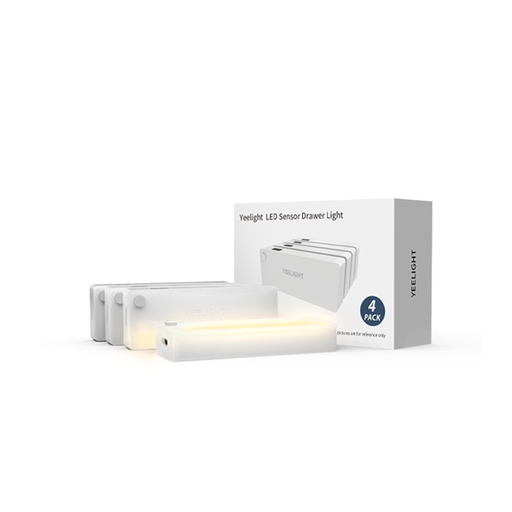
Why This Fits Their Persona: For targeted illumination of drawers, jewellery boxes, or small compartments, standard light strips are often too large and their sensors unsuitable. These compact lights are specifically designed for this purpose.
The sensor is optimised for the short distance and quick motion of opening a drawer. Thanks to its small size and minimal weight, the adhesive mount holds reliably.
The design is purpose-built and highly functional. The included four-pack allows you to outfit an entire cabinet or dresser in one go.
We have compiled a complete, up-to-date list of products that fully meet these strict selection criteria and the German safety regulations.
Battery life depends heavily on the battery capacity (mAh) and frequency of use. With average use (a few times per day), a light with a capacity of 800-1100 mAh can last for several weeks to months. Models with a constant-on mode or very frequent activation will need to be charged more often.
The most common method is mounting with an adhesive strip. For a stable and flexible solution, a model with a magnetic mount is recommended. With this system, only a thin metal plate is adhered to the underside of the cabinet. The light itself attaches magnetically to it and can be easily removed for charging and reattached. Thoroughly clean the surface of grease and dust before applying the adhesive.
Some models offer advanced features. The ability to change the colour temperature (e.g., between warm white, neutral white, and cool white) is particularly useful in kitchens to adapt the light to the specific task. Dimming functions to regulate brightness are also available on some products, which can also help extend battery life. Check the product description for features like "3 Colour Temperatures" or "Dimmable".