
Lieferung heute & morgen

Qualitätsgarantie

Willkommens-Angebote freischalten: KOSTENLOSE Lieferung | Bis zu 80 % RABATT | Kostenlose 30-Tage-JoyPlus-Testphase
App herunterladen
An LED night light with motion sensor can automatically illuminate hallways, cupboards, stairs or the bedroom as soon as movement is detected. However, models vary considerably when it comes to sensors, power supply, brightness and installation. Focusing solely on a high number of LEDs or a particularly low price can mean overlooking important details.
Typical purchasing pitfalls include:
PIR sensors respond to changes in thermal radiation within the detection area. A stated range of “3 to 5 metres” does not automatically mean consistently reliable detection from every angle. Doors, furniture edges and the mounting height all affect performance.
Check the following before buying:
A limited sensor range is often sufficient for a hallway or cloakroom. On a staircase or in a larger bedroom, the light should be positioned so that movement is directed towards the sensor.
A warm white night light in the region of 2800 to 3200 Kelvin feels less intrusive in bedrooms than a cool-white setting. Neutral- or cool-white light can be more practical for kitchen worktops, cupboard interiors or finding objects.
Look out for:
Models with several colour temperatures are versatile, but they do not replace permanently installed room lighting. The stated lumen values should also be considered in relation to the size of the area being illuminated.
A rechargeable night light with a USB connection is particularly suitable for households that already have chargers, laptop ports or power banks. Battery capacity, charging method and whether the light can be removed for charging are key considerations.
A battery-powered night lamp can be a sensible choice if there is no USB connection near the installation site. In this case, consider the battery type, what is included and the switch-off time.
Adhesive or magnetic mounting is practical in rented accommodation. For a cupboard light without drilling, the surface must be dry, clean and as smooth as possible. In bathrooms, you should also check whether the product is specifically suitable for damp conditions. According to the product information, the models described here are intended for indoor use and should not come into contact with water.

Why this product suits this profile: This twin pack is designed for several small areas, such as shelves, cupboards or a short hallway. The compact 200 mm length also fits into narrow recesses.
The product specifications state a PIR detection range of 3 to 5 metres, three light colours and USB charging. This makes it easier to assess the sensor, light colour and power supply clearly before buying.
21 LEDs, 800-mAh battery, three colour temperatures and drill-free installation with adhesive strips.
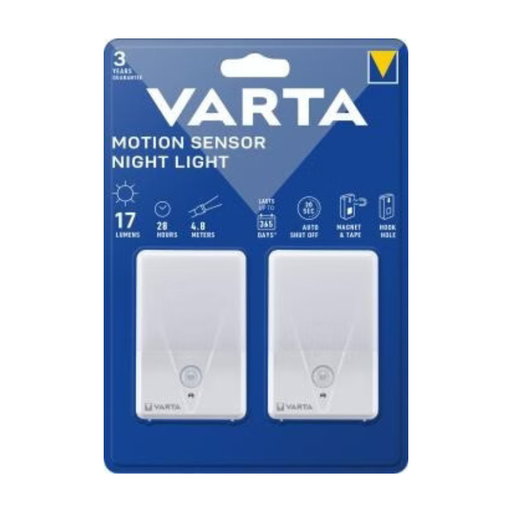
Why this product suits this profile: The twin pack is intended for bedrooms, hallways, bathrooms or cupboards. It can be installed using adhesive strips, a magnet or screws.
Automatic switch-off after 30 seconds limits unnecessary illumination. According to the product information, the sensor works in darkness at distances of up to 3 metres and has a detection angle of 120 degrees.
17 lumens of warm white light, 3 AAA batteries required, a stated runtime of up to 28 hours and a 3-year warranty.
Why this product suits this profile: The 400 mm design is suitable for longer kitchen wall units, wardrobes or shelves. The two lights can be distributed across different rooms.
The product description states dimensions of 400 × 38 × 10 mm, 61 LEDs and a PIR range of 3 to 5 metres. This allows you to check the fit precisely before installation.
1100-mAh battery, USB charging at 5 V and 0.5 A, plus three light colours from warm white to cool white.

Why this product suits this profile: The combination of motion mode, continuous lighting, five brightness levels and three colour temperatures lets you tailor the light to a bedroom, child’s room or hallway.
The brightness is not limited to a single setting. According to the product information, the sensor mode is designed for darkness up to 20 lux and a range of 3 to 5 metres.
500-mAh battery, USB charging at 5 V and 1 A, 30 lumens, five dimming levels and a CRI of over 85 according to the product description.
We have put together a complete, regularly updated list of products that fully meet these strict selection criteria and the safety regulations applicable in the EU.
Before installation, the surface should be degreased and allowed to dry completely. Adhesive strips usually adhere better to smooth tiles, painted surfaces or furniture than to woodchip wallpaper, wallpaper or uneven wood. Position the light so that the PIR sensor is not obscured by edges or objects.
For families with children and babies, batteries, magnets, small parts and installation accessories must be kept out of reach. An LED night light is not emergency lighting and should not be used as a substitute for compliant stairway or room lighting. In damp areas, the product may only be used in accordance with its marking.
Place the light near the passageway, but not directly behind a door or piece of furniture. Test its operation in darkness from different directions. For a model with a dimming function, a low setting is recommended at night, while cupboards or work areas may require greater brightness.
Runtime depends on battery capacity, brightness, how often the sensor is triggered and the switch-off time. According to the product information, a 500-mAh model can achieve up to 10 hours in sensor mode; however, this cannot be taken as a general runtime for other products. For a fair comparison, consider capacity, operating mode and charging time together.
A rechargeable light uses electricity when charging, whereas a battery-powered model regularly requires new batteries. USB charging can be more convenient for frequently used hallways or kitchens. For less frequently used areas without access to charging, a battery-powered version may be more practical. The key factors are therefore how often the light is used, how accessible the charging point is and the stated automatic switch-off settings.