
Lieferung heute & morgen

Qualitätsgarantie

Willkommens-Angebote freischalten: KOSTENLOSE Lieferung | Bis zu 80 % RABATT | Kostenlose 30-Tage-JoyPlus-Testphase
App herunterladen
By the Joybuy Product Recommendation Officer, July 28, 2026
A late-night trip to the bathroom or a quick check on the kids' room can often mean stumbling in the dark or being jolted awake by a harsh overhead light. A rechargeable motion-sensor night light seems like the ideal solution. However, the market is flooded with models whose real-world usability is often questionable until after you've bought them. Many products turn out to be a nuisance due to unreliable technology or impractical design.
This guide highlights the three most common shortcomings that lead to frustration with budget-friendly models and explains which technical features you should look for to find a durable and functional solution for your home.
Before choosing a model, it's helpful to know the typical defects that can severely limit its everyday usefulness.
To avoid the problems mentioned above, you should check three core parameters before buying. These determine whether a night light will be a genuine help or just another unused gadget.
A high-quality night light uses a Passive Infrared (PIR) sensor to react to body heat. Look for the following specifications:
Independence from power outlets is the main advantage of a rechargeable LED night light. Its practicality depends on two factors:
The effect of the light has a direct impact on well-being and sleep patterns.
Based on the criteria above, we have identified a few models that are well-suited for different user profiles and applications.

Why This Fits Their Persona: This 2-pack is a practical solution for families. One light can provide gentle illumination in a child's room, while the other ensures safe passage in the hallway or bathroom at night. The flexibility in colour and brightness adapts to the needs of both parents and children.
The 5-step dimming and three colour temperatures prevent glare. The battery (500mAh) is charged via USB, and the sensor responds reliably in the dark (≤20 LUX).
High adaptability with 3 colour temperatures and 5 brightness levels. The 2-pack offers excellent value for money for outfitting multiple rooms.

Why This Fits Their Persona: Ideal for homeowners seeking discreet and functional lighting for specific areas. The ultra-thin design is perfect for mounting under kitchen cabinets, inside wardrobes, or along staircases without being conspicuous.
With 1100 mAh, the battery offers a long runtime. Installation via adhesive strips requires no drilling. The PIR sensor ensures activation only when needed.
The slim profile (10 mm height) allows for discreet installation. The high battery capacity reduces charging frequency, making it a low-maintenance solution.
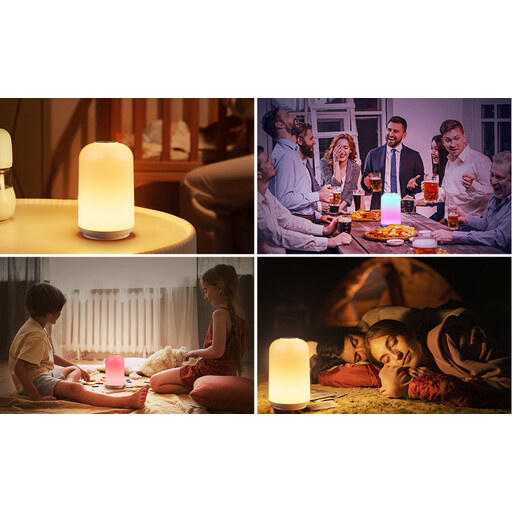
Why This Fits Their Persona: For users looking for more than just an orientation light. This model combines functional warm white light with 7 RGB colours for atmospheric ambience. It's suitable as a bedside lamp, mood light, or a colourful night light in a child's room.
The stepless dimming in warm white mode prevents glare. The integrated battery with USB charging offers flexibility without constant battery changes.
The combination of a functional orientation light and a decorative mood light in one device. The automatic colour-changing mode in RGB operation adds variety.
We have compiled a complete, up-to-date list of products that fully meet these strict selection criteria and UK safety regulations.
1. How long does the battery of a rechargeable night light typically last? The battery life heavily depends on the capacity (in mAh) and the frequency of use. A model with around 500 mAh, activated 8–10 times per night in sensor mode, can last from several weeks up to a month. In continuous-on mode, the runtime shortens to just a few hours. Models with a larger battery (e.g., 1100 mAh) can operate for correspondingly longer.
2. Where is the best place to install a motion-sensor night light? Install the light at a height of about 0.5 to 1.5 metres. Ideal locations include hallways, stair landings, bathrooms, or on the bed frame. Aim the sensor towards the area where movement will first occur. Avoid pointing it directly at heat sources like radiators or at windows to minimise false activations.
3. Does the light disturb sleep? A light that is too bright or has a cool white colour can inhibit the production of the sleep hormone melatonin. Therefore, choose a model with a warm white colour temperature (under 3200 Kelvin) and a dimming function. A low brightness level is sufficient for orientation and is perceived as less disruptive.