
Lieferung heute & morgen

Qualitätsgarantie

Willkommens-Angebote freischalten: KOSTENLOSE Lieferung | Bis zu 80 % RABATT | Kostenlose 30-Tage-JoyPlus-Testphase
App herunterladen
A motion sensor light can automatically illuminate hallways, staircases, wardrobes or entryways. However, for it to be genuinely useful in everyday life, it’s not just about a low price or the widest possible range. What really matters is where you’ll use it, how it’s mounted, how it’s powered, and how well the sensor and light work together.
A stated range doesn’t automatically tell you how well the sensor will cover your room. A narrow detection angle can mean the sensor only picks up a person late. A hallway needs a different detection area than a wardrobe or a staircase.
With a PIR motion sensor, it detects the heat emitted by moving people. Furniture, doors and awkward mounting positions can all restrict the detection area. So always check the range, angle and mounting height.
A motion sensor light shouldn’t trigger with every movement in broad daylight. An adjustable brightness threshold, often measured in lux, cuts down on unnecessary switching. With the Aigostar infrared detector for ceiling mounting, the light sensitivity can be set between 10 and 2,000 lux, according to the product specs.
Without this feature, the light could switch on even when the room is already bright enough. That affects both your electricity consumption and the lifespan of the connected bulbs.
Wireless LED lights can usually be installed without touching your electrical wiring. A wired ceiling motion sensor or wall motion sensor for 220–240 V, on the other hand, requires professional installation. Any work on mains voltage should be carried out by a qualified electrician.
Also pay attention to the IP rating. IP20 is fine for dry indoor spaces. Areas that might get splashed need a different rating. An IP rating isn’t a free pass for use in permanently damp or unprotected outdoor areas.
For a wardrobe, a short detection range is often enough. A hallway or staircase, however, needs coverage that fits the space as well as possible. The Aigostar ceiling sensor is designed for 360-degree detection with a maximum diameter of 6 metres, according to the product description. The Aigostar wall sensor, model VT-8028-W, offers a range of up to 12 metres with an adjustable horizontal and vertical angle.
Always consider these figures in relation to the size of your room. A long range isn’t automatically an advantage if it picks up movement outside the area you want.
With an LED night light with motion sensor, you can choose from plug-in, mains-wired, rechargeable battery or disposable battery models, depending on the design.
One example of a battery-powered smart home sensor is the Aqara Motion and Light Sensor P2. According to the product data, it runs on two CR2450 batteries, uses Matter over Thread, and needs a compatible border router or Aqara M3 hub for full functionality.
For a wardrobe or nighttime orientation, subtle lighting is often enough. For a dark hallway or staircase, a higher light output can be more useful. Check not only lumens but also the colour temperature and whether dimming is available.
The night light with motion sensor, sold as a 2-pack, has a power consumption of 1 W, a brightness of 20 lm, a colour temperature of 4,000–4,500 K and stepless touch dimming with memory function, according to the specs. The automatic mode activates when the ambient brightness is no more than 20 lux and motion is detected within about 3 to 5 metres.
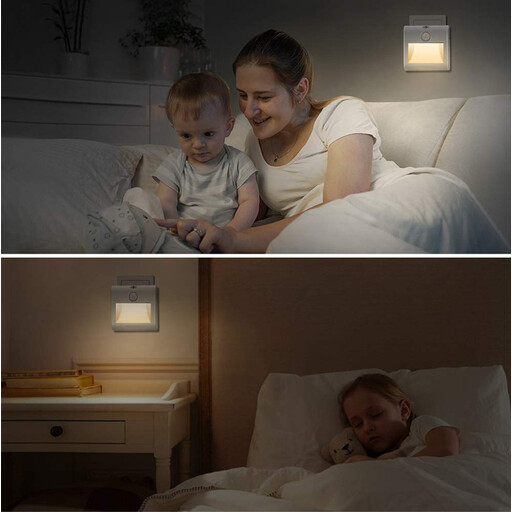
Why this product fits the profile: The 2-pack is ideal for households that want to equip a bedroom, hallway or bathroom with a motion sensor night light at the same time.
The automatic mode is tied to a brightness threshold of no more than 20 lux and a stated detection range of 3 to 5 metres.
Two lights, 1 W power consumption per unit, plus touch dimming with memory function.
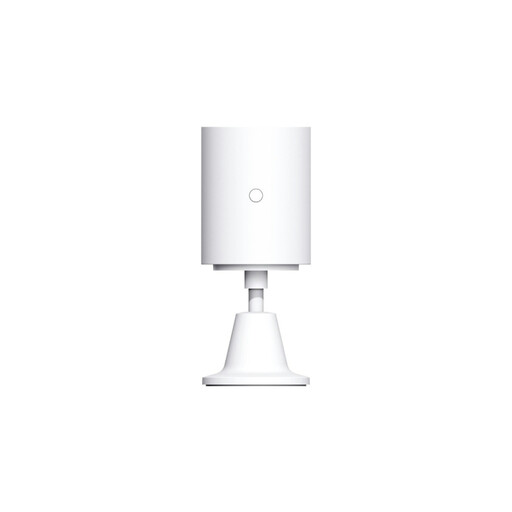
Why this product fits the profile: For users who want to integrate a smart motion sensor light into existing Matter or Thread automations.
The required infrastructure is clearly stated: a Matter-over-Thread border router or Aqara M3 hub for full functionality.
170° detection angle, up to 7 metres range according to product data, and two CR2450 batteries.

Why this product fits the profile: The 60 cm length is ideal for longer wardrobe shelves, worktops or areas under wall units.
The defined light length makes it easier to choose based on your installation situation, rather than relying only on general range figures.
60 cm version, designed as a sensor light for wardrobes or longer shelf areas.
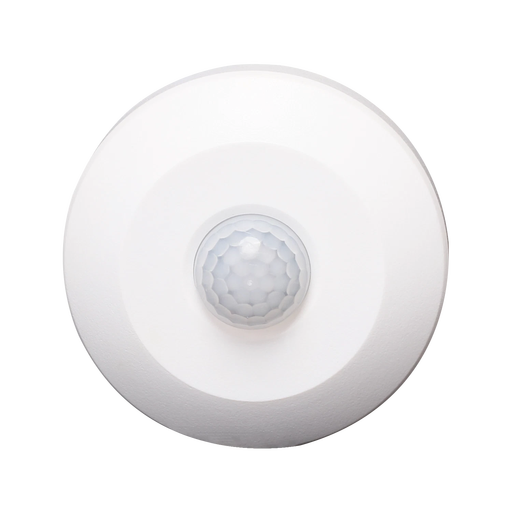
Why this product fits the profile: For hallways, staircases, entrances or other indoor areas where a fixed sensor needs to cover multiple directions.
Light sensitivity and hold-on time are adjustable according to the product data, so you can tailor the switching behaviour to the room.
360-degree detection, 10 seconds to 7 minutes delay, and operates on 220–240 V.
We’ve put together a full, regularly updated list of products that meet these strict selection criteria and comply with EU safety regulations.
Mount the sensor so that the path you want to cover runs through the detection area. Avoid placing it near radiators, air vents or strong sunlight, as these can cause false triggers. Then adjust the brightness threshold and hold-on time, and test the behaviour under both daylight and artificial light.
The actual lifespan depends on the LED module, electronics, operating time and ambient temperature. Without specific manufacturer data, it’s not possible to give a reliable general figure. For rechargeable or battery models, you also need to consider charge cycles or battery consumption.
Power consumption depends on the wattage, how long the light stays on and how often it’s triggered. A model with a short hold-on time and a dusk sensor can reduce unnecessary activations. With a 1 W night light, the power draw during operation is low according to the product specs; for wired sensors, the consumption of the connected lamp also matters.