Joybuy Insights

Motion Sensor Night Light: 2026 Buyer's Guide to Avoiding Common Mistakes

An automatic night light provides safety and comfort, eliminating the need to fumble for a light switch in the dark. However, not every model lives up to its promise. Many buyers get frustrated with unreliable sensors, glaring light, or an impractical power source. This guide will show you which technical features to look for to make an informed decision and avoid a bad investment.

The 3 Most Common Mistakes When Buying Night Lights

Before you decide on a model, you should be aware of the common pitfalls that often only become apparent in everyday use.

  1. Unreliable Sensors: A common issue is a motion detector that either fails to trigger, triggers too late, or activates with the slightest movement. This leads to either frustration in the dark or unnecessary power consumption. A good sensor should have a precise range, a defined detection angle, and only activate in the dark (measured in LUX).
  2. Incorrect Brightness and Light Colour: A night light should provide guidance, not glare. Many basic models are too bright and disrupt sleep, especially in a child's room. Others are so dim that they are unsuitable as an orientation light. A dimmable night light with adjustable colour temperature (measured in Kelvin) is the more flexible solution here.
  3. Unsuitable Power Source: A plug-in night light is maintenance-free but may block a valuable socket and is fixed in one location. A battery-powered night light offers maximum flexibility for use as stair lighting with a motion sensor or as closet lighting with a sensor, but it requires regular recharging. The choice depends entirely on the intended location.

Crucial Selection Criteria

To avoid the problems mentioned above, you should check the following technical parameters before buying.

Power Source: Battery or Plug-In?

The choice of power source is fundamental and determines the night light's flexibility.

  • Battery-Powered Night Light: These models are charged via USB and can be placed anywhere—on walls, under beds, in closets, or on stairs. They are ideal for places without a nearby socket. Pay attention to the battery capacity (specified in mAh) and the operating time in sensor mode. Models with 500 mAh or more often provide weeks of operation before a recharge is needed.
  • Plug-In Night Light: This variant is a "plug-and-forget" solution. It is ideal for hallways, bathrooms, or kitchens where permanent, maintenance-free lighting is desired. Check the form factor to ensure the light does not block adjacent sockets.

Sensor Technology: Range and Sensitivity

A high-quality automatic night light combines two types of sensors:

  • PIR (Passive Infrared) Motion Sensor: This sensor detects heat radiation from moving bodies. Key metrics are the range (typically 3–5 metres) and the detection angle (often 120 degrees). A longer range is useful for a long hallway, while less is often sufficient in a child's room.
  • Dusk-to-Dawn Sensor: This sensor ensures that the light only turns on in the dark (e.g., at an ambient brightness of ≤20 LUX). This saves energy and prevents the light from being activated unnecessarily during the day.

Light Quality: Dimmability and Colour Temperature

The quality of the light has a direct impact on well-being and sleep quality.

  • Dimmability: A dimmable night light allows you to adjust the brightness to the environment and personal preference. A low brightness is sufficient in the bedroom, while more light is required on a staircase for safety.
  • Colour Temperature: Measured in Kelvin (K), it describes the colour of the light.
    • Warm White (approx. 2700–3200 K): Creates a cosy, calming atmosphere. Ideal for bedrooms and children's rooms, as it interferes less with the production of the sleep hormone melatonin.
    • Cool White (approx. 5000–6500 K): Has an activating effect and ensures clear visibility. Well-suited for hallways, basements, or as stair lighting with a motion sensor, where clear orientation is the priority.

Our Top Picks for Different Use Cases in 2026

Here are some recommendations tailored to specific needs and scenarios.
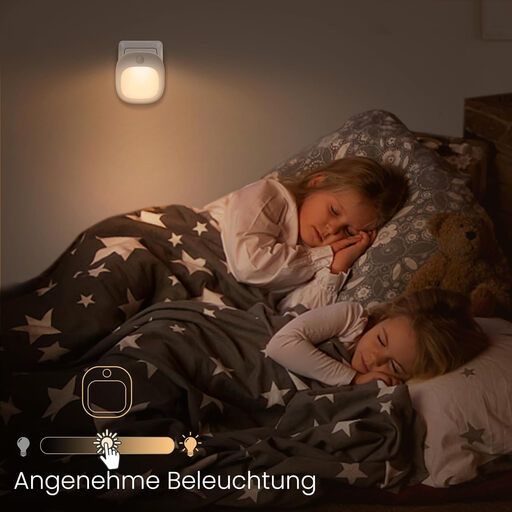
MATCH FOR: The Flexible All-Rounder
2er Pack Wiederaufladbares Nachtlicht mit Bewegungserfassung, 3 Farbtemperaturen 5-stufige Dimmung, SMD LED 0,5W 5V-1A ABS+Metall für Schlafzimmer Babyzimmer

2-Pack Rechargeable Motion-Sensing Night Light

Why This Fits Their Persona: Ideal for users looking for a flexible and customisable solution for various rooms. The battery operation allows for use on stairs, in closets, or in hallways without a socket. The 2-pack offers great value for money for outfitting multiple areas.

How It Avoids the Trap

Thanks to 5-level dimming and 3 selectable colour temperatures, it solves the problem of glaring or unsuitable light. The battery makes you independent of fixed sockets.

Key Advantage & Pros

Battery-powered (500mAh) for flexible placement and USB charging. A precise sensor with a 3-5m range that only activates in the dark (≤20 LUX).

MATCH FOR: Parents of Young Children
Cloud B Tranquil Turtle Nightlight with Music, rechargeable, Aqua Underwater projections, 4 soothing sounds, Adjustable brightness, Timer, Cry sensor, recycled fabric

Cloud B Tranquil Turtle Nightlight with Music

Why This Fits Their Persona: Specifically designed for a child's room to create a soothing sleep environment. It combines light, projection, and sounds, and automatically responds to the child thanks to the cry sensor.

How It Avoids the Trap

Instead of a simple, potentially disruptive light, this model projects gentle underwater waves. The integrated cry sensor offers smart automation that goes beyond a simple motion detector.

Key Advantage & Pros

Multifunctional: Light projection, 4 soothing sound options, and an adjustable cry sensor. USB-C rechargeable and made from recycled materials.
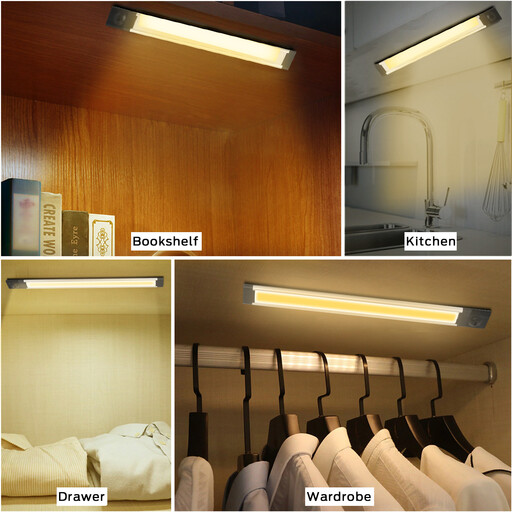
MATCH FOR: Users Needing High Brightness
Motion sensor night light, 36 Epistar 4014 SMD LEDs, 400 lumens, Clap control, USB rechargeable, Suitable for bedroom/baby room/closet

Motion Sensor Night Light, 36 Epistar 4014 SMD LEDs

Why This Fits Their Persona: Perfect for areas that require bright and reliable illumination, such as stairwells, garages, workshops, or long hallways. The high brightness ensures maximum safety and visibility.

How It Avoids the Trap

This model solves the problem of lights that are too dim with a luminous flux of 400 lumens. Gesture control and stepless dimming offer more precise control than simple switches.

Key Advantage & Pros

High brightness (400 Lm) and adjustable colour temperature (2800K-6500K). Robust aluminium housing and flexible mounting via magnetic holder or hook.

Looking for More Options?

We've compiled a complete, up-to-date list of products that fully meet these strict selection criteria and safety standards.

Frequently Asked Questions (FAQ)

1. How long does the battery last on a motion sensor night light?

The battery life depends on the battery's capacity (in mAh) and the frequency of activation. With average use (approx. 8–10 activations per night), a model with a 500 mAh battery can last for several weeks to months. In continuous-on mode, the runtime is significantly shorter, often only a few hours.

2. Can you adjust the sensitivity of the motion detector?

On most standard models, the sensor's sensitivity is fixed. However, higher-quality models sometimes offer modes with different sensitivities or ranges. Reliable performance primarily depends on the quality of the built-in PIR sensor and the dusk-to-dawn sensor.

3. What light colour is suitable for a night light in a bedroom or child's room?

For sleeping areas, a warm white light colour (approx. 2700–3200 K) is recommended. This reddish-yellow light interferes less with the production of the sleep hormone melatonin than cool white light and promotes a relaxed atmosphere. A dimmable light also allows you to reduce the brightness to a minimum.