
Lieferung heute & morgen

Qualitätsgarantie

Willkommens-Angebote freischalten: KOSTENLOSE Lieferung | Bis zu 80 % RABATT | Kostenlose 30-Tage-JoyPlus-Testphase
App herunterladen
A well-placed night light provides safety and comfort in the dark. Whether for a late-night trip to the bathroom, as a gentle light in a child's room, or for fall prevention for seniors, an automatic light is a practical aid. However, the market is flooded with models whose flaws often only become apparent in daily use. Before you make a decision, it's crucial to understand the most common pitfalls to avoid a poor investment.
This guide will help you identify the key features and find the right model for your needs.
Many products promise more than they deliver. Pay close attention to these three points to avoid disappointment:
To avoid these problems, you should carefully examine three technical aspects. These determine whether a night light will truly be helpful in your daily life.
Automation is the core feature of a good night light. There are two main types of sensors:
A combination of both sensors is the most practical solution for most use cases. The light will only turn on when it is dark AND motion is detected.
The choice of power supply depends on where you plan to use it:
The quality of the light is crucial for comfort.
Here are some recommendations tailored to specific use cases that address the pitfalls mentioned.

Why it's a great fit: The friendly sloth design can help ease a child's fear of the dark. The soft silicone material is safe, and the warm yellow light creates a calming atmosphere. Thanks to its rechargeable battery, it can be flexibly placed on a nightstand or dresser.
It avoids the "blinding light" trap with its 3-level dimmable, warm yellow light that won't disturb sleep. The rechargeable battery eliminates the need for constant battery replacements.
Rechargeable via USB-C; 3-level touch-controlled brightness adjustment; child-safe, soft silicone material.

Why it's a great fit: As a classic orientation light for high-traffic areas, this plug-in model is ideal. It's always ready to go and provides automated, energy-efficient lighting with its dual sensor (motion + dusk-to-dawn) to help prevent falls.
It directly addresses the "unreliable sensor" pitfall with a combined motion and dusk-to-dawn sensor. With 5 dimmable levels, the brightness can also be precisely adjusted to prevent glare.
Combined motion and dusk-to-dawn sensor; 5 brightness levels for precise adjustment; very low power consumption of 0.5 W.
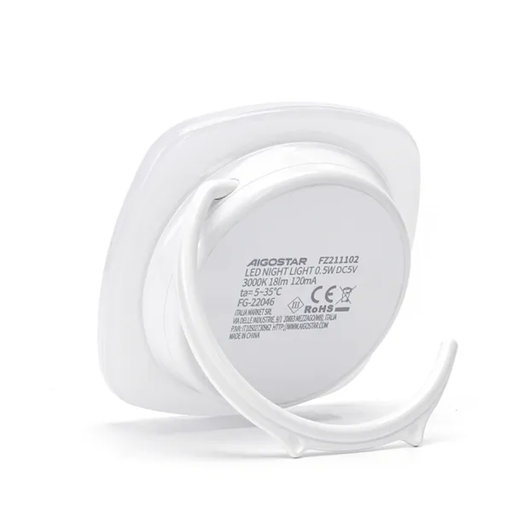
Why it's a great fit: Perfect for places without an outlet, such as wardrobes, basement stairs, or storage rooms. The USB-rechargeable battery and hook design allow for maximum placement flexibility.
This rechargeable night light solves the problem of inflexible installation. Unlike a fixed plug-in night light, it can be placed wherever light is temporarily needed, without relying on a power source.
USB-rechargeable for cordless operation; versatile mounting options (hook/adhesive); compact and unobtrusive design.
We have compiled a complete, up-to-date list of products that fully meet these strict selection criteria and rigorous safety standards.
Most modern LED night lights are extremely energy-efficient. Models with motion sensors often have a power consumption of just 0.5 to 1 watt. Even with daily activation, the annual electricity costs typically amount to less than a couple of dollars or euros. This makes them a very cost-effective solution.
The optimal placement depends on the room. In hallways and on stairs, mounting it at knee or shin height is recommended. This illuminates the floor without shining directly into your eyes. In the bedroom, the light should be positioned so that it isn't accidentally triggered by movements in bed. Ensure the sensor is not obstructed by furniture or curtains.
Many newer models are designed as dimmable LED night lights. This feature is highly recommended as it allows for flexible adjustment of the light intensity. For a child's room night light, a very low brightness level can be selected, while a slightly higher level provides more safety on a staircase. Check the product description for features like "stepless dimming" or "multiple brightness levels."