
Lieferung heute & morgen

Qualitätsgarantie

Willkommens-Angebote freischalten: KOSTENLOSE Lieferung | Bis zu 80 % RABATT | Kostenlose 30-Tage-JoyPlus-Testphase
App herunterladen
A motion-sensor night light promises comfort and safety by illuminating only when truly needed. In practice, however, many models prove unreliable. They react too sensitively, shine too brightly, or their batteries are constantly drained. The result is often frustration instead of relief. Before making a decision, it's crucial to understand the most common pitfalls to avoid a poor investment.
This guide highlights the critical technical features to look for, helping you find a lighting solution that is precisely tailored to your needs—whether for a child's room, a hallway, or as atmospheric accent lighting.
Many products on the market advertise long feature lists, but the devil is often in the details. These three weaknesses most frequently lead to buyer dissatisfaction:
To avoid the problems mentioned above, you should check three core parameters before buying. These determine the functionality and practical use in everyday life.
The quality of the sensors is crucial for reliable operation. Pay attention to the following specifications:
The choice of power source depends on the location and your personal preferences.
The right light ambiance protects your eyes and promotes restful sleep.
Based on the criteria above, we have identified some products that are well-suited for specific user profiles and their requirements.

Why This Fits Their Persona: This user group needs reliable, flexible, and above all, safe lighting for hallways, stairs, and children's rooms. The wireless placement and adjustable light ambiance are key advantages here.
The integrated 500mAh battery avoids constant recharging. With 3 colour temperatures and 5 dimming levels, the light can be precisely adjusted to prevent glare at night—a common problem with rigid models.
Advantage: High flexibility thanks to battery operation and USB charging. The 2-pack allows you to equip multiple areas. The sensor operates with a detection range of 3-5 metres only in darkness (≤20 LUX).
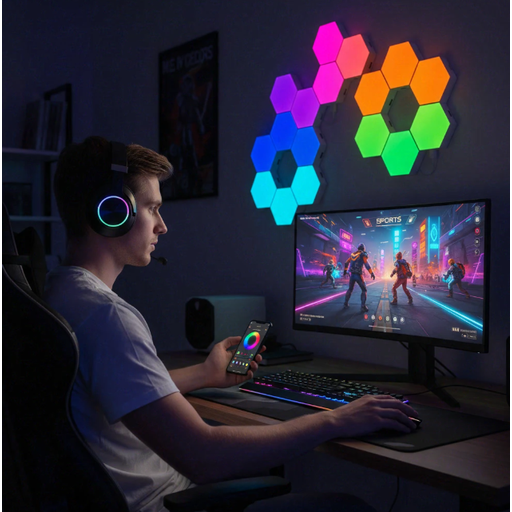
Why This Fits Their Persona: These users aren't just looking for functional lighting, but a decorative element to create an immersive atmosphere. Customisation, RGB colours, and smart features like music sync are the priority.
Instead of a rigid, functional light, these modular wall-mounted LED panels offer unlimited design possibilities. They avoid the trap of a boring design and provide full control over colour and effects via an app and remote control.
Advantage: Fully customisable gaming room lighting. The panels can be connected in any pattern and sync with music, creating a dynamic light show.

Why This Fits Their Persona: These users need targeted, straightforward lighting for niche areas like wardrobes, kitchenettes, or storage rooms. Simple, drill-free installation and on-demand activation are crucial here.
This model solves the problem of inflexible installation. Thanks to its ultra-thin design and magnetic mounting, it can be installed in tight spaces without tools. The 1100mAh battery ensures a long runtime.
Advantage: Targeted and bright LED cabinet lighting with three selectable colour temperatures. The PIR sensor reliably activates the light when a door is opened or on approach, making it very energy-efficient.
We have compiled a complete, up-to-date list of products that fully meet these strict selection criteria and comply with safety regulations.
Battery life depends heavily on the capacity (measured in mAh) and frequency of use. A model with 500 mAh can last for several weeks or even months in sensor-only mode, where it activates only a few times per night. In continuous-on mode, the runtime is significantly shorter. Models with 1100 mAh or more, often found in cabinet lights, offer even longer usage between charges.
Yes, it's possible. Most PIR sensors react to the infrared radiation (body heat) of moving objects. If a dog or cat passes through the detection area, it can activate the light. To minimise false triggers, the night light can be positioned slightly higher (e.g., at hip height instead of near the floor) so that it primarily reacts to human movement.
For optimal performance, the light should be placed so that the sensor effectively covers the area to be monitored. In a hallway, a central position on the wall is ideal. On a stairwell, mounting it at the top or bottom of the stairs is recommended to illuminate the steps in time. Avoid placing it directly opposite heat sources like radiators or windows with direct sunlight, as this can interfere with the PIR sensor's function.