
Lieferung heute & morgen

Qualitätsgarantie

Willkommens-Angebote freischalten: KOSTENLOSE Lieferung | Bis zu 80 % RABATT | Kostenlose 30-Tage-JoyPlus-Testphase
App herunterladen
A late-night trip to the bathroom, soothing a baby, or just heading to the fridge—too often, these moments end with fumbling for a light switch in the dark or being jolted by the harsh, unpleasant glare of a ceiling light. A motion sensor night light promises a simple solution. However, the market is flooded with models whose practical utility varies greatly. Many buyers discover only after a short time that their new guide light is more of a nuisance than a help.
This guide highlights the three most common pitfalls when buying a motion sensor night light and explains which technical features you should look for to find a reliable and comfortable lighting solution for your home.
Before choosing a model, you should be aware of the typical weaknesses that can render a seemingly practical product useless.
plug-in guide light is maintenance-free but useless if there's no power outlet in the desired location—such as the middle of a long hallway or on a staircase. A rechargeable LED night light is flexible but may require frequent recharging if used in high-traffic areas.To avoid these mistakes, you should carefully examine three core technical parameters. These determine whether a night light will truly be helpful in your daily life.
A good night light combines two types of sensors:
stair light with a sensor, a wide angle is important to detect movement from above and below early on.The decision depends entirely on the location:
children's room night light, the bathroom, or the hallway, provided a free outlet is available. The energy consumption is extremely low, often under 0.5 watts.The quality of the light is crucial for comfort.
dimmable night lamp is essential. It allows you to adjust the brightness to the surroundings and the specific task. A gentle glow is sufficient for orientation in the bedroom, while more brightness might be needed temporarily for a nursing light during nighttime changes.Based on the criteria mentioned, we have identified a few models that are well-suited for specific application profiles.

Why This Fits Their Persona: Ideal for users seeking a simple and reliable solution for hallways or children's rooms. Just plug it in, select the brightness, and the integrated dusk-to-dawn sensor does the rest.
Avoids the problem of incorrect brightness with three adjustable levels. The dusk-to-dawn sensor also prevents unnecessary operation during the day.
Very low power consumption (0.5 W) and maintenance-free operation. The slim design doesn't block adjacent outlets.

Why This Fits Their Persona: Perfect for users who need customisable lighting without being tied to an outlet. Suitable as a nursing light, for closets, or for stair sections without a power source.
Solves the problem of a mismatched power source with its integrated 500 mAh battery. With 3 colour temperatures and 5 dimming levels, glare is avoided.
High adaptability through battery operation, various light colours, and brightness levels. The compact design allows for discreet placement.
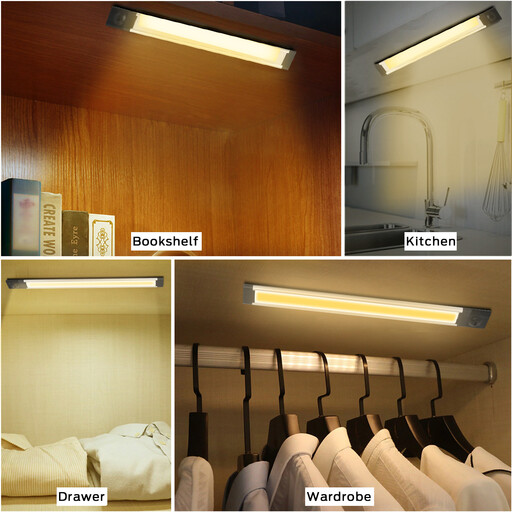
Why This Fits Their Persona: For users who need bright and even illumination for larger areas like stairwells, garages, or long hallways where a small point of light is not enough.
Fixes the problem of insufficient brightness with a luminous flux of 400 lumens. The gesture control for dimming offers intuitive operation without fixed steps.
Flexible installation via magnetic mount and hook without drilling. The wide light bar ensures very uniform illumination.
We have compiled a complete, up-to-date list of products that fully meet these strict selection criteria and safety regulations.
The battery life heavily depends on the frequency of use and the set brightness level. In pure sensor mode, where the light is activated only a few times per night for short periods, many models can last several weeks or even months on a single charge. With continuous use or very frequent activation, the runtime shortens accordingly. Most manufacturers specify the runtime for sensor mode, which often amounts to up to 10 hours of pure illumination time.
For optimal performance, a stair light with a sensor should be mounted in the lower third of the wall, around knee or calf height. This has two advantages: First, the sensor detects the movement of your legs early as you approach the stairs. Second, the light shines directly onto the steps and doesn't cause glare, as it is below eye level.
No, modern LED night lights are extremely energy-efficient. A typical plug-in guide light has a power consumption of 0.3 to 1 watt. Even with continuous operation over an entire year, the electricity costs would only amount to a few dollars. Models with a dusk-to-dawn sensor are even more economical, as they are only active in the dark.