
Lieferung heute & morgen

Qualitätsgarantie

Willkommens-Angebote freischalten: KOSTENLOSE Lieferung | Bis zu 80 % RABATT | Kostenlose 30-Tage-JoyPlus-Testphase
App herunterladen
A good motion-sensor night light provides safety and comfort without disturbing your sleep. However, the market is flooded with models whose flaws only become apparent in daily use. Incorrect brightness, unreliable sensors, or the wrong light colour are common reasons for a bad purchase. This guide will help you identify the crucial features and make an informed choice.
Many products promise more than they deliver. Watch out for these three typical shortcomings to avoid disappointment:
To avoid the problems mentioned above, you should check three core technical features before buying. These define the quality and real-world usability of a night light.
Light quality is the most important criterion for a sleep-friendly environment. Two values are crucial here:
The reliability of the automatic light depends on the sensor. Pay attention to the following specifications:
The most common and practical option is the plug-in night light with a motion sensor. It simply plugs into a free socket and is ready to use immediately. Look for a compact design to avoid blocking adjacent sockets. For areas without a power outlet, like closets or certain sections of stairs, battery-powered alternatives are available. Those looking to equip multiple areas will often benefit from a motion sensor light 2-pack, which offers a cost-effective solution.
Based on the criteria above, we have identified some products that are suitable for different user profiles and use cases.
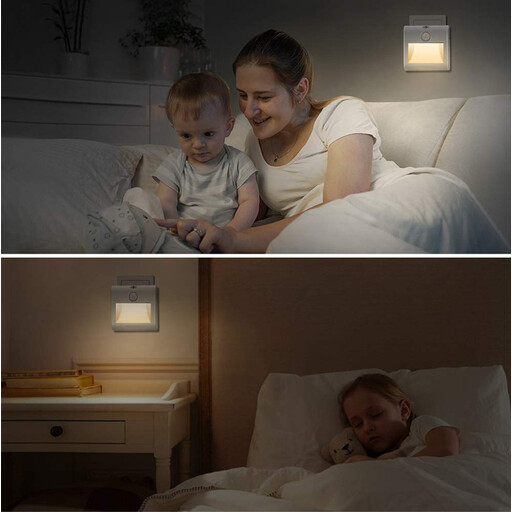
Why This Fits Their Persona: Ideal for parents or seniors who need to safely illuminate multiple areas like children's rooms, hallways, and bathrooms. The set provides a uniform and cost-effective solution for the entire home.
The stepless touch dimming solves the problem of fixed brightness. Its 4000-4500K light colour is a neutral warm white that provides guidance without being glaring or significantly disrupting sleep.
Stepless dimming with a memory function and the practical motion sensor light 2-pack offer excellent value for money.

Why This Fits Their Persona: For anyone seeking a light source for their nightstand or bookshelf that is both functional and aesthetically pleasing. It replaces a purely functional light with a decorative element.
The 4-level touch dimming provides control over brightness. The 3000K warm white light colour is ideal for a relaxing bedroom atmosphere and avoids sleep-disrupting blue light.
Combines elegant design with practical functionality through multi-level dimming and a memory function. Not just a night light, but a complete bedside lamp.

Why This Fits Their Persona: Perfect for illuminating areas without a power socket, such as stair railings, bed frames, or closets. The battery operation allows for flexible and creative placement.
Even without a motion sensor, these string lights provide controlled, gentle illumination that isn't perceived as disruptive, thanks to 8 different modes and a warm white light colour (3000K).
Maximum flexibility due to battery operation and an 8-metre length. The 8 lighting modes with a memory function allow for a customised ambiance.
We have compiled a complete, real-time list of products that fully satisfy these strict selection criteria and UK safety regulations.
Power consumption is extremely low. A typical LED night light has a power draw of about 0.5 to 1 watt. Since it is only active for a few minutes per night thanks to the motion and dusk-to-dawn sensors, the annual electricity costs are minimal, typically amounting to less than one euro.
For a child's room night light, a warm white light colour with a colour temperature below 3000 Kelvin is recommended. Light with a low blue light component and a warm, amber, or reddish hue is least disruptive to the production of the sleep hormone melatonin and promotes restful sleep.
Install the plug-in night light with a motion sensor at a height of about 30 to 60 cm above the floor. In this position, the sensor reliably detects leg and foot movement without activating with every small motion in bed. Ideal locations include sockets in the hallway, on a stair landing, or in the bathroom.