
Lieferung heute & morgen

Qualitätsgarantie

Willkommens-Angebote freischalten: KOSTENLOSE Lieferung | Bis zu 80 % RABATT | Kostenlose 30-Tage-JoyPlus-Testphase
App herunterladen
A night light with motion sensor can make it easier to find your way around the home at night without leaving the ceiling lights switched on. However, not every model is equally suitable for families with children, people who need help finding their way at night or poorly lit hallways. The key factors are the sensors, brightness, power supply and intended mounting location.
A PIR night light responds to movement, usually by detecting heat radiation. A dusk sensor, on the other hand, measures the ambient light level. Many plug-in night lights combine both functions: they only switch on when it is dark and movement is detected. A motion-only sensor can activate during the day, while a light-only sensor stays on continuously as soon as the room becomes dark.
That is why you should check the specific details for the activation threshold, detection angle, range and switch-off time. The GRIFEMA model has a stated range of up to 3 metres at 120° and switches off after 60 seconds without movement.
A night light for a bedroom or children’s room should provide enough light to find your way around, but it does not necessarily need to illuminate the entire room. Lumen ratings help you assess this: 20 lm is more suitable for short routes and orientation, while 400 lm can already illuminate a much larger area and is better suited to cupboards, work areas or staircases.
A dimming function is useful if you want to use a light in several locations. It is important to check whether the brightness can be adjusted in steps or continuously, and whether the setting is retained.
A plug-in night light is ready to use straight away, but it requires an available wall socket. A cordless night light can be mounted more flexibly on cupboards, shelves or in hallways, but it must be recharged regularly. With rechargeable models, you should check the battery capacity, charging port and mounting method.
For permanent lighting in a hallway, mains operation is usually more straightforward. For a motion-sensor cupboard light or a kitchen unit, a USB-rechargeable model may be more practical.
Check the distance from which the sensor detects movement and the angle at which it operates. A detection range of 3 to 5 metres may be sufficient for a short hallway. For staircases or longer passages, position the light so that the sensor detects movement as early as possible.
The switch-on conditions are also important. Some models specify a threshold of 20 lux. This means that the automatic function only becomes active when the ambient light level is relatively low. In a bright bathroom, the light may therefore remain switched off despite movement.
A warm white night light is often in the region of 2700 to 3000 Kelvin. It appears less bright in a room than neutral or cool white light with the same lumen rating. Some products offer several colour temperatures, such as warm white, natural white and cool white. This is practical if you want to use the same light at night and for tasks at a cupboard.
The CRI or Ra rating describes colour rendering. A value of Ra ≥ 80 is stated for the products listed; higher values can make colours appear more natural, but on their own they say nothing about sensor quality or service life.
For plug-in models, the socket must be suitable for the specified voltage range and must not be damaged. Models with IP20 are intended exclusively for dry indoor areas. A night light for the bathroom should therefore not be mounted where it may be exposed to splashing water.
For adhesive mounting, the surface must be clean, dry and suitable for supporting the light. An ultra-thin model can be attached to the inside of a cupboard, but it should not fall down or obstruct the sensor. Before cleaning, unplug the model from the mains; surfaces should be wiped with a soft, dry cloth.

Why this product suits this profile: This plug-in night light requires no batteries and offers five brightness levels from 20% to 100%. It is suitable for children’s rooms, hallways, staircases or indoor bathrooms.
The combination of motion and dusk sensors prevents the light from switching on unnecessarily when there is sufficient ambient light. According to the product details, it switches off automatically after 60 seconds without movement.
0.5 W power consumption, 2700 K warm white light, 3 m range and a 120° detection angle.
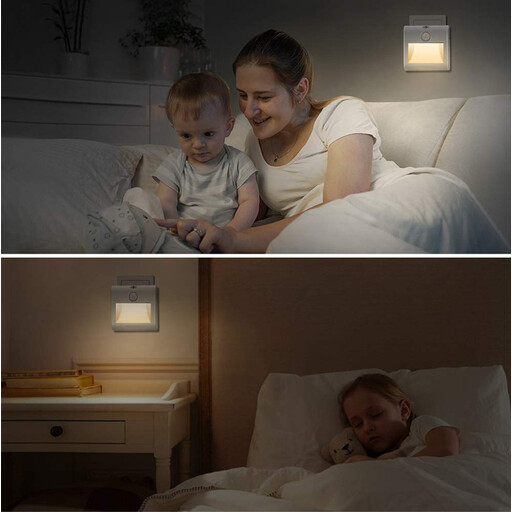
Why this product suits this profile: The two lights can be used separately in bedrooms, toilets, hallways or children’s rooms. Switching between continuous lighting and sensor mode allows for flexible use.
The brightness can be adjusted continuously using touch controls. According to the product description, a memory function retains the last selected setting.
1 W power consumption, 20 lm, 100–240 V and a stated sensor activation level of no more than 20 lux, with a range of 3–5 m.

Why this product suits this profile: The two cordless lights are designed for cupboards, kitchen units, shelves and short hallways. They can be attached with adhesive tape without drilling.
PIR detection prevents the lamp from staying on continuously. Before buying, you should still check whether the stated range of 3–5 m is suitable for the installation location.
800 mAh battery, USB charging, 21 LEDs and three colour temperatures ranging from 2800–3200 K to 6500–7000 K.
We have put together a complete, regularly updated list of products that fully meet these strict selection criteria and the safety regulations applicable in the EU.
Mount or plug in the light so that the sensor detects the route you usually take. In a hallway, it should not be positioned directly behind a door or piece of furniture. With adhesive models, the surface must be dry and clean. Then test the position in the dark and check whether the light responds early enough.
The service life depends on the LED technology, electronics, operating time and heat dissipation. With plug-in models, there is no need to replace batteries regularly. Rechargeable night lights, on the other hand, require care and repeated charging cycles depending on how they are used and the condition of the battery. Without specific information from the manufacturer, it is not possible to give a reliable general service-life estimate.
According to the product details, the selected models have a power consumption of between 0.3 W and 1 W. Sensor operation can limit how long the light stays on, whereas a continuous light will use electricity for correspondingly longer. For a realistic assessment, you should consider power consumption, daily operating time and your electricity tariff together.