
Lieferung heute & morgen

Qualitätsgarantie

Willkommens-Angebote freischalten: KOSTENLOSE Lieferung | Bis zu 80 % RABATT | Kostenlose 30-Tage-JoyPlus-Testphase
App herunterladen
A motion sensor night light is designed to guide you in the dark without staying on permanently. In practice, however, unclear product specifications, awkward installation or an unsuitable power supply can quickly lead to a poor purchase. This applies just as much to an LED night light with sensor in a child’s bedroom as it does to a sensor light for a cupboard, staircase or bathroom.
As Joybuy’s Product Recommendation Officer, I’ll give you a balanced overview of the key buying criteria and show you which models suit different home situations.
A long detection range sounds practical at first. But in a narrow hallway, an overly sensitive PIR sensor can pick up movement from adjacent areas. For cupboards, shelves or the area around a bed, 3 to 5 metres of detection range is often sufficient. For a longer hallway, a wider detection angle may be more useful.
It’s also important to check whether the sensor only works in the dark. An integrated dusk sensor prevents the light from activating when there’s enough daylight.
The word “bright” doesn’t tell you much. Instead, check the lumens, Kelvin and, where relevant, the colour rendering index (Ra/CRI) . A night light for a child’s room or bedroom doesn’t need to deliver the same light output as an LED cupboard light for work surfaces.
A rechargeable battery night light is flexible, but it needs regular charging. With an under-cabinet light with motion sensor, you should also check that the charging port remains accessible after installation. A plug-in night light, on the other hand, doesn’t need a battery and is ready to use straight away, but it does take up a socket.
The fixing method also deserves attention: adhesive strips work well on smooth, clean surfaces, while magnetic mounts can make it easier to remove the light later. In damp rooms, only use products whose IP rating and usage instructions are suitable for the intended environment. The models featured here are, according to their product details, intended for indoor use; water and high humidity should be avoided unless explicitly stated otherwise.
A PIR sensor detects changes in infrared radiation caused by moving people. This is the typical technology used in a PIR sensor light. Look out for:
A model with a range of 3 to 5 metres often works well for a bed, cupboard or short hallway. For a larger area, a light with a range of up to 7 metres may be more suitable.
For simple orientation, a few lumens are often enough. A light with a higher lumen output, however, can be suitable for cupboard compartments or work surfaces. Multiple colour temperatures increase flexibility, but they don’t replace checking the actual installation position.
When choosing for children’s rooms and bedrooms, a low brightness level and a short afterglow time are also practical. For stairs and hallways, the light should make the path clearly visible without spilling unnecessarily into adjacent rooms.
With a USB rechargeable night light, the battery capacity, charging port and charging source all need to match. The stated battery values aren’t a blanket guarantee of runtime, because how often you use the light and at what brightness level will affect consumption.
A 2-pack can be useful if you want to light up, for example, two cupboard areas, a bedroom and hallway, or multiple floors. For a single socket, a compact single unit is often the more suitable choice.
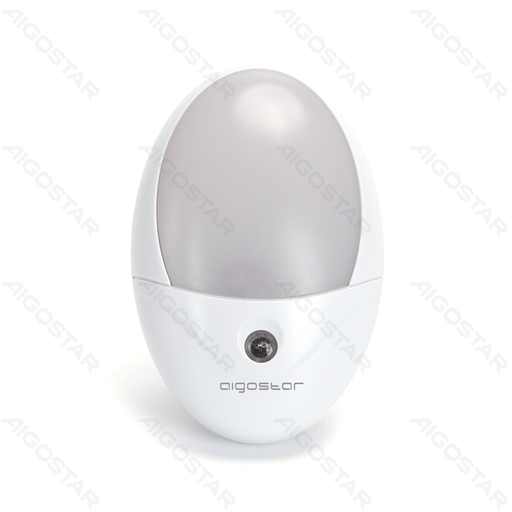
Why this product suits the profile: This plug-in model is ideal for buyers who don’t want to charge batteries or carry out any installation. It delivers 3000 K warm white light, 20 lm and a stated PIR range of 7 metres.
Powering via the socket means you’ll never forget to charge it. The stated 20 lm and 3000 K make the light output easier to assess than a vague description like “soft”.
Plug-and-play operation, 1 W power consumption and a PIR sensor with a stated 120° angle.
Why this product suits the profile: This model is aimed at users who want to adjust brightness, colour temperature and installation flexibly – for example, in the bedroom, on the stairs or in a wardrobe.
The technical specs state 400 lm, a range of 2800 to 6500 K and stepless dimming. This makes it much easier to assess the lighting.
Magnetic mount and hanging hook – no drilling required; gesture control with dimming function.

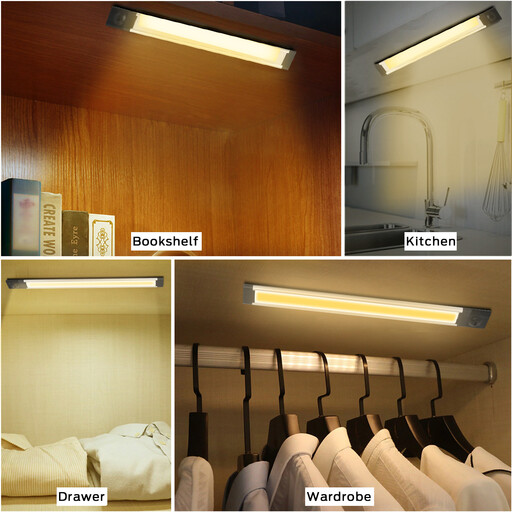
Why this product suits the profile: These two slim lights are ideal for kitchen under-cabinets, inside cupboards and on shelves when you need to light up several areas without fixed wiring.
The product data gives dimensions of 300 × 38 × 10 mm, a PIR range of 3 to 5 metres and a USB charging function. This makes planning for tight installation spots much easier.
41 LEDs, 1100 mAh battery, three colour temperatures and adhesive strip mounting – no drilling required.

Why this product suits the profile: This plug-in model is designed for children’s rooms, hallways, stairs and bedrooms, and offers five brightness levels for different rooms.
Brightness is adjustable in five steps from 20 to 100 per cent. According to the product details, the sensor works up to 3 metres and switches off after 60 seconds without movement.
2700 K warm white light, 0.5 W power consumption and no need to change batteries.
We’ve put together a full, regularly updated list of products that fully meet these strict selection criteria and the safety regulations in force in the EU.
Mount the light so that the sensor isn’t blocked by furniture, curtains or the light itself. For hallways and stairs, position it so that it covers the path of movement. If you’re using adhesive mounting, make sure the surface is dry, clean and smooth. Plug-in models must not be covered.
It’s impossible to give a fixed runtime without knowing how often you’ll use it. It depends on factors such as battery capacity, brightness level, how long the light stays on and how many times it’s triggered. When the brightness starts to fade, charge the battery. Damaged or swollen batteries must not be used.
Models with low power consumption and automatic shut-off can limit how long they’re on. A plug-in night light with, for example, 0.5 or 1 W only uses electricity while it’s actually lit. With battery-powered lights, the mains power consumption mainly occurs during charging. So the key factors are the stated power rating, the afterglow time and how you actually use the light.