
Lieferung heute & morgen

Qualitätsgarantie

Willkommens-Angebote freischalten: KOSTENLOSE Lieferung | Bis zu 80 % RABATT | Kostenlose 30-Tage-JoyPlus-Testphase
App herunterladen
An automatic light that illuminates your path when you get up at night or open a dark wardrobe—a motion sensor night light offers both convenience and safety. However, the market is flooded with models whose real-world performance often falls short of their promises. Faulty sensors, short battery life, or inadequate brightness can quickly lead to frustration.
As your Joybuy Product Recommendation Officer, I'll help you identify the key features that matter. This guide will show you what to look for to find a reliable and durable lighting solution and which three common product flaws you should avoid.
Many products advertise impressive features, but their weaknesses often become apparent in daily use. Pay close attention to these three points to avoid a bad purchase:
To make the right choice, you should check three core technical parameters. These determine the functionality and longevity of your night light.
The type of power supply is crucial for the location of use and the level of maintenance required.
A good motion sensor is the heart of the night light. Look for the following specifications:
The light itself should be pleasant and functional.
Here are some models tailored to specific needs that meet the quality criteria mentioned above.
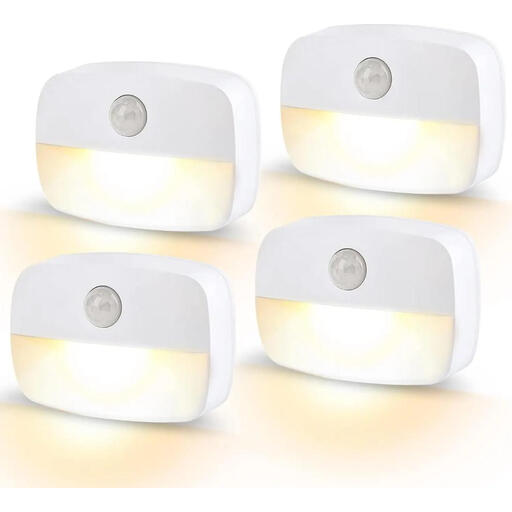
Why This Fits Their Persona: Ideal for renters and homeowners who want to easily equip multiple areas like hallways, stairs, and bathrooms. The battery operation allows for placement independent of outlets, and the 4-pack offers excellent value for money.
This set bypasses the problem of unstable mounting with a simple but effective adhesive installation that requires no drilling. The low power consumption of 0.5W per light conserves battery life.
Warm white light (3200K–2800K) with 35 lumens for glare-free orientation. The sensor detects motion within a range of up to 6 metres and a 120° angle.

Why This Fits Their Persona: Perfect for illuminating wardrobes, kitchen counters, or display cases. The ultra-slim design (10 mm) is discreet, and the three selectable colour temperatures adapt to any environment—from task lighting to ambient light.
This model solves the problem of short battery life with a powerful 1100 mAh rechargeable battery. The magnetic mount with an adhesive strip is more stable than a simple adhesive-only solution.
Three colour temperatures (warm, neutral, and cool white). High brightness from 41 LEDs and a long battery life. The 2-pack allows for flexible outfitting.

Why This Fits Their Persona: Specifically designed for parents and seniors looking for safe and simple nighttime lighting. The direct plug-in operation eliminates the need for battery changes, and the adjustable brightness is easy on the eyes in the dark.
This night light avoids the problem of unreliable sensors by combining a motion sensor with a dusk-to-dawn sensor. It only activates in darkness and with movement, preventing unnecessary operation.
Five adjustable brightness levels (20% to 100%). Maintenance-free operation directly from the wall outlet. The warm white light (2700 K) is particularly gentle on the eyes.
We have compiled a complete, up-to-date list of products that fully meet these strict selection criteria and German safety regulations.
The battery life depends on the capacity (in mAh), the frequency of activation, and the duration of illumination. A model with an 800 mAh battery can last for several weeks or even months on a single charge, assuming an average of 5–10 activations per night (each for 20 seconds). Models with a higher capacity (e.g., 1100 mAh) will extend this period accordingly.
For optimal performance, the light should be mounted at knee or hip height, as PIR sensors respond best to movement across the sensor's axis. Avoid installing it directly opposite heat sources like radiators or windows with direct sunlight to prevent false triggers. In hallways, a good placement is one that illuminates the path to the bathroom or stairs.
Most of the models presented here are designed exclusively for indoor use and typically have an IP20 protection rating. This means they are not protected against water. For outdoor use, on balconies, or in damp basements, you should specifically look for products with a higher protection rating, such as IP44 or higher, which are protected against splashing water.