
Lieferung heute & morgen

Qualitätsgarantie

Willkommens-Angebote freischalten: KOSTENLOSE Lieferung | Bis zu 80 % RABATT | Kostenlose 30-Tage-JoyPlus-Testphase
App herunterladen
By the Joybuy Product Recommendation Officer, August 29, 2026
A good guide light provides safety in the dark, whether for a nightly trip to the bathroom, a soothing presence in a child's room, or for fall prevention on the stairs. However, the market is flooded with models whose practical utility often falls short of their marketing promises. Many users only realise after purchase that the light is too harsh, the sensor is unreliable, or the installation is impractical.
This guide highlights the three most common pitfalls when buying a motion-sensor night light and explains which technical features you should look for to make an informed decision.
Before making a purchase, you should be aware of these common problems that can severely limit a night light's usefulness.
To avoid the problems mentioned above, you should check three core technical parameters. These are crucial in determining the functionality and comfort of your night light.
A high-quality motion-sensor night light typically combines two types of sensors:
The combination of both sensors ensures fully automatic and efficient operation: the light only activates when it is dark and motion is detected.
Light quality is critical for nighttime comfort.
The choice of power source depends on the intended location.
Here are some recommendations tailored to specific user profiles that meet the criteria mentioned above.

Why This Fits Their Persona: Ideal for parents seeking safe, gentle, and child-friendly lighting. The soft silicone material is harmless, and the cute design appeals to children. Being rechargeable means there are no cables within the child's reach.
Avoids the "too bright light" trap with 3-level dimming and warm yellow light. The "inflexible installation" issue is solved by its wireless, rechargeable design.
Combines safe silicone material, a child-friendly design, and rechargeable operation. The integrated 1200mAh battery offers a long runtime.
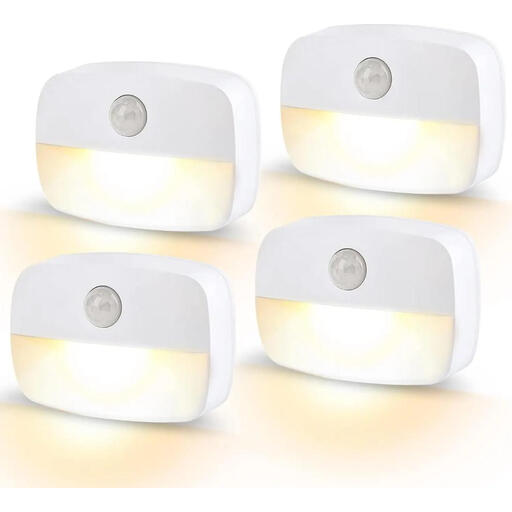
Why This Fits Their Persona: Perfect for homeowners and renters who want to illuminate multiple areas without existing outlets, such as hallways, stairs, closets, or the basement. The 4-pack offers an economical whole-house solution.
Completely solves the "inflexible installation" problem, as the lights are battery-powered and mount with an adhesive pad. The 120° detection angle sensor prevents sluggish reactions.
Tool-free installation and battery operation for maximum flexibility. The low power consumption of 0.5W ensures a long battery life.
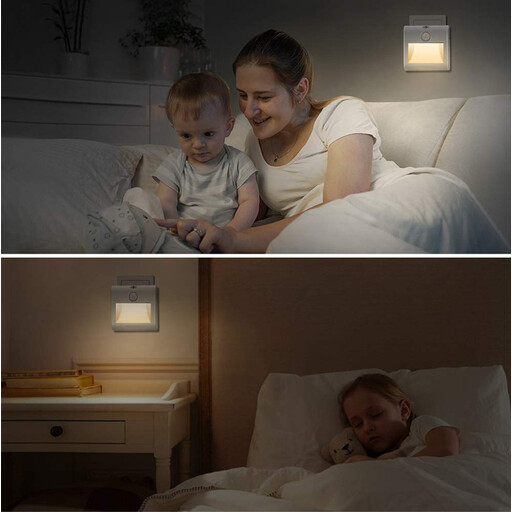
Why This Fits Their Persona: For users who value precise control and advanced features. The stepless touch dimming and memory function offer a high degree of customisation and convenience.
Counteracts the "too bright light" trap with a stepless dimming function. The memory function ensures the desired brightness level is retained. Two operating modes (Always-On/Sensor) offer flexibility.
Stepless touch dimming with a memory function for perfectly customised brightness. The set of 2 allows you to equip multiple rooms.
We have compiled a complete, up-to-date list of products that fully meet these strict selection criteria and German safety regulations.
The operating costs are extremely low. A modern LED night light with a power consumption of 0.5 watts, running for 8 hours daily, uses about 1.46 kilowatt-hours (kWh) per year. Assuming an electricity price of 35 cents per kWh, the annual electricity cost is around 51 cents.
The optimal location depends on its purpose. For stairs, low installation (approx. 20–30 cm above the steps) is recommended to directly illuminate the treads and avoid glare. In hallways, the sensor should cover the main path of travel. In a child's room, it's wise to position it so it doesn't point directly at the bed, to avoid disturbing sleep. Ensure the sensor has a clear "line of sight" to the area being monitored.
Colour temperature, measured in Kelvin (K), describes the colour of the light. Lower values represent warmer, yellowish-orange light, while higher values mean cooler, bluish light. For a soothing light or a general guide light, warm white light (approx. 2700 K to 3300 K) is recommended, as it is considered easy on the eyes and inhibits the production of the sleep hormone melatonin less.