
Lieferung heute & morgen

Qualitätsgarantie

Willkommens-Angebote freischalten: KOSTENLOSE Lieferung | Bis zu 80 % RABATT | Kostenlose 30-Tage-JoyPlus-Testphase
App herunterladen
Finding the right motor skills toys for children aged three and up can be a challenge. The market is flooded with products, all promising educational value. However, not every toy labelled as an "educational toy" genuinely supports long-term development. As a Joybuy Product Recommendation Officer, I'm here to help you cut through the noise and make an informed decision.
Many parents and relatives invest with the intention of promoting cognitive and motor development, but often encounter common problems:
To avoid these pitfalls, it's important to focus on objective criteria rather than trusting marketing promises.
Before making a purchase, you should examine three core areas. These will help you assess the quality and actual benefit of a toy.
The choice of material is crucial for safety and durability. Solid wood is often a good choice as it is robust and resilient. Look for a smooth surface and rounded edges to prevent injuries. For painted toys, the paints should be water-based and certified non-toxic. A good wooden Montessori toy is characterised by high-quality, child-safe craftsmanship. Plastic parts should be made of sturdy, BPA-free material.
A good educational toy for ages 3+ offers a challenge without being overwhelming. It should specifically promote skills relevant to this age group. This primarily includes the development of fine motor skills—the ability to make small, precise movements with hands and fingers. Toys that require grasping, inserting, screwing, or guiding a pen are particularly suitable here. Ideally, the toy combines multiple learning levels, such as learning numbers and colours, to maintain long-term play appeal.
In the EU, toys must bear the CE marking. This mark confirms that the product meets the EU's essential health and safety requirements. Always read the manufacturer's warnings. The notice "Not suitable for children under 36 months" due to small parts that can be swallowed is an important indicator that should also be considered when supervising three-year-olds.
Based on these objective criteria, we have identified some products that are suitable for different needs and developmental focuses.
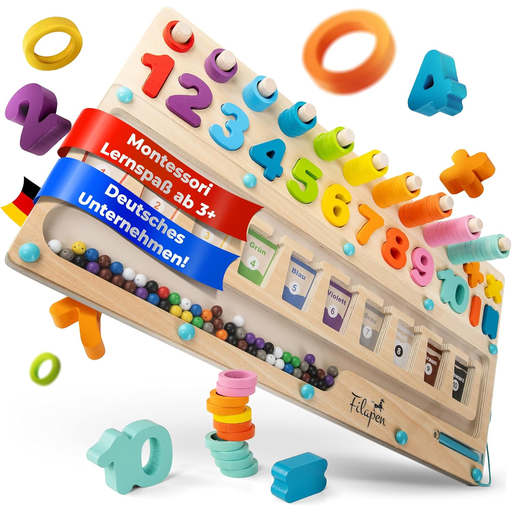
Why This Fits Their Persona: Ideal for parents who want to specifically promote their child's hand-eye coordination and fine motor skills. Guiding the beads with the magnetic pen requires concentration and precise movements, which is excellent preparation for holding a pen.
This magnetic labyrinth for kids combines colour sorting and number matching. It thus offers multiple, progressive play options, avoiding the pitfall of a single-purpose toy that quickly becomes boring.
A multifunctional learning board made of sturdy wood that combines fine motor skills, colour recognition, and early number sense in a self-contained system (no loose parts).
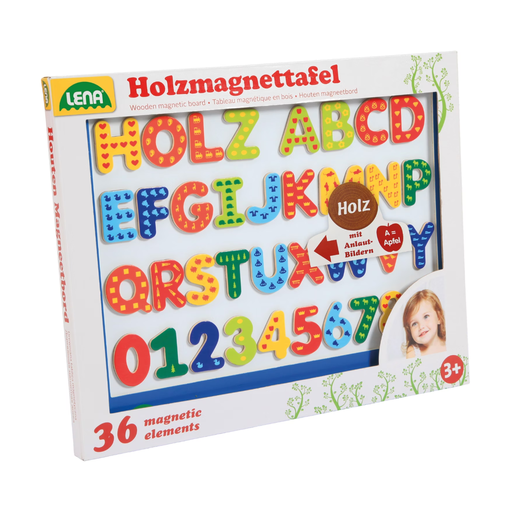
Why This Fits Their Persona: A great choice for children showing their first interest in letters and numbers. The large board provides a tangible and visual platform for spelling names, forming simple words, and practising counting.
Instead of overloaded electronic features, this set focuses on the fundamentals. The sturdy wooden frame and clearly designed magnets ensure durability and prevent the frustration that comes with cheaply made alternatives.
Large magnetic board (approx. 44 x 38 cm) with a hanging fixture. Includes a complete set of letters and numbers for diverse and long-lasting learning games.
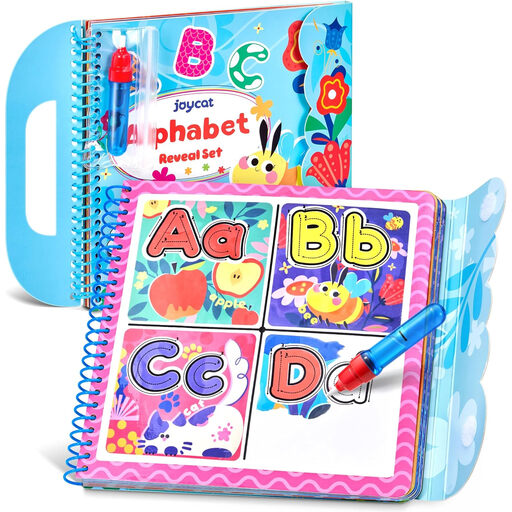
Why This Fits Their Persona: Perfect for parents looking for a quiet, clean, and reusable activity for home or on the go. It combines the fun of painting with the playful learning of the alphabet, without any stains from paint or pens.
This book offers a clear, repeatable play incentive. The pages dry and can be painted over and over again. This avoids the "buy, use once, throw away" cycle and ensures long-lasting value.
Reusable colouring book that works only with water. Promotes pen grip and letter tracing without any mess. Ideal for travel thanks to its carrying handle and pen holder.
We have compiled a complete, up-to-date list of products that fully meet these strict selection criteria and European safety regulations.
Look for the use of solid wood instead of particleboard, a smooth, splinter-free surface, and rounded edges. The paint should be declared as non-toxic or water-based. A reliable indicator of compliance with safety standards in the EU is the CE marking on the product or its packaging.
The term "Montessori" refers to the principles of educator Maria Montessori. Toys of this type are often made from natural materials like wood, have a simple design, and are created to isolate a specific skill. They are intended to encourage the child to engage in independent, focused, and practical learning without being distracted by too many stimuli.
For cleaning, a slightly damp cloth is usually sufficient. For heavier soiling, a mild, child-safe cleaner can be used. Avoid immersing wooden toys in water or treating them with harsh chemicals, as the material could swell or become damaged. Allow it to air dry completely after cleaning.