
Lieferung heute & morgen

Qualitätsgarantie

Willkommens-Angebote freischalten: KOSTENLOSE Lieferung | Bis zu 80 % RABATT | Kostenlose 30-Tage-JoyPlus-Testphase
App herunterladen
Motor skills toys for babies and toddlers encourage them to grasp, press, turn, sort or make music. But there are plenty of products on the market with similar promises. That’s why parents, grandparents and other family members should look beyond colours and features. Age recommendations, build quality, volume controls and how well a toy fits into everyday life are all important.
A baby activity centre with a piano, telephone, gears, lights and animal sounds might seem versatile. But a crowded surface can be confusing for younger children. Check that the controls are large enough and easy to reach. In everyday use, a few features that work well are often more useful than a long list of modes that are hard to tell apart.
Terms such as ‘Montessori toy’, ‘educational’ or ‘supports development’ are not standardised, protected quality categories. More useful details include the recommended age, the materials used, whether the toy contains small parts and how to clean it.
Musical toys for babies and children’s musical instruments can quickly seem very loud indoors. A volume control or quiet mode is therefore useful. Before buying, also check whether batteries are included, which type you need or whether the toy uses a rechargeable USB battery.
The age recommendation is an important safety and usability guide. For babies from around six months, large, easy-to-reach features for pressing, tapping and grasping are usually suitable. From around twelve months, shape sorters, simple peg toys and activity cubes may be a good fit. Depending on their design, motor skills cubes and more complex musical instruments may be better suited to toddlers aged one year and over.
An age recommendation does not replace supervision. Pay particular attention to warnings on products with small parts, even if your child can already grasp objects and sit confidently.
Look for clear information about the main material, rounded edges and a sturdy design. The descriptions of several products featured here state that they are made from ABS plastic and are BPA-free. This is a product feature, not a claim about medical benefits.
For wooden toys, look for a smooth, splinter-free finish, neatly drilled holes and clear care instructions. The Hauck shape sorter is described as being made from FSC-certified wood. Before each use, check whether any parts have come loose or are damaged.
For sensory toys with lights and sounds, check for a volume control and, where appropriate, a mute function. For a baby activity table, the size of the base, stability and whether it can be used on the floor are also important. Removable legs can make it easier to switch from tummy-time play to standing play.
Measure the space you have in mind before buying. A large play centre is not necessarily more practical if it’s always in the way in your living area. Compact activity cubes or portable learning toys for toddlers are easier to move between the nursery, living room and travel bag.
Why this product suits this profile: This compact play centre combines drum pads, lights, animal sounds, and shape and colour sorting in one toy for babies aged six months and over.
The features are brought together to support early grasping and cause-and-effect play. The product description mentions rounded edges and a non-slip base.
Four play areas, BPA-free ABS plastic according to the product description, and no batteries included.
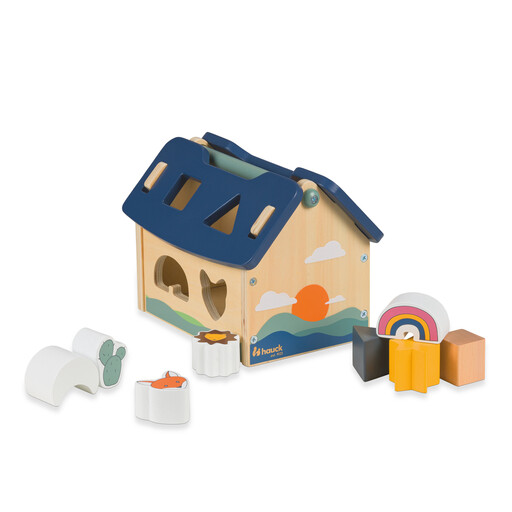
Why this product suits this profile: According to the product description, this wooden sorting house is designed for children aged twelve months and over, with a focus on shapes, colours and placing pieces into slots.
Rather than offering lots of electronic stimulation, it focuses on one clearly defined task. The safety information warns about small parts and the need to check the toy regularly.
FSC-certified wood according to the product description, eight shape pieces and storage space inside the playhouse.

Why this product suits this profile: This cube is a good fit for families looking for a portable learning toy with a range of hands-on and musical activities.
Its compact shape makes it easy to store and take with you. The description says it has rounded edges, but you should still check it regularly for loose parts.
Eight play modes, a carry handle, and piano, guitar, telephone and gear features in one cube.
We’ve put together a complete, regularly updated list of products that meet these strict selection criteria and fully comply with the safety regulations in force in the EU.
It depends on the product. Simple features for grasping, tapping and responding to lights are often designed for babies from around six months. Sorting houses, motor skills cubes and more complex learning toys for toddlers are often intended for children aged twelve months and over. Always follow the guidance from the individual manufacturer.
Lifespan depends on the material, how often the toy is used and how well it is cared for. Electronic products need working batteries and should be kept away from moisture. Wooden toys can last a long time if cared for properly, but should be checked regularly for splinters, cracks and loose parts.
There’s no general answer. Many products need batteries, which may not be included. Before buying, check the required battery size, expected battery life and whether the toy has features such as automatic shut-off or volume control.