
Lieferung heute & morgen

Qualitätsgarantie

Willkommens-Angebote freischalten: KOSTENLOSE Lieferung | Bis zu 80 % RABATT | Kostenlose 30-Tage-JoyPlus-Testphase
App herunterladen
As a Joybuy Product Recommendation Officer, I see every day how the right equipment can transform work in the garage or workshop. A motorcycle lift is not a luxury item, but a core tool for safety and ergonomics. However, the market is crowded, and not every model delivers on its promises. Before you make a decision, it's crucial to know the most common pitfalls that can lead to frustration and, in the worst-case scenario, accidents.
This guide will help you separate marketing hype from solid facts and find a lift that truly fits your needs.
Many buyers are drawn to seemingly attractive deals, overlooking critical flaws that only become apparent during use. Pay special attention to these three points:
To avoid buyer's remorse, you should base your selection on objective technical parameters. A good motorcycle lift is an investment in your safety and efficiency.
The specified load capacity should exceed your motorcycle's wet weight (including all fluids) plus a generous safety margin of at least 20–30%. For most street bikes, cruisers, and tourers, a 500 kg motorcycle lift is a solid and future-proof choice. Don't just check the number; also inspect the material thickness and the quality of the welds.
The type of lifting mechanism significantly affects comfort and the amount of effort required.
Two numbers are critical here: the minimum and maximum lift height.
Instead of making a one-size-fits-all recommendation, we have identified models tailored to specific needs and workflows.
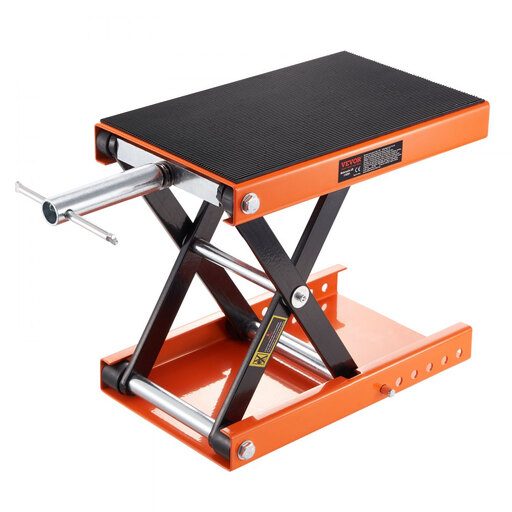
Why This Fits Their Persona: Ideal for hobby mechanics who need a reliable and straightforward solution for occasional maintenance tasks like oil changes or chain care. The hand-crank operation is simple and requires no complex hydraulics.
This model includes a safety lock pin that mechanically secures the platform at the desired height, minimizing the safety risk of a sudden drop.
The 500 kg load capacity provides a high safety margin for most motorcycles. The compact design of the scissor lift allows for space-saving storage in the garage.
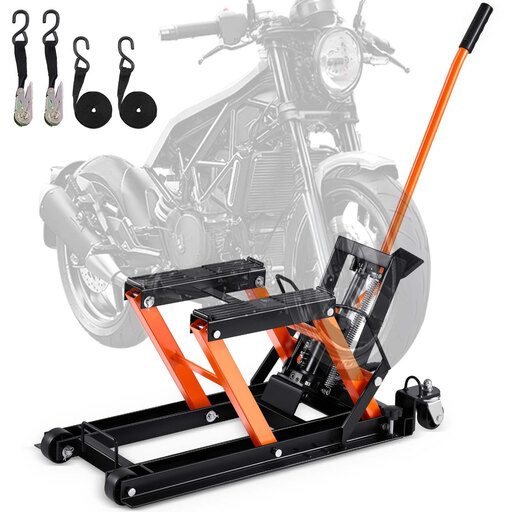
Why This Fits Their Persona: Perfect for owners of heavy cruisers or touring bikes who work on their machines regularly and extensively. The hydraulic mechanism makes lifting heavy loads effortless and controlled.
The 700 kg load capacity is realistically rated and supported by a robust steel construction. The foot-pedal operation allows for smooth lifting, which increases stability throughout the entire process.
The hydraulic drive reduces physical effort to a minimum. The integrated swivel casters make it easy to move the lift and the motorcycle around the workshop.
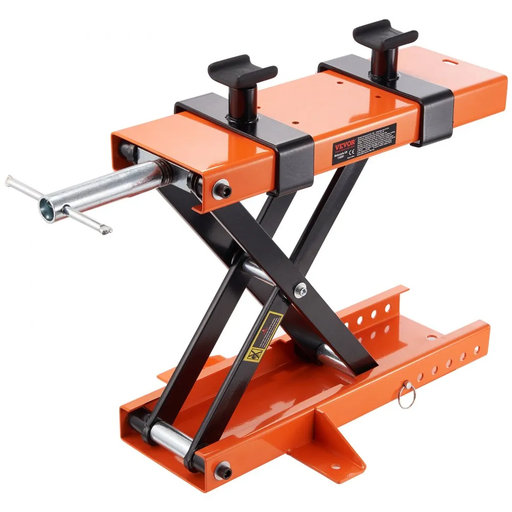
Why This Fits Their Persona: For users in a small to medium-sized garage lift or workshop where flexibility and easy setup are crucial. The combination of hydraulic power and mobility makes it a versatile tool.
This model features a dedicated safety lock that prevents unintentional lowering. The solid steel construction provides the necessary stability to safely handle the rated load capacity of approx. 500 kg (1100 lbs).
Setup is straightforward and quick. The locking casters offer both mobility and stability during work, which is a major advantage in a busy workshop environment.
We've compiled a complete, up-to-date list of products that fully meet these strict selection criteria and industry safety standards.
Ensure the lift is on a level, solid surface. Position the rubber-padded contact surfaces of the lift under stable frame points on the motorcycle, never under the engine case or exhaust system. Lift the motorcycle slowly, checking for stability. Once the desired height is reached, immediately engage the mechanical safety lock (locking pin). For added stability, tie-down straps can be used to secure the motorcycle to the lift.
The choice depends on your motorcycle's weight and your frequency of use. For lighter motorcycles (< 250 kg) and occasional maintenance, a mechanical motorcycle scissor lift is often sufficient and more cost-effective. If you own a heavy motorcycle or work on it regularly, a hydraulic motorcycle lift makes the job significantly easier and is a worthwhile investment in comfort and efficiency.
Most mechanical and hydraulic scissor lifts are designed to be very flat in their lowest position. This allows them to be easily stored under a workbench, on a shelf, or leaning against a wall without taking up much space in the garage. Clean the threaded rod or hydraulic cylinder before storage and protect it from dust and moisture to ensure its longevity.