
Lieferung heute & morgen

Qualitätsgarantie

Willkommens-Angebote freischalten: KOSTENLOSE Lieferung | Bis zu 80 % RABATT | Kostenlose 30-Tage-JoyPlus-Testphase
App herunterladen
A solid motorcycle lift is the foundation for safe and comfortable maintenance work. However, the market is filled with models whose quality differences are barely noticeable at first glance. Those who focus only on the price risk not only a bad purchase but also the safety of their motorcycle. Before you make a decision, you should be aware of the typical weak points that often only become apparent during use.
Many buyers focus on the maximum load capacity and overlook crucial design flaws. Here are three common pitfalls you should avoid:
A well-thought-out selection protects you from these problems and ensures that your money is invested in a durable and safe tool for motorcycle repair.
To make an informed purchasing decision, you should focus on the core technical features. These objective criteria will help you evaluate the performance and safety of a motorcycle jack or a scissor lift for motorcycles.
The load capacity is the first selection criterion. It indicates the maximum weight the lift can safely handle. It is advisable to include a generous safety margin here. Choose a model whose load capacity is at least 20–30% above your motorcycle's curb weight. This ensures stability, even if the weight is not perfectly distributed or accessories are mounted.
The lifting range defines the minimum and maximum working height.
The mechanism for lifting the motorcycle significantly influences user comfort and efficiency.
Both systems require the use of a safety pin for securing the lift during extended work, which locks the mechanism at the desired height and relieves the drive system.
Based on these objective criteria, we have identified models that are well-suited for specific requirements and user groups.
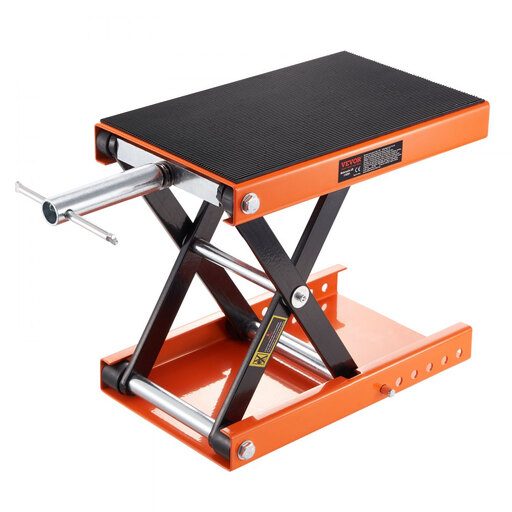
Why This Fits Their Persona: Ideal for hobby mechanics looking for a reliable and space-saving solution for occasional maintenance tasks like oil changes or chain care on standard motorcycles. The hand-crank operation is straightforward and low-maintenance.
The robust steel X-frame with a central spindle counteracts the risk of an unstable construction. An included safety pin locks the height and prevents unintentional lowering, addressing the weakness of an inferior lifting mechanism.
Compact Design: Easy to store in a garage or workshop. Low Minimum Height of 95 mm, suitable for many models with low ground clearance.
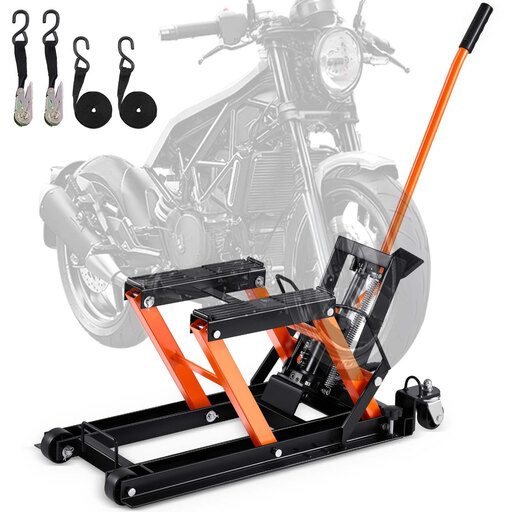
Why This Fits Their Persona: Perfect for owners of heavy motorcycles like cruisers or tourers, as well as for anyone who works on their bike frequently and values effortless operation. The hydraulic mechanism significantly reduces physical effort.
The high-quality hydraulic pump ensures a reliable lifting process and avoids the pitfall of a leaky, underperforming system. The wide, non-slip platform with rubber strips prevents the motorcycle from slipping and protects against paint damage.
Effortless Lifting: The foot pedal allows you to lift machines weighing up to 700 kg without strain. Mobile: Equipped with swivel and fixed castors for easy manoeuvring in the workshop.
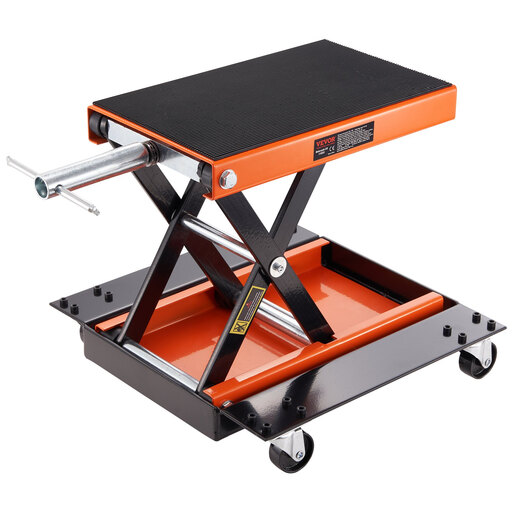
Why This Fits Their Persona: For users who need maximum flexibility. Ideal for moving the jacked-up motorcycle around the garage, whether for repositioning or to work on it from different sides without having to lower it.
The four robust cast iron universal casters are designed for heavy loads, avoiding the weakness of wobbly, undersized wheels. The sturdy frame and safety pin ensure a secure stance during work, even when mobile.
High Mobility: Four 360° swivel casters allow for effortless movement of the lifted vehicle. Wide Lifting Range: From 120 mm to 390 mm, the lift offers a good working height for various tasks.
We have compiled a complete, up-to-date list of products that fully meet these strict selection criteria and safety requirements.
Always place the lift on a level, solid surface. Position the motorcycle jack centrally under the frame or engine lifting points specified by the manufacturer. Lift the motorcycle slowly, continuously checking for stability. Once the desired working height is reached, be sure to insert the mechanical safety pin to relieve the hydraulics or spindle and prevent it from lowering. For longer or more intensive work, additional securing with tie-down straps may be advisable.
That depends on the type of lift and the work you plan to do. A central scissor lift (motorcycle jack) lifts the motorcycle by the frame, leaving both wheels freely accessible—ideal for tyre changes or fork work. A motorcycle paddock stand for the rear or front lifts only one wheel at a time. It is a good supplement but not always necessary if you already have a central motorcycle lift. For some jobs where the motorcycle must be perfectly vertical, combining both systems can be useful.
To ensure the longevity of your lift, you should clean it after use. Keep the threaded spindle on mechanical models clean and apply a little grease regularly. On hydraulic models, you should check for oil leaks. Store the lift in a dry environment to prevent corrosion. Lower the lift completely before storage to protect the seals of the hydraulic cylinder.