Joybuy Insights

Motorhome Tyre Pressure Monitoring System: Buyer’s Guide

Preparing for a trip with a motorhome or a vehicle-and-trailer combination requires special attention to vehicle safety. Correct tyre pressure is a fundamental factor that is often underestimated. Incorrect pressure not only leads to increased fuel consumption and uneven tyre wear but also poses a significant safety risk, especially on long motorway journeys.

A Tyre Pressure Monitoring System (TPMS) continuously monitors the pressure and temperature of your tyres in real time. This allows you to detect potential problems like slow leaks or overheating early on, helping to prevent breakdowns or dangerous tyre failures. This article serves as a guide to help you understand how these systems work and find a suitable solution for your vehicle.

What to Look for When Choosing a TPMS for Your Motorhome

Choosing the right system depends on your vehicle type, its length, and your specific requirements. Here are three key criteria to help you make your decision.

1. Number of Sensors: Matching Your Vehicle and Rig

The number of sensors you need is the first critical point.

  • Standard Motorhome (4 tyres): A system with four sensors is usually sufficient.
  • Motorhome with a dual-tyre setup or a trailer: If you drive a vehicle with dual tyres on the rear axle or need tyre pressure monitoring for a caravan or a trailer TPMS (e.g., for horses or boats), a TPMS with 6 sensors or more is required. Some systems are modularly expandable, allowing you to add more sensors as needed.

2. Measurement Range and Signal Transmission

Motorhomes and light trucks have significantly higher tyre pressures compared to passenger cars.

  • Pressure Range: Ensure the system's measurement range is designed for your vehicle's recommended tyre pressure. While systems for cars often only measure up to about 6 Bar, tyre pressure sensors for trucks and large motorhomes need a range of up to 13 Bar or more.
  • Signal Range: For long vehicles or vehicle-trailer combinations, the wireless connection between the rear sensors and the cockpit display can become unstable. In such cases, a TPMS with a repeater is a practical solution. The repeater is positioned between the monitor and the sensors to amplify the signal and ensure reliable data transmission.

3. Installation and Power Supply

Modern retrofit systems are designed for ease of use.

  • Retrofitting a TPMS: Most systems use external sensors that simply screw onto the tyre valves in place of the valve caps. There is no need to dismount the tyres.
  • Power Supply: Many monitors are powered via a USB cable. A solar-powered tyre pressure monitor with a panel on the display offers added flexibility, as it maintains its charge in sufficient light and reduces cable clutter in the cockpit.

Recommended Tyre Pressure Monitoring Systems

Based on the criteria mentioned, we have compiled a selection of systems suitable for various vehicle types and requirements.
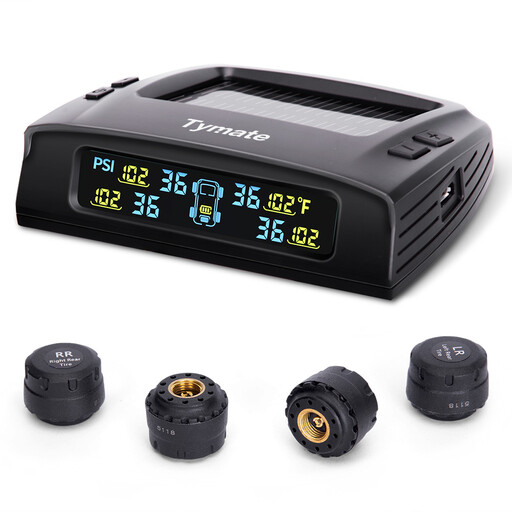

Tymate RV Tire Pressure Monitoring System with 4 Sensors

Tymate RV TPMS with 4 Sensors

What makes it stand out: A compact, solar-assisted system optimised for the pressure range of smaller vehicles like vans, SUVs, or compact motorhomes.

Advantages:

  • Pressure Range: 0–8 BAR (0–116 PSI), suitable for many common vehicle types.
  • Alarm Modes: Offers 5 different alarm types, including rapid leak, high/low pressure, and high temperature.
  • Display: Colour LCD with a smart backlight that adjusts to ambient light.
  • Energy Efficiency: Automatic sleep mode after 10 minutes of inactivity and auto-wake when driving begins.

Who is it for? This system is a great choice for drivers of smaller motorhomes, panel vans, or SUVs up to approximately 6 metres in length who are looking for straightforward, real-time monitoring.
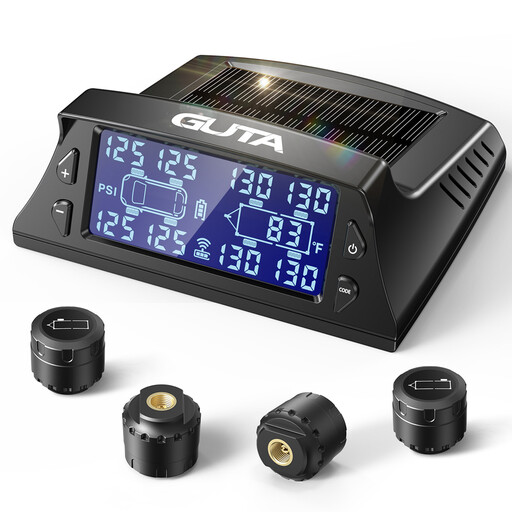

GUTA RV/Trailer Tire Pressure Monitoring System with 4 Sensors

GUTA RV/Trailer TPMS with 4 Sensors

What makes it stand out: This system offers a significantly extended measurement range, qualifying it for heavier motorhomes and light commercial vehicles.

Advantages:

  • High-Pressure Range: Monitors pressures from 0–13 BAR (0–188 PSI).
  • Long Sensor Battery Life: The sensor batteries (Type CR2032) have a lifespan of up to 4 years, according to the manufacturer.
  • Automatic Calibration: The system can use the current tyre pressure as the reference value for its alarm thresholds.
  • Smart Alarms: Warns of rapid leaks, pressure deviations, high temperature, and low sensor battery.

Who is it for? Ideal for owners of standard motorhomes or light trucks who require higher tyre pressures and value long sensor battery life.
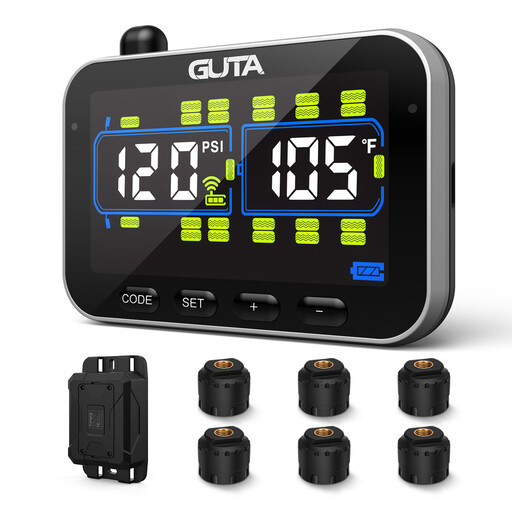

GUTA RV/Trailer Tire Pressure Monitoring System with 6 Sensors and Repeater

GUTA RV/Trailer TPMS with 6 Sensors and Repeater

What makes it stand out: An all-in-one solution for large vehicles and rigs, equipped out of the box with 6 sensors and a signal repeater for stable transmission over long distances.

Advantages:

  • Comprehensive Kit: Includes 6 sensors and a repeater, ideal for vehicle-trailer combinations or vehicles with dual-tyre setups.
  • Very High-Pressure Range: Covers a range of 0–14 BAR (0–203 PSI), making it suitable for heavy-duty vehicles.
  • Stable Signal Transmission: The included TPMS with repeater ensures a stable connection for vehicle lengths up to 15 metres.
  • Large Colour Display: The clear LCD colour display shows data for all tyres simultaneously, simplifying monitoring.

Who is it for? The top choice for drivers of large motorhomes, rigs with a caravan or trailer TPMS, and light trucks. Perfect for anyone who needs reliable monitoring for more than four tyres over a greater distance.


Looking for More Options?

The market offers a wide variety of systems tailored to different vehicle configurations and needs. If the models presented here don't exactly match your requirements or if you're looking for alternatives, you can find more products in our range.

Discover more driving safety solutions in our Safety Accessories category to find the right system for your vehicle.

Frequently Asked Questions (FAQ)

Is a Tyre Pressure Monitoring System Mandatory for Motorhomes?

Since November 2014, a direct or indirect TPMS has been legally required in the EU for newly registered M1 class vehicles (which includes most motorhomes based on a passenger car chassis). There is no obligation to retrofit older vehicles or vehicles in other classes (e.g., truck-based motorhomes in class N1/N2). Regardless of legal requirements, retrofitting a TPMS is recommended for all motorhomes and trailers for safety reasons.

How Easy Is It to Retrofit a TPMS?

Retrofitting a system with external sensors is very simple and does not require a trip to a workshop. The sensors are screwed onto the valves in place of the valve caps. The monitor is placed in the cockpit and powered by USB or its integrated solar panel. Most systems are already paired at the factory and are ready to use out of the box.

What Is the Advantage of External Sensors?

External sensors offer the key advantage of simple installation. They can be fitted in minutes without any tools and without dismounting the tyres. Replacing the batteries is also straightforward and can be done by the user. Internal sensors, on the other hand, must be mounted inside the tyre by a specialist workshop, but in return, they offer better protection against theft and damage.