
Lieferung heute & morgen

Qualitätsgarantie

Willkommens-Angebote freischalten: KOSTENLOSE Lieferung | Bis zu 80 % RABATT | Kostenlose 30-Tage-JoyPlus-Testphase
App herunterladen
A tyre pressure monitoring system for your motorhome or trailer can display pressure and temperature readings while you’re on the move. But choosing the right one involves more than looking for a high PSI rating or lots of sensors. You’ll need to consider your vehicle’s length, its actual tyre pressure, signal transmission and the effort involved in changing batteries and fitting the system.
A tyre pressure monitoring system rated up to 188 PSI may sound versatile. What matters, though, is whether its range suits your vehicle’s required tyre pressure and construction. A range of up to 87 PSI is enough for many cars and smaller SUVs. A higher range may be useful for motorhomes, lorries, semi-trailers and heavy trailers.
Also look out for conflicting product information. If the product name says 188 PSI but the technical specifications list 199 or 203 PSI, check the specific instruction manual before buying.
A tyre pressure monitoring system with 6 sensors won’t automatically suit every vehicle and trailer combination. If you’re only monitoring four tyres, the extra sensors will go unused. However, 6, 8 or 10 sensors may be useful for caravans with tandem axles, trailers or combinations with multiple vehicle sections.
It’s important to be able to match each sensor clearly to its tyre position. Pre-paired, labelled sensors make set-up easier, but you should still check that each one is assigned to the right position after fitting.
Metal vehicle parts, the distance between the towing vehicle and trailer, and the display’s position all affect signal transmission. For long vehicles and combinations with multiple sections, a TPMS with a signal repeater is often more practical than one without. Treat manufacturers’ guidance on vehicle length as a guide, and take your own set-up into account.
Check whether the system displays bar and PSI, and whether its measurement range exceeds your vehicle’s maximum recommended tyre pressure. A range that’s too low may not be suitable for commercial vehicles. If you’re choosing a TPMS for a lorry or caravan, pay particular attention to the pressure range, pressure accuracy and adjustable warning thresholds.
According to the GUTA product information available, the stated measurement accuracy is within 2 PSI. GT20C series systems are advertised with a range of 0 to 188 PSI; some detailed specifications list 0 to 14 bar or up to 203 PSI. Buyers should check the current product page to clarify this discrepancy before ordering.
A tyre pressure and temperature monitoring system alerts you not only to pressure loss but also to rising temperatures. This is particularly useful on long journeys, when carrying a heavy load or in warm weather. However, an alarm is no substitute for checking tyre pressure when the tyres are cold or looking for visible damage.
Common alarm types include:
According to the manufacturer’s information, GUTA models have a stated temperature range of approximately -40 to 105 °C. Product information for the smaller Tymate range gives a temperature range of approximately -20 to 85 °C.
A tyre pressure monitoring system with 4 sensors may be enough for a motorhome without an additional trailer. For a caravan with a tandem axle or a larger vehicle combination, versions with 6 sensors may be suitable. A tyre pressure monitoring system with 8 or 10 sensors is better suited to vehicles with several monitored axles or fleet operators.
A solar-powered tyre pressure monitoring system can reduce the display’s energy consumption, but the external sensors usually still need coin cell batteries. According to the product information for the models mentioned here, they use either CR1632 or CR2032 batteries, depending on the system. Tymate gives an approximate battery life of two years, while the GUTA models mentioned are rated at around four years. Temperature, radio activity and frequency of use can all affect actual battery life.
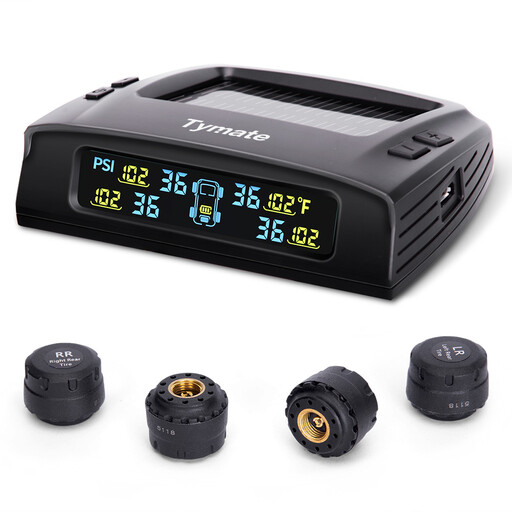
Why this product suits this profile: For smaller motorhomes, SUVs or trailers with four tyres to monitor and a pressure range of up to 116 PSI.
The limited sensor count avoids paying for features you don’t need for a straightforward four-tyre set-up. Before buying, compare the measurement range with your vehicle’s tyre pressure.
According to Tymate product information: colour LCD, pressure range of 0–116 PSI, temperature display and sleep mode after ten minutes of inactivity.
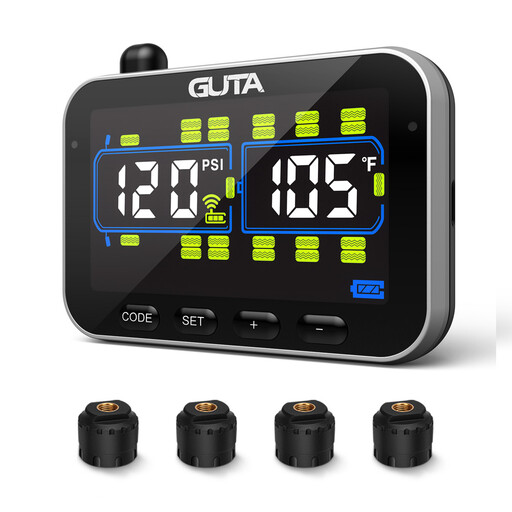
Why this product suits this profile: For drivers who prefer a colour display, six alarm functions and signal support for longer vehicles.
The repeater helps address the range challenges often encountered with longer vehicles. Check the pressure specifications on the product page, as the PSI and bar figures differ.
According to GUTA product information: 433.92 MHz transmission, colour LCD, six alarm types, automatic calibration and pre-labelled sensors.
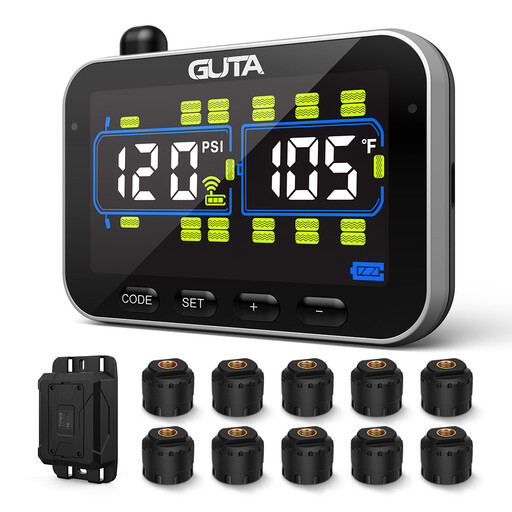
Why this product suits this profile: For multi-section vehicle combinations, heavy trailers, semi-trailers or fleets where numerous tyre positions need to be monitored.
The high sensor count suits vehicles with numerous tyre positions and avoids having to buy extra sensors later. It wouldn’t be necessary for a vehicle with just four tyres, though.
According to GUTA product information: ten sensors, repeater, temperature range of -40 to 105 °C, six alarm types and sensor batteries with a stated life of around four years.
We’ve put together a complete, regularly updated list of products that meet these strict selection criteria and fully comply with the safety regulations in force in the EU.
External tyre pressure sensors screw onto the valves. Before fitting, check the valve type, thread, seal and whether the sensors are suitable for metal valves. The product information for the GUTA systems mentioned recommends fitting them to metal valve stems. After fitting, check for air leaks and make sure each reading is assigned to the correct tyre position.
Ongoing costs mainly include replacement batteries for the sensors. Depending on the model, displays can be charged via USB-C; solar versions can reduce the display’s charging needs. Battery life figures are estimates, not a guarantee of how long they’ll last in use.
Four sensors may be enough for a single-axle caravan. For tandem axles, six sensors are a sensible choice if you want to monitor every tyre. Systems with 8 or 10 sensors may be suitable if you also need to monitor spare wheels or additional axles.
Battery life depends on the battery, temperature and radio activity. According to the manufacturers, the models mentioned have a stated life of around two to four years. Check the battery status before longer trips and keep a suitable replacement type to hand.
No. Standard transmission may be enough for shorter vehicles. For long motorhomes, trucks, semi-trailers or combinations of a towing vehicle and trailer, a TPMS with a signal repeater can help maintain transmission between the sensors and display. The key factors are the vehicle’s actual length and layout.