
Lieferung heute & morgen

Qualitätsgarantie

Willkommens-Angebote freischalten: KOSTENLOSE Lieferung | Bis zu 80 % RABATT | Kostenlose 30-Tage-JoyPlus-Testphase
App herunterladen
Motor skills toys for children are designed to combine engaging play, movement and early learning. For parents, grandparents and educational settings, however, choosing the right product is not always straightforward: Many products advertise Montessori-inspired design, developmental benefits or an extensive range of functions without clearly highlighting important details such as age recommendations, materials and supervision requirements.
The following selection by the Joybuy Product Recommendation Officer therefore focuses on transparent product features. It explains which details matter before purchase and which toys may suit different everyday situations.
An activity cube with music, lights, buttons and rotating elements may appear highly versatile. For a child under three, however, too many simultaneous stimuli can be overwhelming. What matters is whether each element is easy to reach and appropriate for the recommended age group. Volume levels and any battery requirements should also be checked before purchase.
The term Montessori toy does not automatically describe a certified product category. It may refer to a particular type of play, such as independent sorting, matching or grasping. Buyers should also pay attention to age recommendations, material specifications, safety warnings and the specific play activities offered.
A foam puzzle mat can define a play area and provide a softer surface. It is not, however, a fall-protection solution for every situation. Edges, connecting pieces, odour, cleaning options and material specifications should be checked. If a product contains small parts, direct supervision is also required whenever this is stated in the product information.
Toys intended for children aged 1 and over should not contain easily detachable small parts that could be put in the mouth. Products labelled “from 3 years” are not intended for younger children. The Filapen magnetic maze, for example, carries an explicit small-parts warning; according to the product information, it is designed for children aged 3 and over and requires direct supervision.
You should also check:
For wooden puzzles for children and motor skills boards, the material, surface treatment and edge finishing are all relevant. Some products specifically state that they are made from natural wood; this does not automatically mean that every wooden toy is suitable for babies. Plastic products should clearly specify their materials. The activity cube is listed as being made from ABS plastic and, according to the product description, uses BPA-free materials and has rounded edges.
For everyday use at home, in nurseries or in preschools, easy-to-wipe surfaces are particularly practical. A foam mat should be stored dry and checked regularly for cracks or loose connecting pieces.
Motor skills toys should enable a clear, purposeful action: turning, inserting, sorting, guiding, grasping or matching. A motor skills board with a small number of clearly defined activities may be better suited to short play sessions than a complex set containing numerous individual pieces.
You should also check the dimensions. According to the product information, the Selecta Minitivity motor skills toy measures 14 cm and can be attached to a cot, playpen or buggy using hook-and-loop fasteners. An activity cube measuring 23 × 23 × 24 cm, by contrast, requires a stable surface, although its carry handle makes it portable according to the description.
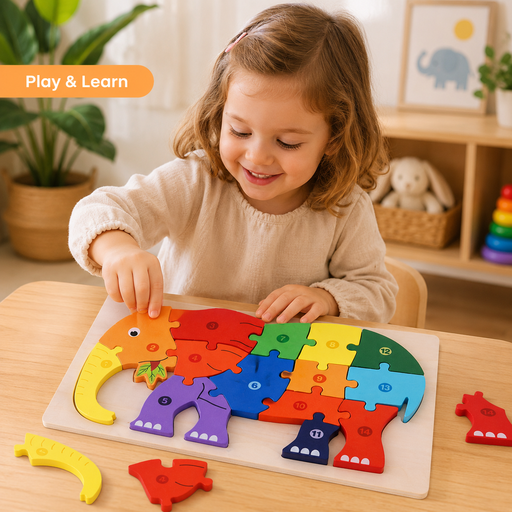
Why it suits this profile: This wooden puzzle is designed for simple matching and peg-insertion activities in everyday family life and requires no batteries.
The product description focuses on a clear play concept involving colour and shape matching rather than a confusing array of difficult-to-classify functions. Supervision is recommended depending on the child’s age and the situation.
Wooden construction, a single set in the package and easy integration into indoor play routines.
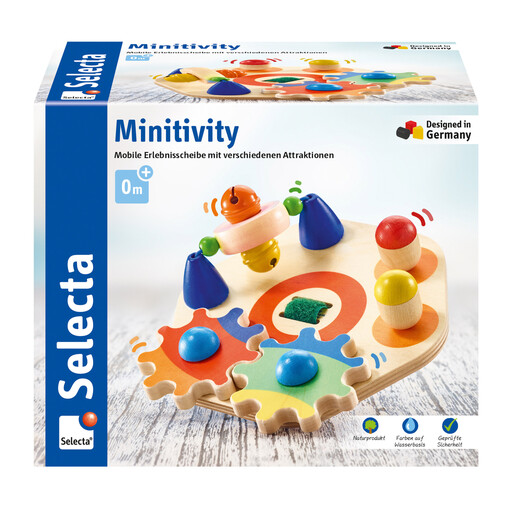
Why it suits this profile: Three activity stations made from natural wood are ideal for families looking for a compact motor skills toy with clearly described functions.
Rather than making broad developmental claims, the product specifies its features: gears, movable peg elements and bell spinners. According to the product information, the model is made in Germany.
14 cm size, natural wood and hook-and-loop attachment for a cot, playpen or buggy, according to the product data.
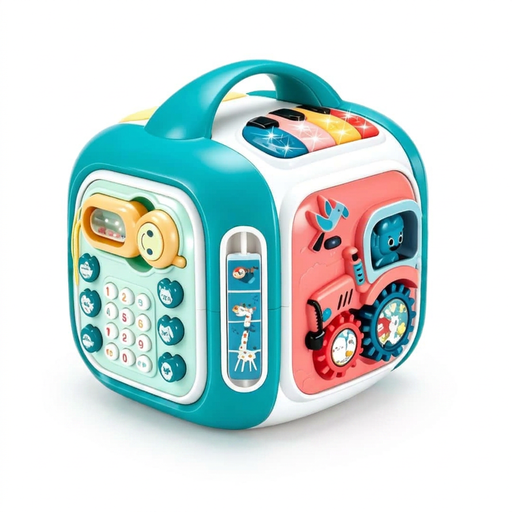
Why it suits this profile: The activity cube combines eight play areas—including a piano, guitar, gears and a telephone activity—in one compact format.
The recommended age range of 1 to 3 years is stated. According to the product description, the cube has rounded edges and is made from ABS plastic; the specific labelling and instructions should be checked before purchase.
23 × 23 × 24 cm, a carry handle and multiple grasping, turning and pressing elements for use at home or on the go.
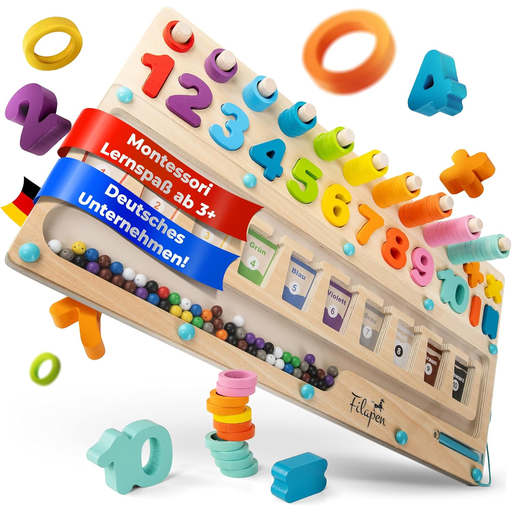
Why it suits this profile: The magnetic maze combines colour matching, numbers from 1 to 10 and guided ball movement for children aged 3 and over.
The toy is focused on one specific activity. The warning about small parts and the requirement for direct supervision are stated explicitly.
Solid wood according to the product description, packaging dimensions of 23 × 43.5 × 4 cm and no batteries required.
For play areas, children’s rooms or group spaces, Benrita foam puzzle mats with six EVA foam squares and ten edge strips may be worth considering. According to the product information, each piece measures 12 × 12 inches. The pieces interlock and can be wiped clean. The mat should be checked regularly for damaged connections and should not be treated as equivalent to certified fall protection.
A falling-sticks catching game may also be suitable for children aged 3 and over. According to the product information, it offers three falling speeds and a USB-rechargeable battery. Because it contains small parts and involves assembly and a rechargeable battery, it should only be used by children within the specified age range and under supervision.
Depending on the manufacturer’s specifications, simple insertion, turning and grasping activities may be suitable for children aged 1 and over. An activity cube labelled for ages 1–3 can combine several such activities. The key considerations are an appropriate age rating, rounded edges and the absence of easily detachable small parts.
Service life depends on the material, mechanisms, frequency of use and storage conditions. Wooden toys should be stored in a dry place and checked regularly for splinters or loose parts. With foam mats, the connecting pieces and edges should be inspected. Electronic learning toys may also depend on the condition of their rechargeable battery or disposable batteries.
Wooden puzzles, motor skills boards and magnetic mazes generally do not require a power source. Electronic products may need batteries or USB charging. Before purchase, check the product description for the battery type, included accessories and charging equipment.
We have put together a current selection of products that can be compared based on age recommendation, materials, play activities and safety information.