
Lieferung heute & morgen

Qualitätsgarantie

Willkommens-Angebote freischalten: KOSTENLOSE Lieferung | Bis zu 80 % RABATT | Kostenlose 30-Tage-JoyPlus-Testphase
App herunterladen
A mud kitchen for children combines role play with water, sand and soil. If you don’t want your child’s outdoor play kitchen to end up unused in the garden after a short time, it’s worth taking a closer look before you buy. The key factors aren’t the number of features printed on the box, but choosing the right size and materials, and making sure the kitchen is safe and easy to use day to day.
Pots, cups and scoops can add to the fun. But if there’s no sturdy work surface, easy-to-reach basin or practical way to supply water, the accessories may end up being an afterthought. So start by checking the design of the children’s garden kitchen, then look at how many accessories are included.
When choosing a wooden mud kitchen, consider the type of wood, its finish and the care instructions. Certification such as FSC can provide clear evidence that the wood comes from certified sources. However, it doesn’t replace checking the edges, screw fittings and stability of the specific model.
A tap on a children’s kitchen sounds handy, but it needs to be used safely and cleaned regularly. Empty the container and basin after every play session. Otherwise, there’s a risk of slipping, dirt build-up and hygiene issues. It’s also best to position the mud kitchen so that water doesn’t run directly onto house walls or delicate patio surfaces.
Measure the space you have in mind, including room to move around. A large children’s garden kitchen can accommodate several children at once, but it needs a level, stable surface. Check the following:
The roba model measures 124 × 89 × 34 cm. Its width may make it suitable for shared play, while its relatively shallow depth could also work well on narrower patios.
For wooden models, look for rounded edges, sturdy joints and clear care instructions. A grey stain or coating alone doesn’t prove that a product is weather-resistant. The manufacturer’s guidance on outdoor use is what matters.
Plastic parts such as the play basin, water container and cups should have no sharp edges. After play, clean them with a damp cloth and mild detergent. Allow the wood to dry afterwards. To help the kitchen last longer, store it in a dry indoor space or under a suitable cover.
For outdoor toys from 18 months, parents should check the specific age recommendation and warnings. The stated minimum age doesn’t replace supervision. Small accessories may be a choking hazard, so children should be supervised during play and damaged parts removed straight away.
Also look for information about relevant toy safety requirements, such as CE marking and any details about European safety standards such as EN 71. CE marking is a legally relevant declaration of conformity, but it isn’t an independent quality seal. The specific product information and safe use remain essential.
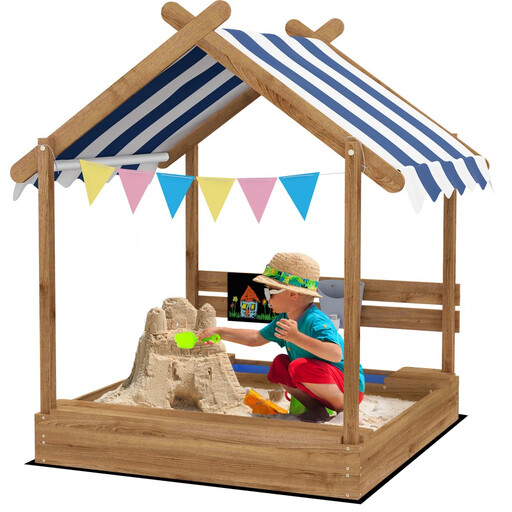
Why it suits this profile: The house-shaped design combines sand play with creative outdoor fun. The product name lists two basins, a roof and a blackboard, which may appeal to families looking to combine several play areas.
The play features go beyond a few loose accessories. Before buying, though, check the space required, material details and exactly what’s included, as a full product description isn’t available.
The listed features include dimensions of 124 × 116 × 146 cm, two basins, a canopy and a blackboard.

Why it suits this profile: This wooden mud kitchen combines a play basin, a hanging water container with a tap and several fixed play features. According to the product details, the kitchen structure is made of wood; the model is FSC-certified and suitable from 18 months.
The water feature is clearly described as a hanging container with a tap. After use, empty the basin and container, and check all parts regularly for damage.
Two printed hotplates, four turning knobs, an oven with a door, a plastic basin and accessories including a pot, ladle and two cups.
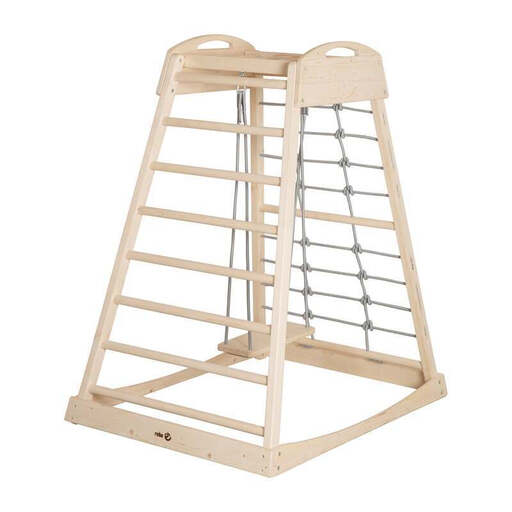
Why it suits this profile: This isn’t an outdoor play kitchen. Instead, it’s an additional option for families who want to give children a separate way to stay active indoors, taking some pressure off the outdoor play area. According to the product details, it’s suitable from 24 months.
Its clearly stated purpose helps set the right expectations: this climbing frame isn’t a substitute for a mud kitchen and, according to the product details, is intended for indoor use.
Climbing ropes, gymnastic rings and a replaceable wooden swing; listed dimensions are 127.5 × 83 × 110.5 cm, with a maximum load of 70 kg.
We’ve put together a complete, regularly updated list of products that meet these strict selection criteria and fully comply with the safety regulations in force in the EU.
Choose a level, stable surface and keep it well away from steps, ponds, vehicles and slippery paths. The kitchen shouldn’t wobble or tip over. Children should be supervised while playing, particularly when using water containers, small kitchen utensils or other mud-play accessories.
Its lifespan depends on the quality of the wood, how well it’s made, how often it’s used and how it’s cared for. Storing it somewhere dry or covering it will help protect it from prolonged exposure to moisture. Check the screws, edges, basin, tap and wooden surfaces regularly. If any parts are loose or damaged, stop using the product until they’ve been repaired.
There are usually no specific ongoing costs. You’ll just need water and, if necessary, a mild detergent. A small container uses a modest amount of water, but it should still be emptied completely after every use. So the key consideration isn’t so much the amount of water used as choosing a suitable location near an accessible water source.