Shoppers keeping an eye on fat content
You’re looking for a small late-night snack and want to compare the fat content of different muesli bars without treating ‘light’ as the same as ‘low fat’.


If you’re choosing a muesli bar for a midnight snack and fat content is your main concern, compare the fat per 100 g and per bar rather than relying on the word ‘light’ in the name. The Corny and GOLDEN BRIDGE chocolate light varieties listed by ALDI SÜD contain 9.4 g and 10 g of fat per 100 g respectively. Both exceed the European Commission’s threshold of 3 g of fat per 100 g for a ‘low fat’ claim on solid foods. Whether a variety can be described as ‘reduced fat’ is a separate matter and requires a like-for-like product comparison.
You’re looking for a small late-night snack and want to compare the fat content of different muesli bars without treating ‘light’ as the same as ‘low fat’.
You want to tell the difference between the sugar content of a sweet bar, a ‘no added sugar’ claim and the ingredients used.
You need to know which allergens a particular variety contains and whether the packaging mentions possible traces.
First decide whether fat content, sugar and ingredients, or how well a particular portion suits you is your priority. Then compare the nutrition information per 100 g, and check the figures per bar too so you know what you’ll be getting in your snack.
| What to check | What to look for | Who it matters to |
|---|---|---|
| Fat and ‘light’ claims | Compare fat and saturated fat per 100 g, as well as fat per bar. If a claim refers to a reduction in fat, check which comparable product is being used as the reference. | If I have a muesli bar late at night, I want to compare the fat content of similar varieties in a clear, like-for-like way. This is the main consideration for around 42% of shoppers. |
| Sugar and sweeteners | Check ‘of which sugars’ in the nutrition table. For ‘no added sugar’ claims, check the ingredients list too. | For my sweet snack, what matters is how much sugar the variety contains and which ingredients are used instead. This is the priority for around 33% of shoppers. |
| Allergens and portion size | Check the highlighted allergens, any possible traces and the weight of an individual bar on the packaging. | Before reaching for a bar at night, I need to make sure that the particular variety meets my requirements for ingredients and portion size. Around 25% of shoppers put this first. |
The variety name alone doesn’t tell you how much fat a bar contains. The figures given by ALDI SÜD for Corny Schoko light and GOLDEN BRIDGE Schoko light are 9.4 g and 10 g of fat per 100 g respectively, both above the EU threshold for a ‘low fat’ claim.
Check the fat per 100 g first, then look at the portion information on the packaging.
Choosing less fat and choosing less sugar are two different priorities. ALDI SÜD lists 42 g of polyols per 100 g for Corny Schoko light. Corny Free Schoko, listed at Joybuy, is described as ‘no added sugar’ and also contains 10.5 g of fat per 100 g.
Decide which figure matters more to you, and read the ingredients list as well as the nutrition table.
According to ALDI SÜD, the nutritional values for GOLDEN BRIDGE Schoko light can vary depending on the supplier. A figure you noted earlier may therefore not apply to the pack you’re planning to buy.
Check the information on the specific pack you’re buying.
Ingredients and possible traces vary between muesli bars. EDEKA explains that allergens present are highlighted in the ingredients list, and additional trace information may also be provided.
Check both for each variety, even if you’re already familiar with another bar from the same brand.
REWE stocks a range of Corny muesli bars, including Free and Haferkraft varieties.
ALDI SÜD lists GOLDEN BRIDGE Schoko light muesli bars in a pack of eight, with each bar weighing 25 g.
EDEKA stocks a GUT&GÜNSTIG chocolate muesli bar in an 8 × 25 g pack.
REWE’s muesli bar range includes organic oat and chocolate bars.
These two Corny muesli bars are worth considering if you want to compare nutritional values and portion sizes. Their product names alone don’t prove that they contain less fat; check the information on the specific pack.
 No image available
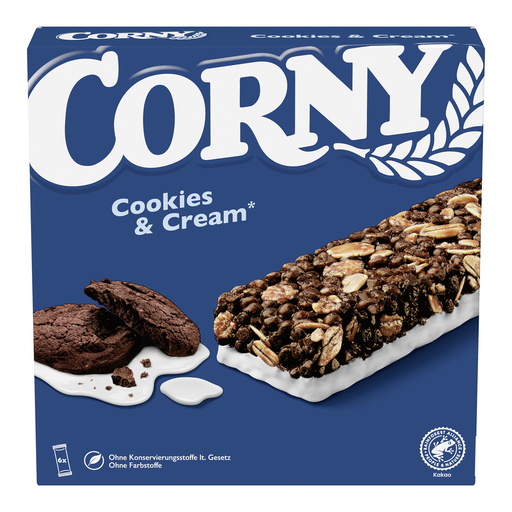
If you’re looking for an individually portioned muesli bar for a late-night snack, the pack named in the product title contains six bars weighing 23 g each. Compare the fat content on the pack with similar varieties, and check the ingredients and allergen information if needed.
 No image available
If you want to compare sugar and ingredients as well as fat content, check the nutrition table and ingredients list for this Haferkraft variety. The product name gives the pack size as 4 × 35 g; check the weight of each bar on the packaging before comparing figures per portion.
No, not under the EU nutrition claim ‘low fat’: for solid foods, the European Commission sets a limit of no more than 3 g of fat per 100 g. The chocolate light varieties from Corny and GOLDEN BRIDGE listed by ALDI SÜD contain 9.4 g and 10 g respectively, so both are over the limit.
Not simply because the word appears in the variety name. Check the specific pack to see which nutrient the claim refers to and which comparable product is used to support a reduction claim.
Use both: figures per 100 g make it easier to compare different muesli bars, while the figures per bar help you work out how much you’ll be having as a snack. ALDI SÜD explains that using figures per 100 g provides a consistent basis for comparing products.
Read the ingredients list and any trace information on the specific pack. EDEKA explains that allergens present are highlighted in the ingredients list; there may also be a trace warning underneath.