Sugar-label checkers
You want to keep the total sugar in your weekday breakfast low, so you check the ‘of which sugars’ figure per 100 g rather than relying solely on a claim on the front of the pack.


If keeping the total sugar in your weekday breakfast low matters to you, start by comparing the ‘of which sugars’ figures per 100 g on muesli nutrition labels. A base you can mix yourself lets you choose what else to add. A ready-made fruit muesli with no added sugar is more convenient, but dried fruit can mean it contains considerably more sugar.
You want to keep the total sugar in your weekday breakfast low, so you check the ‘of which sugars’ figure per 100 g rather than relying solely on a claim on the front of the pack.
You want a base without dried fruit, so you can decide whether to add fruit or other ingredients, and how much.
You prefer fruity flavour without added sugar, while bearing in mind that dried fruit contributes to the total sugar content.
Start by comparing the sugar figure per 100 g. Then decide whether you’d prefer a ready-made mix or more control over the ingredients you add yourself.
| Criteria | What to check | Who it matters to |
|---|---|---|
| Low total sugar | Compare the ‘of which sugars’ figures per 100 g. According to Lebensmittelklarheit, solid muesli can be labelled ‘low sugar’ if it contains no more than 5 g of sugar per 100 g. | If you want to keep total sugar as low as possible, you may need to accept a less sweet mix. Around 42% of consumers would make a low sugar figure their main criterion. |
| Base to mix yourself | Check the ingredients, dried fruit, and the labelling of the grains and allergens it contains. | If I want to add my own fruit and other ingredients, I don’t need a mix that’s already fruity and sweet. Around 33% of consumers would prioritise putting their own mix together. |
| Fruity flavour | Even when a product says ‘no added sugar’, check the ingredients list and the sugar figure per 100 g. | A ready-made fruit mix matters more to me in the morning than keeping total sugar as low as possible. Around 25% of consumers would choose fruity flavour with no added sugar as their first choice. |
This claim doesn’t mean the total sugar content is low. REWE lists 22 g of sugar per 100 g for Kölln Früchte Hafer-Müsli ohne Zuckerzusatz.
Before choosing a fruit mix, compare the ‘of which sugars’ figure per 100 g.
A relative comparison on its own doesn’t tell you how much sugar the muesli actually contains.
Check the stated figure per 100 g and consider how large a portion you plan to have.
Even a simple base can contain several gluten-containing grains, as well as ingredients such as sesame or almonds.
Check the current ingredients list and allergen information on the specific pack every time you buy.
The wholegrain claim describes the cereal ingredients, not the total sugar content. Dried fruit can contribute to the sugar figure even in wholegrain muesli.
Check the wholegrain ingredients and the ‘of which sugars’ figure separately.
Kölln’s range includes fruity oat mueslis with no added sugar.
Seitenbacher offers a muesli labelled ‘low sugar’.
REWE Bio 5-Korn-Müsli is a base to which you can add your own ingredients.
Alnatura’s range includes Bircher muesli with fruit ingredients.
familia offers a range of Müesli varieties with less sugar.
H. & J. Brüggen makes breakfast cereals, including products for own-label brands.
This selection includes crunchy mueslis, a fruit muesli and oats to use as a base for your own mix. Oats aren’t a ready-made muesli mix; for all these products, it’s worth checking the nutrition information per 100 g.
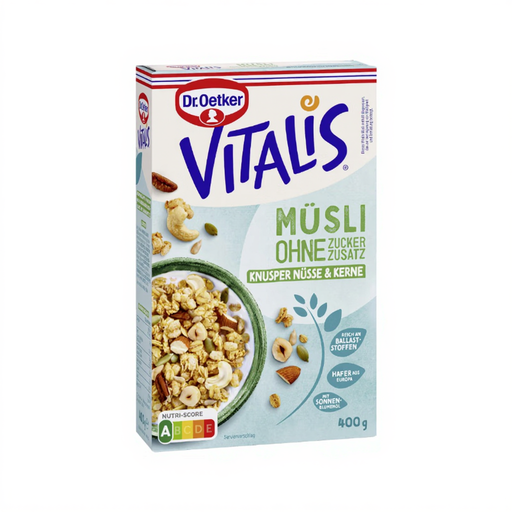 No image available
If you’re looking for a ready-made crunchy nut mix, check the sugar figure, ingredients and allergens for this variety. The pack contains 400 g. ‘No Added Sugar’ in the product name is no substitute for checking the ‘of which sugars’ figure.
 No image available
These oats could make a good base if you’d like to put your own breakfast together. The 500 g pack contains fine organic oats rather than a ready-made muesli mix, so you can choose what else to add.
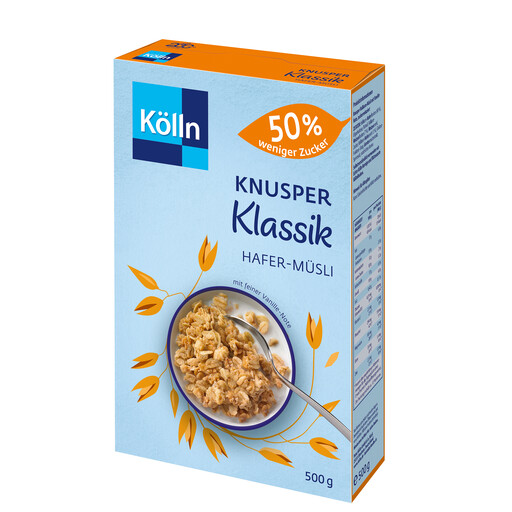 No image available
If you’re after a crunchy mix, compare the stated sugar figure per 100 g for this 375 g variety. ‘50% less sugar’ is a relative claim and doesn’t, on its own, tell you that the final sugar content is low.
 No image available
This 500 g fruit mix could suit you if you’d rather have a ready-made fruity option than keep total sugar as low as possible. Even with the ‘no added sugar’ claim, check the ‘of which sugars’ figure on the pack.
No. Under the EU regulation on nutrition claims, a solid food can only be labelled ‘sugar-free’ if it contains no more than 0.5 g of sugar per 100 g. Muesli can still contain naturally occurring sugar, such as that from dried fruit, even if no sugar has been added.
Compare the ‘of which sugars’ figures per 100 g. According to Lebensmittelklarheit, a solid food can be labelled ‘low sugar’ if it contains no more than 5 g of sugar per 100 g. The nutrition table shows you the figure for the specific muesli.
Dried fruit contributes naturally occurring sugar to the total. REWE lists 22 g of sugar per 100 g for Kölln Früchte Hafer-Müsli ohne Zuckerzusatz. So always check the nutrition table when choosing a fruit mix.
Read the ingredients list and allergen information on the specific pack. The mixes described here may contain gluten-containing grains, almonds or sesame, for example. A low sugar figure tells you nothing about whether a product is suitable if you have an allergy.