If a hotel wants to label a muesli as ‘sugar-free’ on its breakfast buffet, it should check the ‘of which sugars’ value for the specific product: the Verbraucherzentrale (German consumer advice centre) states that this must be no more than 0.5 g of sugar per 100 g. ‘No added sugar’ does not mean the same as ‘sugar-free’. To cater for different preferences, it may make sense to offer a separate cereal base alongside a fruity option, as long as the sugar and allergen information for each option is kept up to date.
Which buffets is this selection relevant to?
Hotels with a specific sugar-free requirement
If you want to use ‘sugar-free’ on your buffet label, you need to check the sugar content of the specific muesli. The Verbraucherzentrale states that this label requires no more than 0.5 g of sugar per 100 g.
Buffets with a fruity, no-added-sugar option
A suitably labelled option may appeal to guests who like a fruity flavour. Kölln notes that its fruit and oat muesli may contain sugars from dried fruit, and that ‘no added sugar’ does not mean ‘sugar-free’.
Buffets with a make-your-own station
Offering a cereal base separately from fruit and other toppings lets guests choose their own combination. Ingredients and allergens for each component must be clearly identified at the open buffet.
What should you look for when choosing?
First, decide whether you want to label the buffet ‘sugar-free’ or offer a selection with less sugar or no added sugar. Then consider the ingredients, how the food will be served and whether the allergen information is up to date.
| Criterion |
What to check when buying |
Who it matters most to |
| ‘Sugar-free’ claim |
Compare the ‘of which sugars’ value per 100 g for the specific product with the 0.5 g limit stated by the Verbraucherzentrale. |
If I want to label something ‘sugar-free’ on the buffet, I need a suitable nutritional value, not just similar wording on the packaging. This clear distinction is a priority for around 31% of consumers. |
| Allergens at the open buffet |
Record the ingredients and main allergens for every mixture and topping; update the information if the recipe or supplier changes. |
When serving food at an open buffet, I want to be able to give guests the correct allergen information for every container. Reliable identification is a priority for around 25% of consumers. |
| Fruity option |
Consider the ‘no added sugar’ claim, the ingredients list and the ‘of which sugars’ value separately. |
If I want a fruity flavour, I accept that fruit ingredients may contribute to the total sugar content. Around 19% of consumers mainly look for this kind of no-added-sugar option. |
| Cereal base for mixing |
Check the sugar content and ingredients of the base, and offer toppings separately with their own allergen information. |
If guests are to make up their own mix, I don’t want to dictate the fruit and other ingredients in the base. This choice is the most important requirement for around 25% of consumers. |
Which mistakes can you avoid?
-
Labelling ‘no added sugar’ as ‘sugar-free’
Even with no added sugar, muesli can still contain sugars from its ingredients. Kölln makes this distinction clear for its fruit and oat muesli, which contains dried fruit.
Before making a sugar-free claim, check the ‘of which sugars’ value per 100 g for the product you’re actually offering.
-
Assuming ‘less sugar’ means a low sugar content
A relative claim doesn’t tell you the absolute sugar content. Kölln’s Knusper Klassik, for example, is labelled ‘50% less sugar’ but still contains 8 g of sugar per 100 g; its ingredients include sugar and glucose-fructose syrup.
When comparing different mueslis, check the nutritional information per 100 g rather than relying on the claims on the front of the pack.
-
Checking allergens only when setting up the buffet
Even a base without dried fruit may contain allergenic ingredients. According to IHK Schwaben, allergen information is also required for unpackaged foods served at hotel buffets.
Match the base and toppings to their allergen information before serving, and check everything again if a product or recipe changes.
Separate containers and changes to buffet labels mean extra work.
-
Planning on one mix to meet every sugar and flavour requirement
A fruity mix with no added sugar won’t automatically meet a strict sugar-free requirement; a cereal base, meanwhile, offers a different flavour and different ways to combine it.
Choose options that suit the claims you want to make on the buffet, and check the sugar content and allergens of each mix individually.
Brands and product ranges to consider
Kölln
Its no-added-sugar fruit and oat muesli is an example of a fruity buffet option.
- Kölln lists dried fruit as the source of sweetness in this muesli.
- The brand makes clear that ‘no added sugar’ does not mean ‘sugar-free’.
Seitenbacher
Its low-sugar muesli is an example of a cereal base without a fruity flavour.
- Seitenbacher states that this product contains 1 g of sugar per 100 g.
- This is above the limit for ‘sugar-free’ stated by the Verbraucherzentrale. Check the ingredients and allergens for the specific product you’ll be serving at the buffet.
Alnatura
Its Bircher muesli is a fruity organic option for buffets where this flavour is popular.
- Alnatura describes the fruit ingredients as the source of sweetness.
- A fruity flavour alone doesn’t justify a sugar-free claim; the nutritional information and ingredients on the pack you’re offering are what matter.
REWE Bio
Its five-grain muesli could work as a base mix for a buffet with ingredients served separately.
- REWE describes the mix as a base without dried fruit.
- A base without dried fruit isn’t automatically sugar-free or suitable for every allergen requirement.
Brüggen
Brüggen describes how it makes mueslis that can be customised for own-label projects.
- For a planned bespoke recipe, the ingredients and intended use on the buffet can be agreed together.
- You’ll need to check the product data for the specific recipe to see whether it meets your requirements for sugar claims and allergen information.
Muesli selection at Joybuy
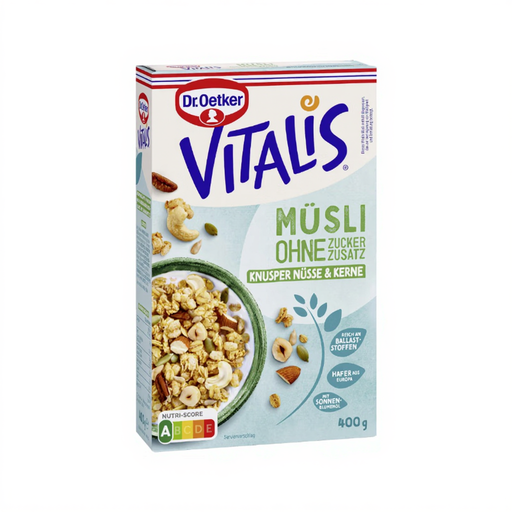
This section focuses on a crunchy muesli with ‘No Added Sugar’ in its product name. If you want to label it ‘sugar-free’ on the buffet, check the sugar content on the current pack before choosing it; the product name alone isn’t enough.
 No image available
Dr. Oetker Vitalis No Added Sugar Crunchy Nut Muesli, 400 g
A crunchy muesli option for a buffet with a separately labelled no-added-sugar choice.
The pack size is 400 g, according to the product name. Before deciding what to state on the buffet, check the sugar content per 100 g, as well as the ingredients and allergens, for the pack you’ll be serving.
View at Joybuy
Frequently asked questions
Does ‘no added sugar’ mean the same as ‘sugar-free’?
No. The Verbraucherzentrale states that ‘sugar-free’ means no more than 0.5 g of sugar per 100 g; muesli with no added sugar can still contain sugars from its ingredients. Kölln highlights this distinction for its fruit and oat muesli.
Does muesli served loose at a hotel breakfast buffet need allergen information?
Yes. According to IHK Schwaben, allergen information is also required for unpackaged food served at hotel buffets. The information must match the mixes and toppings actually being served, and be updated if they change.
Are ‘vegan’ or ‘no added sugar’ labels enough for guests with allergies?
No. These labels don’t replace allergen information. Check the ingredients and allergen details for the specific products, and make sure they’re clearly matched to every mix and topping on the buffet.
How should you store muesli for the breakfast buffet?
Store muesli in suitable containers and protect it from heat, air, light and moisture. The Bundeszentrum für Ernährung also recommends these conditions to help prevent pest infestations; always follow the instructions on the pack too.


