When stocking up on muesli with diabetes in mind, start by comparing carbohydrates, sugar, fibre and ingredients per 100 g, then factor in the amount you plan to eat. A large pack labelled ‘no added sugar’ may still contain sugar from fruit ingredients; smaller mixes with a lower stated sugar content offer a different balance from buying in bulk.
Who this choice matters to
Shoppers comparing sugar and carbohydrates
You want to understand the nutritional values in your usual serving of muesli, rather than relying solely on a claim such as ‘no added sugar’. The consumer advice centre points out that fruit ingredients can also contribute to the sugar content.
Households that eat muesli regularly
Alongside the recipe, pack size, space for dry storage and how quickly you’ll use an opened pack all matter.
Shoppers interested in wholegrains and fibre
You compare wholegrain ingredients and fibre, while also keeping an eye on sugar, carbohydrates and potential allergens.
What to look for when buying
Start with the nutritional information and ingredients for the specific mix. Then decide which pack size you’re likely to use and can store properly.
| Criteria |
What to check |
Who it matters most to |
| Sugar and carbohydrates |
Compare ‘of which sugars’ and carbohydrates per 100 g, then take your planned portion and the ingredients list into account. |
If I choose my breakfast based on its carbohydrate content, I need the figures for the amount I actually eat. Around 40% of shoppers prioritise this comparison. |
| Wholegrains and fibre |
Check the wholegrain ingredients and fibre per 100 g, as well as any ingredients you need to avoid. |
Wholegrains and fibre matter more to me than a particularly fruity mix, but the other nutritional values are still relevant. This is the main priority for around 30% of shoppers. |
| Pack size and storage |
Check the total quantity, how quickly you’re likely to use it and the storage instructions for the opened pack. |
If my household eats muesli often, I want to stock up sensibly without leaving an opened pack for too long. Around 30% of shoppers prioritise this need. |
Common comparison mistakes
-
Assuming ‘no added sugar’ means low in sugar
Fruit ingredients can contribute to the total sugar content. REWE lists 22 g of sugar per 100 g for its 1.7 kg version of Kölln Früchte Hafer-Müsli ohne Zuckerzusatz.
Alongside the claim on the pack, check the ingredients list, ‘of which sugars’ and carbohydrates in the nutrition table.
-
Choosing a large pack just for the quantity
A large pack is only practical if the recipe meets your criteria and you have space to store it and can use it up.
Compare the nutritional values before considering pack size, and follow the storage instructions once it’s opened.
An opened pack that takes a long time to use up needs space and should be kept dry and tightly sealed.
-
Using fibre as your only selection criterion
A fibre figure doesn’t tell you the sugar or carbohydrate content of a muesli. Ingredients and portion size also matter when comparing products.
Compare the fibre and wholegrain ingredients with the other nutritional information for the same product.
-
Overlooking allergens in mueslis with similar names
Wholegrain mixes may contain gluten-containing cereals and nuts. Similar names don’t mean that two varieties have the same ingredients.
Check the ingredients and allergen information on the pack of the variety you’re planning to buy.
Brands to consider
Kölln
Kölln offers its Früchte-Müsli ohne Zuckerzusatz in a pack of 4 × 1,200 g; REWE also lists a 1.7 kg version in this range.
- The documented multipack may suit households that regularly eat fruity muesli.
- The 1.7 kg version listed by REWE contains 22 g of sugar and 64 g of carbohydrates per 100 g. Don’t assume these figures apply to other pack sizes without checking.
Seitenbacher
The Müsli zuckerarm and Spezial-Müsli 2 varieties have published nutritional information and come in 600 g and 750 g packs respectively.
- Seitenbacher states that both varieties contain 1 g of sugar per 100 g; their stated fibre content is 9 g and 10 g per 100 g respectively.
- The varieties described contain gluten-containing cereals; almonds are also listed for Müsli zuckerarm. Neither pack size is a large multipack.
Alnatura
Alnatura’s Bircher muesli is a 500 g organic variety made with cereals, nuts and fruit ingredients.
- This particular Bircher recipe offers an alternative if these ingredients matter more to you than buying a large pack to stock up.
- The ingredients described include date syrup and apple juice concentrate. Check the nutritional information rather than assuming the sugar content based on the source of the sweetness.
Muesli for your breakfast cupboard at Joybuy
Here you’ll find three crunchy mueslis in single packs. If you’re stocking up, the pack sizes and nutritional information for each variety are key; this selection is not a comparison of large multipacks.
 No image available
Dr. Oetker Vitalis Less Sweet Pure Crunchy Müsli, 600 g
The 600 g pack could work for stocking up on breakfast if you’re looking for crunchy muesli. Compare sugar, carbohydrates and fibre using the nutritional information, and take your planned portion into account.
View at Joybuy
 No image available
Jeden Tag Less Sweet Crunchy Oat Müsli, 750 g
The 750 g single pack is worth comparing if you eat crunchy muesli regularly. As well as pack size, check the sugar and carbohydrate figures and the ingredients for this specific variety.
View at Joybuy
 No image available
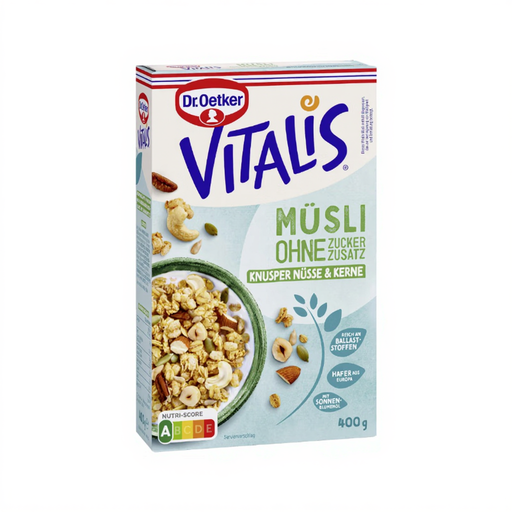
Dr. Oetker Vitalis No Added Sugar Crunchy Nut Müsli, 400 g
If you’re looking for a smaller pack of crunchy muesli with nuts, you could compare the 400 g variety. The ‘No Added Sugar’ claim doesn’t replace checking the sugar and carbohydrate content per 100 g; also check the ingredients and allergen information.
View at Joybuy
Frequently asked questions
Do I need a special ‘diabetic muesli’?
According to the Federal Office of Consumer Protection and Food Safety, people with diabetes don’t need a special dietary food. Instead, compare the ingredients and nutritional values of the specific mueslis. diabetesDE also points out that there is no special diet with foods that are generally off-limits to people with diabetes.
Does ‘no added sugar’ mean a muesli is low in sugar?
No. The claim alone doesn’t tell you the total sugar content. The consumer advice centre lists ingredients such as dried fruit and fruit juice as potential contributors; REWE states that its 1.7 kg version of Kölln Früchte Hafer-Müsli ohne Zuckerzusatz contains 22 g of sugar per 100 g. The ingredients and nutritional information for the specific variety are what matter when comparing products.
How should I store an opened large pack of muesli?
Store muesli in a dry place away from heat, following the instructions on the pack. For the Kölln muesli listed by REWE, it’s recommended that you reseal the inner bag securely after opening. This is particularly important if you’re using a large pack over a longer period.


