
Lieferung heute & morgen

Qualitätsgarantie

Willkommens-Angebote freischalten: KOSTENLOSE Lieferung | Bis zu 80 % RABATT | Kostenlose 30-Tage-JoyPlus-Testphase
App herunterladen
Choosing the right muffin tin affects more than just the appearance of your muffins and cupcakes. The material, spacing between the cups, cleaning requirements and temperature range all influence whether the batter bakes evenly and can be removed easily afterwards. As a Joybuy Product Recommendation Officer, I explain the key details objectively and show which tin suits each type of user.
A non-stick muffin tin can make it easier to remove your bakes. However, how it may be cleaned is crucial. Some coatings are not suitable for the dishwasher. Harsh cleaners, abrasive sponges and metal utensils can damage the surface. A tin that releases bakes easily is therefore not automatically a dishwasher-safe muffin tin.
A 12-cup muffin tin is practical for larger batches, but it needs enough space on the oven rack and in the kitchen cupboard. Check the external dimensions before buying. Depending on its construction, a 12-cup muffin tray can take up considerably more room than a flexible silicone mould.
The maximum temperature does not indicate that a tin is suitable for every heat source. A product may be oven-safe but unsuitable for a hob, microwave or grill. Also check whether sudden temperature changes are prohibited – for example, moving the tin directly from the freezer into a hot oven. This is particularly important with stoneware.
Carbon steel heats up relatively directly and, when the construction is stable, can help distribute heat evenly. A coating makes it easier to remove the bakes, but requires gentle cleaning. According to the product details, the Ballarini PATISSERIE muffin tin has a two-layer PFAS-free coating; the tin is oven-safe up to 230 °C and intended for hand washing.
A silicone muffin mould is flexible, lightweight and space-saving. It is usually easier to turn out, but should be placed on a baking tray when being filled. Stability depends on whether a reinforcing frame is included. The 5five Silitop is specified as having twelve cups, a steel frame and a temperature range of -40 °C to 230 °C.
Stoneware retains heat and can also be used for serving. However, it is heavier and more vulnerable to knocks and sudden changes in temperature. The Le Creuset stoneware models each hold 200 ml, are oven-safe up to 260 °C according to the manufacturer’s specifications, and are stackable.
For classic muffins and cupcakes, a 12-cup tin is a practical choice for families or preparing several portions. Look for details such as diameter and depth. Deep cups provide more room for risen batter, while shallower tins are more suitable for tarts, quiches or small savoury bakes.
Do not fill the cups to the rim. For the Le Creuset muffin tin for twelve muffins, filling to no more than around two thirds is recommended. This leaves room for the batter to rise and reduces the risk of it overflowing.
Before buying, check the following:
A muffin tray made from coated steel is often sturdy, but takes up more storage space. A silicone mould can be stored more flexibly. Stoneware moulds may be stackable, but their weight means they need a secure place in the cupboard.
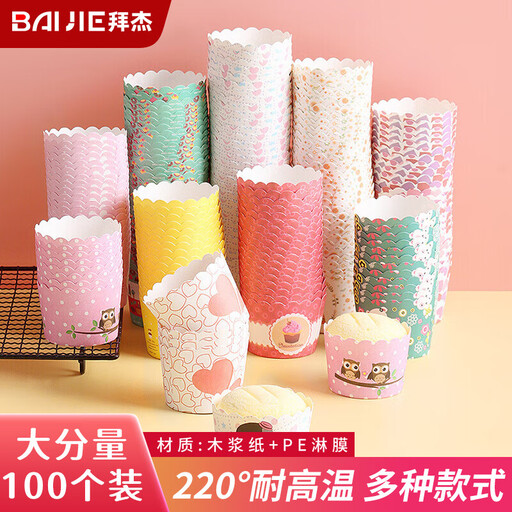
Why this product suits this profile: The 100 paper cases are suitable for occasional baking, celebrations and larger quantities. You will also need a sturdy muffin tray.
The cases reduce direct contact between the batter and the tray and are designed for single use. This prevents damage to a coating caused by incorrect cleaning.
100 pieces; suitable for standard muffin and cupcake tins; no need to grease the paper.
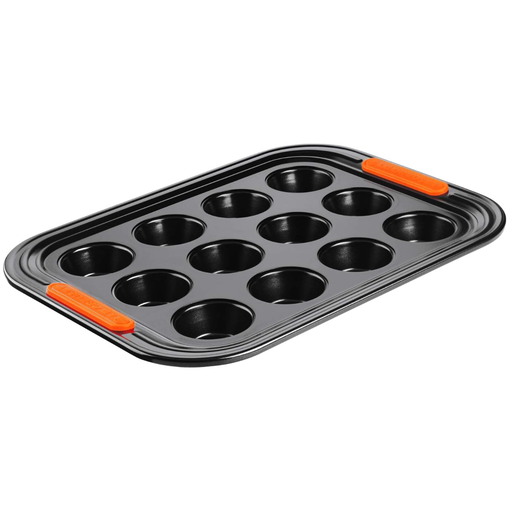
Why this product suits this profile: This 12-cup carbon steel muffin tray is designed for regular baking of muffins, cupcakes and small savoury bakes.
The product details specify sturdy carbon steel, deep cups and a smooth coating. At the same time, the tin is explicitly not dishwasher-safe.
12 cups with a diameter of around 7 cm; oven-safe up to 240 °C; reinforced rim with silicone inserts.
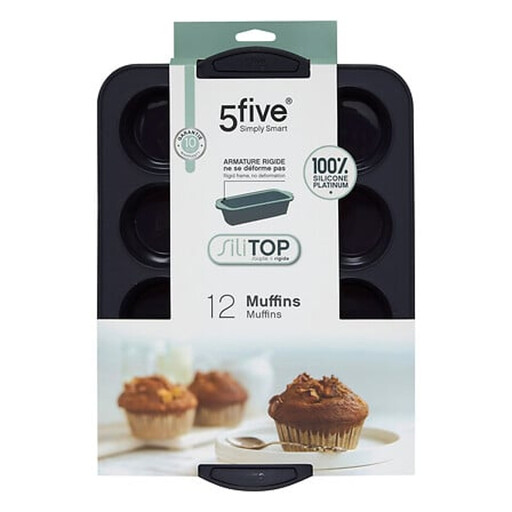
Why this product suits this profile: The combination of flexible silicone and a steel structure offers space-saving storage together with extra stability when transporting the mould.
The frame reduces the risk of a completely flexible mould bending out of shape. For clean filling, the mould should still be placed on a baking tray.
12 cups; dimensions 33.1 × 23.7 × 4.1 cm; steel structure and stated capacity of 0.85 l.

Why this product suits this profile: The six small silicone moulds are designed for individual cakes, cupcakes, jellies and frozen desserts for special occasions.
This is not intended to be a classic 12-cup muffin tray. If you use the six individual cups for small quantities, you avoid buying an oversized standard tin.
Six moulds, each measuring 8 × 7.5 × 3.1 cm; temperature range from -40 °C to 230 °C; dishwasher-safe according to the product details.
We have put together a complete, regularly updated list of products that fully meet these strict selection criteria and the safety regulations applicable in the EU.
A 12-cup muffin tin made from sturdy metal or silicone is suitable for many standard recipes. Metal provides a firm structure while filling; silicone is easier to store and turn out. With a flexible mould, using a baking tray as a base is recommended.
This depends on the individual product. A general statement covering all silicone moulds cannot be relied upon. Check the care instructions. The heart-shaped mould set mentioned above is specified as dishwasher-safe; for the Silitop mould, check the specific manufacturer’s instructions before cleaning it.
Its service life depends on temperature, cleaning, storage and how the surface is handled. Avoid abrasive products, sharp objects and temperatures above the stated limit. A damaged coating should no longer be used.