
Lieferung heute & morgen

Qualitätsgarantie

Willkommens-Angebote freischalten: KOSTENLOSE Lieferung | Bis zu 80 % RABATT | Kostenlose 30-Tage-JoyPlus-Testphase
App herunterladen
Creating complex prototypes and functional components places high demands on manufacturing technology. The desire for multi-color or multi-material objects, in particular, can complicate the selection process for a suitable 3D printer. This article serves as a guide, presenting a selection of FDM printers designed for multi-color and multi-material printing. The goal is to provide an objective overview of technical features and potential applications to facilitate an informed decision.
Before you buy a multi-color 3D printer, several technical aspects should be considered that are crucial for professional results.
A multi-color 3D printer can do more than just create colorful models. The ability to combine different materials in a single print job opens up new possibilities for functional prototypes. For example, rigid components can be printed with flexible ones (PLA with TPU), or parts can be created with soluble support structures (PVA). Systems that can process up to 16 colors or more often use a central material management unit (AMS/MMS). It is therefore important to check compatibility with the required filament types, especially if a 3D printer for multiple materials is needed.
For professional users and small-batch production, print speed is a critical factor. A fast FDM printer significantly reduces iteration times. Many high-speed models rely on CoreXY kinematics. In this design, the motors responsible for the X and Y axes do not move with the print head, which reduces the moving mass. The result is greater stability during fast movements, fewer vibrations, and improved surface quality of the printed objects. A CoreXY 3D printer is therefore often a great choice for demanding printing tasks.
Processing engineering-grade plastics like ABS, ASA, PC, or fiber-reinforced composites (e.g., carbon fiber 3D printer) places special demands on the printing environment. These materials tend to shrink as they cool, which can lead to warping and layer separation. A 3D printer with a heated build chamber creates a consistently tempered environment that counteracts these effects. An active chamber heater is a feature that often distinguishes a professional 3D printer, as it enables reliable processing of high-performance materials.
Based on the criteria mentioned above, we have compiled a selection of printers designed for multi-color and multi-material printing.
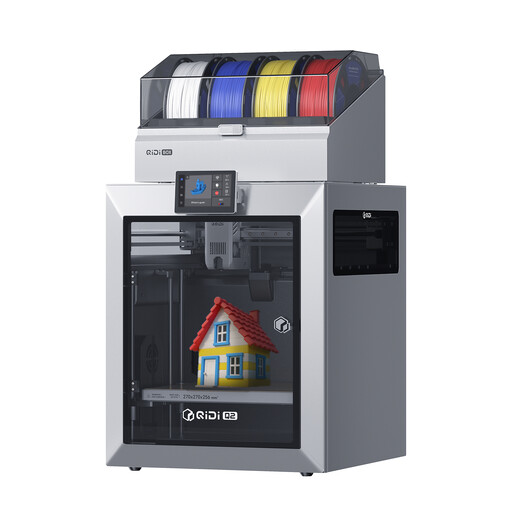
What sets it apart: The QIDI Q2 Combo is an enclosed FDM printer specifically developed for demanding multi-material printing. Its combination of an actively heated build chamber, a filament drying system, and the ability to process high-performance materials makes it a strong option for technical applications.
Advantages:
Who is it for? For engineers, designers, and small businesses who need a reliable machine for creating functional prototypes and small-batch runs from a variety of materials, including technical composites.
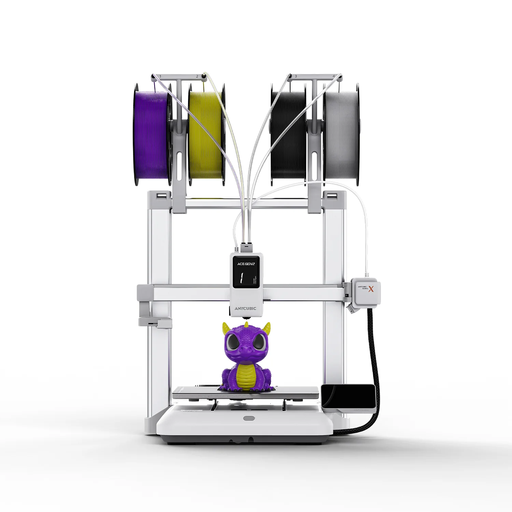
What sets it apart: The ANYCUBIC Kobra X is an open-frame FDM printer that offers flexibility and a large build volume. Its multi-color system is expandable, making it an adaptable solution for creative and complex projects.
Advantages:
Who is it for? For experienced hobbyists (prosumers) and creatives looking for a fast printer with a large build volume and a flexible, expandable multi-color system.
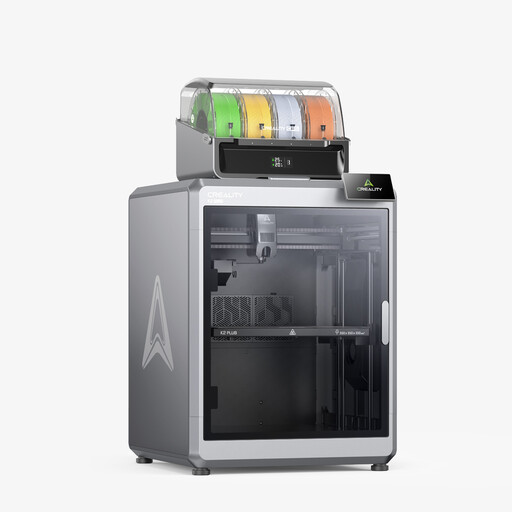
What sets it apart: The Creality K2 Plus Combo combines a very large build volume with an advanced 16-color printing system (CFS). The high nozzle temperature and heated build chamber expand material compatibility to include demanding engineering polymers.
Advantages:
Who is it for? For users in prototyping, small-batch manufacturing, and design who need to print very large, complex, and multi-color objects from a wide range of materials.
If the models presented here do not meet your specific requirements, there is a wider range of devices to explore. From entry-level models to specialized industrial machines, the market offers diverse alternatives.
Discover more FDM printers on Joybuy.de
There are several technologies. Many modern systems, like those presented here, use an external material management unit (often called an AMS or MMS). This unit feeds the required filament from a selection of spools to the printer's single extruder. With each color or material change, the old filament is retracted, the new one is loaded, and the extruder is purged, often by printing a small "purge tower" next to the actual object. Other systems use multiple extruders, but these can be more complex to calibrate.
Material compatibility largely depends on the specific printer model. In general, most multicolor 3D printers can process common filaments like PLA and PETG. Models with a heated build chamber and a high-temperature nozzle are also capable of printing engineering materials such as ABS, ASA, PC, Nylon (PA), and fiber-reinforced composites like carbon fiber (CF) or glass-fiber-reinforced filaments. It is crucial to check the manufacturer's specifications.
Devices in this category are generally aimed at advanced users, professional users, or ambitious hobbyists. Setting up the multi-color system, calibrating filaments, and optimizing print parameters for high speeds require a certain level of experience. While automation features like auto-leveling make it easier to get started, technical understanding is beneficial for fully realizing the printer's potential and for troubleshooting.