
Lieferung heute & morgen

Qualitätsgarantie

Willkommens-Angebote freischalten: KOSTENLOSE Lieferung | Bis zu 80 % RABATT | Kostenlose 30-Tage-JoyPlus-Testphase
App herunterladen
The ability to print complex objects in multiple colors and materials is no longer exclusive to industrial users. A modern multi-color 3D printer also opens up new dimensions for ambitious hobbyists, engineers, and small businesses in prototyping and small-batch production. However, the market is filled with tempting offers that don't always deliver on their promises. Before you invest, it's crucial to understand the common pitfalls that often lead to disappointment and unnecessary expenses.
This guide focuses on the objective criteria that define a high-performance multi-color printer, helping you distinguish marketing hype from genuine functionality.
Choosing the wrong model often leads to frustration. Pay close attention to these three points to avoid a bad purchase:
To avoid the issues mentioned above, you should carefully examine three core technical aspects. These define the true performance and versatility of a multi-color 3D printer.
The heart of any multi-color printer is the system that manages and switches filaments. An advanced automatic material system (often referred to as AMS or CFS) should have the following features:
For professional applications, every minute counts. Pay attention not only to the maximum print speed (in mm/s) but also to the acceleration (in mm/s?). High acceleration values are crucial for the printer to even reach its top speed on short paths. A high-speed 3D printer with speeds of 500 mm/s or more and an acceleration of over 10,000 mm/s? drastically reduces production times.
The ability to process demanding materials depends directly on these three components:
Here are three recommendations tailored to different requirements that meet the criteria mentioned above.
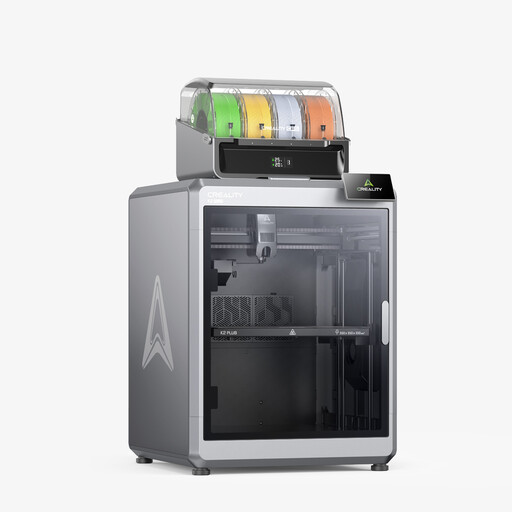
Why This Fits Their Persona: Ideal for engineers and small businesses that need to produce large, functional parts and prototypes in a single run using various materials. The massive build volume maximizes productivity.
Combines a very large build volume (350mm?) with high speed (up to 600 mm/s) and a scalable 16-color system. The 350°C nozzle and 60°C build chamber enable the processing of carbon fiber composites.
Large Build Volume 3D Printer: 350×350×350 mm for maximum flexibility.
Comprehensive Material Support: Actively heated chamber and high-temperature hotend.
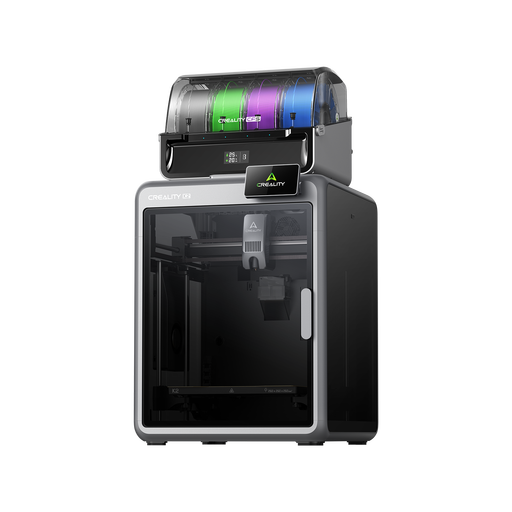
Why This Fits Their Persona: Perfect for designers and makers seeking a powerful, fast, and reliable multi-color solution in a standard build volume. The smart features simplify the workflow.
Offers the same advanced CFS technology and high speed as the Plus model, but in a more compact format. The AI camera and automatic leveling minimize print failures and manual intervention.
Integrated Ecosystem: The CFS system for up to 16 colors is seamlessly integrated.
Smart Monitoring: The AI camera detects errors in real-time.
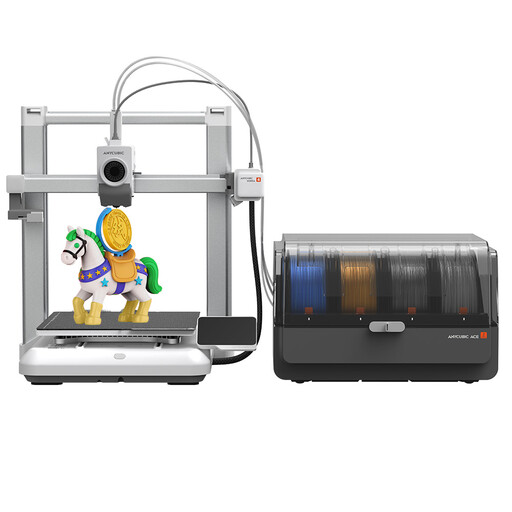
Why This Fits Their Persona: Suitable for advanced hobbyists looking to upgrade from an entry-level model and explore the world of multi-color printing without sacrificing high speed and modern features.
Delivers a balanced package of speed (up to 600 mm/s), a 4-color system (expandable to 8), and a 300°C hardened steel nozzle. It makes no compromises on core performance.
Balanced Price-to-Performance: Offers high-end features like high speed and multi-color printing in an accessible package.
Print and Dry: The system supports active drying during the print.
We have compiled a complete, real-time list of products that fully satisfy these strict selection criteria and UK safety regulations.
1. How much filament is used during a color change? The filament consumption depends heavily on the specific automatic material system. Modern systems are designed to minimize waste by purging only a small amount of material into a purge tower or directly into the model's infill. Compared to older systems, consumption is significantly lower, but some material loss is technically necessary and unavoidable for clean color transitions.
2. Is a multi-color 3D printer suitable for beginners? While modern printers have become more user-friendly with features like automatic leveling and an AI camera, multi-color printing adds a layer of complexity. Preparing models in the slicing software and managing multiple filaments require a certain basic understanding. Therefore, these devices are better recommended for advanced hobbyists or users with prior experience in 3D printing.
3. Can I print engineering materials like carbon fiber with a multi-color printer? Yes, provided the model meets the technical requirements. Crucial factors include a nozzle temperature of at least 300°C, a hardened steel nozzle to prevent abrasion, and ideally, an enclosed, heated build chamber to control the ambient temperature. Check the printer's specifications carefully to ensure it is designed for carbon fiber 3D printer filament and other engineering-grade materials.