
Lieferung heute & morgen

Qualitätsgarantie

Willkommens-Angebote freischalten: KOSTENLOSE Lieferung | Bis zu 80 % RABATT | Kostenlose 30-Tage-JoyPlus-Testphase
App herunterladen
Multi-color 3D printing opens up new dimensions for creativity and prototyping. The ability to create complex models in multiple colors without manual intervention is equally attractive to designers, engineers, and ambitious prosumers. However, the market is flooded with devices whose performance claims often don't hold up in practice. Before you buy a multi-color 3D printer, it's crucial to understand the common pitfalls that can lead to frustration and unnecessary expense.
Many users invest in a system only to find that its advertised features come with significant drawbacks. The most frequent issues include:
To avoid these pitfalls, you should base your purchasing decision on objective technical parameters. Three aspects are critical for reliable and efficient multi-color 3D printing.
The mechanical design of the printer is a key determinant of its precision at high speeds. The CoreXY structure has proven to be advantageous here. In a CoreXY 3D printer, the print head is moved by two stationary motors and a sophisticated belt system. Since less mass needs to be moved on the axes, higher accelerations (measured in mm/s?) and speeds (in mm/s) are possible with fewer vibrations. An enclosed frame also stabilizes the build chamber temperature, which is essential for printing with temperature-sensitive materials like ABS and also makes the printer quieter.
A high-performance FMS is the heart of any multi-color printer. It is responsible for much more than just changing colors. Look for the following features:
Such a system is the foundation for reliably harnessing the potential of up to 16-color 3D printing.
Modern 3D printers relieve the user of many complex setup steps. Features like fully automatic bed leveling (Auto-Leveling), dynamic flow control, and pressure advance compensation are not gimmicks but necessary tools for repeatable and precise results. AI-powered failure detection, such as "spaghetti detection," can stop a failed print early, saving material and time.
Based on the criteria above, we have identified products that represent a well-thought-out solution for specific user profiles.
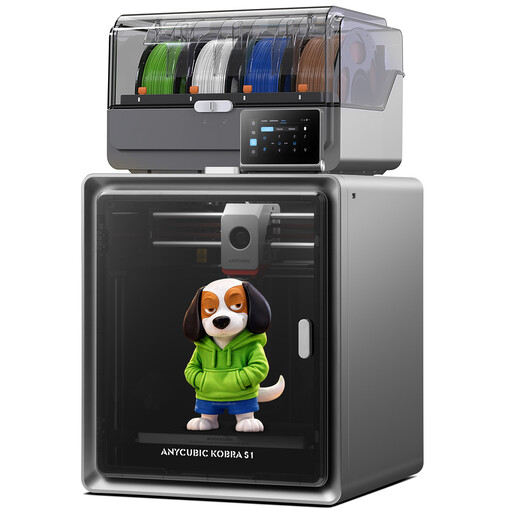
Why This Fits Their Persona: This system is an all-in-one solution for engineers, designers, and small businesses who need high print speed, material versatility, and reliable multi-color printing. It combines a fast CoreXY printer with an advanced filament management system.
The ACE 2 Pro system, with active drying up to 65°C and four independent motors, minimizes color change errors. The CoreXY structure enables high speeds (up to 600 mm/s) even on complex multi-color prints without sacrificing precision.
Integrated solution for up to 16 colors (expandable), active filament drying, and an enclosed frame for demanding materials like ABS and ASA. The quiet operating mode (down to 44 dB) is suitable for office environments.
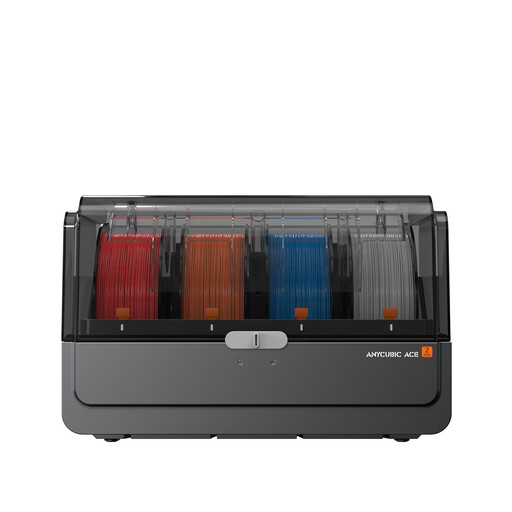
Why This Fits Their Persona: For users who already own a compatible Anycubic Kobra series 3D printer and want to cost-effectively upgrade it for multi-color printing. It offers a modular expansion path.
This system retrofits the most critical features: a reliable 4-color feeding mechanism and active filament drying. This eliminates the main causes of failed multi-color prints on compatible printers.
Enables entry into multi-color printing with active drying as a retrofit solution. Compatibility with the Kobra X / Kobra S1 (Max) series protects previous investments.
A significant advantage of an enclosed frame is noise insulation. While open-frame printers can easily exceed 55 dB, models with an enclosure often operate much more quietly. The Anycubic Kobra S1, for example, features a special quiet mode that reduces operating noise to as low as 44 dB, according to the manufacturer. This is comparable to the volume of a quiet library, making it suitable for use in homes or offices.
Many high-performance filaments like PETG, TPU, ABS, and ASA are hygroscopic, meaning they absorb moisture from the surrounding air. Damp filament leads to printing problems such as steam bubbles forming in the nozzle, which manifests as a rough surface ("stringing," "oozing") and poor layer adhesion. An active drying unit, which keeps the filament at a constant temperature before and during printing, removes this moisture and ensures consistently high print quality.
The days of manual, time-consuming calibrations are largely over. Modern systems like the Kobra S1 use advanced automation features. The LeviQ 3.0 Auto-Leveling measures the print bed at multiple points and compensates for any unevenness completely automatically. Functions for flow calibration and pressure advance optimize the extrusion for each filament, which significantly simplifies setup and ensures a perfect first layer.