
当日/次日达

品质保障

开启新人专享福利: 全场免邮 | 低至 2 折 | 免费试用 30 天 JoyPlus 会员
下载 Joybuy
By a Joybuy Product Recommendation Officer, July 28, 2026
For advanced and professional users, the transition from single-color to multi-color 3D printing marks a pivotal step. The ability to produce complex, full-color prototypes, functional models, or small-batch productions opens up new possibilities in design, engineering, and manufacturing. However, the market for Multi-Color 3D Printers is complex and defined by technical specifications.
This article serves as a guide. Instead of overwhelming you with marketing promises, we focus on the objective criteria relevant for an informed purchasing decision. We will analyze the key features of modern devices and present a selection of models suitable for demanding projects.
Choosing the right printer depends on your specific requirements. You should consider three central aspects in your decision.
A Multi-Color 3D Printer is not necessarily a Multi-Material 3D Printer. Most systems use a single nozzle combined with an external unit (like an AMS or ACE) that feeds filaments of different colors. This is efficient for creating colorful models from the same material type, such as PLA.
Systems with multiple independent print heads, on the other hand, offer true multi-material capability. They can process different material types simultaneously, for example, a rigid material like PETG with a flexible TPU or a water-soluble support material (PVA). This is crucial for manufacturing complex functional components.
A 3D printer with a large build volume is essential for producing large objects or for the parallel production of several smaller parts. However, a large print volume requires stable and precise mechanics to ensure consistent quality, even at high speeds.
The CoreXY 3D printer design has become established in this area. By arranging the belts so that the motors for the X and Y axes are fixed to the frame, the moving mass of the print head is reduced. This allows for high accelerations, making it a high-speed 3D printer without quality degradation from vibrations.
A professional 3D printer is characterized by reliability and low maintenance. Automation features are of central importance here. A 3D printer with automatic leveling is standard today, but advanced models go a step further.
Look for features like automatic Z-offset calibration, vibration compensation (Input Shaping), and flow control (Pressure Advance). These algorithms correct mechanical inaccuracies and material flow fluctuations in real time, leading to more precise print results and a significantly lower failure rate.
Based on the criteria above, we have compiled a selection of printers that are well-suited for advanced users due to their specific performance characteristics.
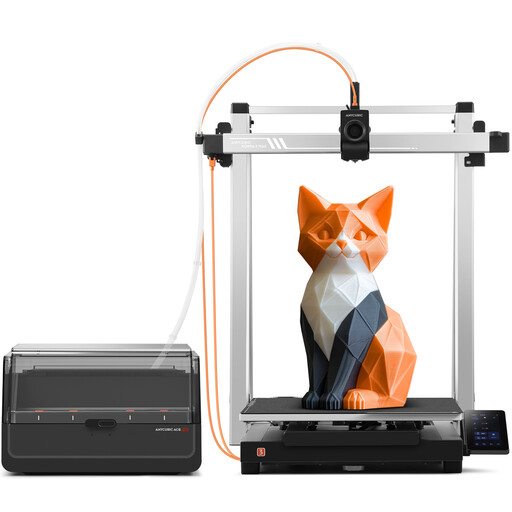
What Sets It Apart: The Kobra 3 Max Combo is designed for maximum productivity and scale. With a build volume of 420 × 420 × 500 mm (88 liters), it targets users who need to print very large models or high quantities in series. The ACE Pro system enables printing with up to 8 colors. Features like the LeviQ 3.0 automatic leveling and an integrated filament drying box support reliable and continuous operation.
Advantages:
Who It's For: Ideal for engineers, designers, and small business owners who produce large-format prototypes, architectural models, or small-batch series with multiple colors and prioritize high speed.
View More Details on the ANYCUBIC Kobra 3 Max Combo
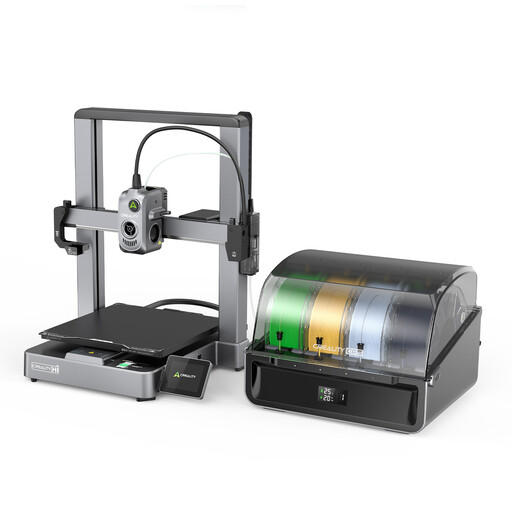
What Sets It Apart: The Creality Hi Combo focuses on modularity and user-friendliness. The Creality Filament System (CFS) is expandable to up to four units, allowing for printing with up to 16 colors. A special feature is the RFID filament detection, which automatically recognizes the material type and color and adjusts the print settings accordingly. With an operating noise level of under 48 dB, the device is also suitable for office environments.
Advantages:
Who It's For: Users who want maximum color variety and appreciate a straightforward, automated workflow. Its low noise level makes it a great choice for use in work or living spaces.
View More Details on the Creality Hi Combo
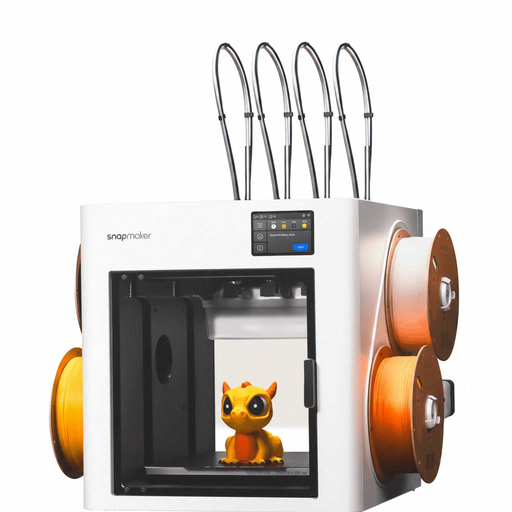
What Sets It Apart: The Snapmaker U1 takes a different approach: it is a true multi-material 3D printer with four independent toolheads. The SnapSwap technology allows for a tool change in about 5 seconds. Since there is no need for laborious filament purging in a single nozzle, material waste is reduced by up to 80% compared to single-extruder systems, according to the manufacturer. The CoreXY system ensures precision at high speeds.
Advantages:
Who It's For: Professional users such as engineers and product designers who need to produce functional parts from different materials (e.g., rigid/flexible) or with soluble support structures, and who demand the highest precision and efficiency.
View More Details on the Snapmaker U1
While FDM printers are designed for the precise manufacturing of models, some creative projects require a more direct, freehand approach. If you are exploring tools for freeform 3D modeling, our selection of 3D pens for adults could be an interesting addition to your creative toolkit.
1. What is the difference between a multi-color 3D printer and a multi-material 3D printer? A multi-color 3D printer typically processes different colors of the same material (e.g., red, blue, and green PLA) through a single nozzle. A multi-material 3D printer can combine different material types with varying properties (e.g., rigid PLA and flexible TPU) in a single print job. Models with independent toolheads, like the Snapmaker U1, are typical examples of this category.
2. How fast is a modern CoreXY 3D printer? A modern high-speed 3D printer with CoreXY architecture can achieve print speeds of 300 mm/s to 600 mm/s and acceleration values of up to 20,000 mm/s?. These high speeds are only possible due to the lightweight print head and stable frame, which minimize vibrations and maintain print quality.
3. Is automatic leveling necessary for a 3D printer with a large build volume? Yes, for a 3D printer with a large build volume, automatic leveling is essential. Manually leveling a large print bed perfectly is extremely difficult and time-consuming. An automatic system measures the bed at multiple points and digitally compensates for any unevenness. This ensures optimal first-layer adhesion, which is crucial for the success of a long print on a large surface.