
Lieferung heute & morgen

Qualitätsgarantie

Willkommens-Angebote freischalten: KOSTENLOSE Lieferung | Bis zu 80 % RABATT | Kostenlose 30-Tage-JoyPlus-Testphase
App herunterladen
As a Joybuy Product Recommendation Officer, I analyse product data and user feedback daily. A recurring theme is that the search for the right multi-colour 3D printer is often clouded by marketing promises that don't hold up in practice. Many users invest in a device that either fails to meet their complex requirements or quickly loses value due to hidden defects. This guide will help you identify the crucial features and make an informed choice.
Advanced users and small businesses have specific expectations for an FDM printer. However, certain heavily advertised features quickly reveal themselves to be weaknesses.
To avoid these problems, you should check three core technical areas before buying. These determine whether a printer is truly suitable for prototyping and small-batch production.
For printing engineering-grade plastics like ABS, ASA, or materials for a carbon fibre 3D printer, an actively heated chamber is essential. A constant ambient temperature of around 60–65°C minimises warping and ensures stable inter-layer adhesion, which is critical for the mechanical strength of functional parts. Additionally, a nozzle capable of reaching temperatures of at least 300°C is required to reliably melt these materials.
A large build volume 3D printer, for example, 350 x 350 x 350 mm, allows for the production of large prototypes or multiple smaller parts in a single run. However, this size places high demands on frame stability. CoreXY kinematics is often the preferred choice here, as it reduces moving mass and enables more precise movements at high speeds. Features like input shaping (vibration compensation) and pressure advance are crucial to ensure high print quality, even in the corners of the large build volume.
Modern multi-colour systems, often called CFS (Color Filament System) or AMS (Automatic Material System), are more than just filament changers. Look for the following features:
The following models were selected based on the objective criteria mentioned above. They cater to different requirement profiles in the prosumer and small business sectors.
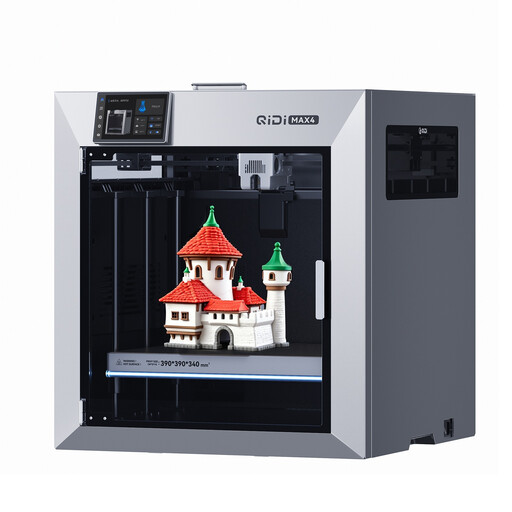
Why This Fits Their Persona: Ideal for users who create functional prototypes and tools from a wide range of materials. The focus is less on colour variety and more on processing high-performance plastics.
The active chamber, heated up to 65°C, and the high-temperature hotend bypass the incompatibility with engineering filaments like carbon fibre nylon or PPS-CF. The large build volume is designed for demanding projects.
Very large build volume (390x390x340 mm) and high material compatibility thanks to the heated chamber. The system is expandable with the QIDI BOX for up to 16-colour printing.
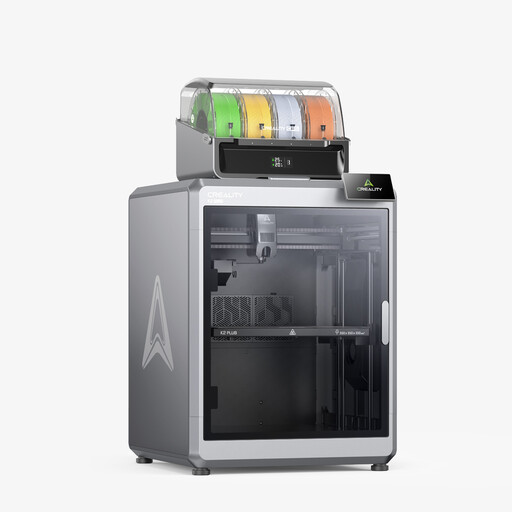
Why This Fits Their Persona: Perfect for small businesses that need a reliable, fast, and versatile printer for small-batch production and complex, multi-colour models. Time is a critical factor here.
The Creality Filament System (CFS) is designed for efficiency, enabling printing with up to 16 colours. The high print speed of up to 600 mm/s is supported by stable mechanics and smart compensation, avoiding unrealistic speed promises.
Combines a large build volume (350x350x350 mm) with high speed and an advanced 16-colour system. Dual AI cameras for error detection minimise waste and save costs.
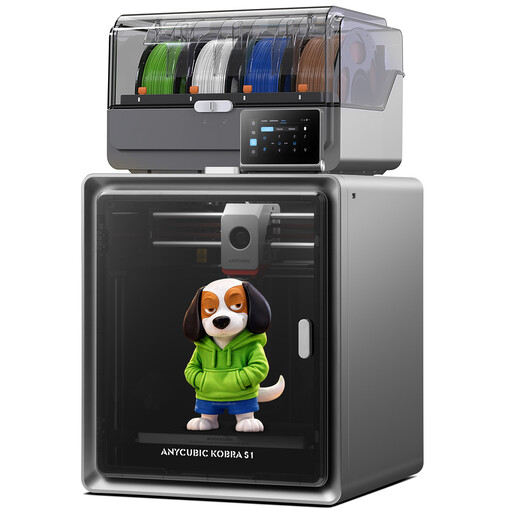
Why This Fits Their Persona: For creatives and designers who want to push the boundaries of FDM printing with complex, multi-colour models. The expandability and integrated drying are key advantages here.
The ACE 2 Pro system is not just a colour changer; it actively dries the filament at up to 65°C. This prevents moisture-related print failures and material waste, a common problem with inefficient systems.
Comes standard with 4 colours but is expandable to 16. The combination of a CoreXY structure for high speeds and active filament drying makes it a versatile tool.
We have compiled a complete, up-to-date list of products that meet these strict selection criteria and European safety regulations. Discover our range of compatible filaments and accessories as well.
How much waste is actually generated in multi-colour printing? Material waste, primarily from the purge tower, is unavoidable to ensure clean colour transitions. However, modern systems like the Creality K2 Plus Combo optimise this process with intelligent algorithms that reduce the amount of purged material. The waste heavily depends on the model's complexity and the number of colour changes per layer.
Is a 3D printer with a heated chamber safe for home use? Yes, as long as basic safety precautions are taken. Place the printer on a stable, fire-resistant surface and ensure good ventilation in the room, especially when printing materials like ABS or ASA that can release fumes. Look for CE marking, which confirms compliance with European safety standards.
Is investing in a 16-colour 3D printing system worth it? The answer depends on your use case. For producing purely functional parts with no aesthetic requirements, it may not be necessary. However, if you are creating visually appealing prototypes, detailed architectural or design models, or customised small-batch products, 16-colour 3D printing opens up entirely new possibilities and can create significant added value.