
Lieferung heute & morgen

Qualitätsgarantie

Willkommens-Angebote freischalten: KOSTENLOSE Lieferung | Bis zu 80 % RABATT | Kostenlose 30-Tage-JoyPlus-Testphase
App herunterladen
For advanced 3D printing users, it's no longer just about printing a model. The demands are increasing: projects must not only be detailed but also realised at high speed and with multiple colours. However, the search for a device that combines precision, speed, and multi-colour capability can quickly become overwhelming. This article serves as a guide, presenting selected devices and materials that can be considered for demanding printing projects.
Technical data sheets are often long and filled with marketing terms. To make an informed decision, it's helpful to focus on a few key aspects that are crucial for print quality and efficiency.
A high-speed 3D printer is not defined solely by its maximum print speed. An equally important value is acceleration, often specified in m/s?. High acceleration allows the print head to actually reach its specified top speed over short distances. A stable frame and precise mechanics are prerequisites for this, minimising vibrations and maintaining print quality even at high speeds. Pay attention to the recommended print speed, as this often represents a more realistic value for everyday use than the maximum achievable speed.
A multi-colour 3D printer is a complex system. The best results are achieved when hardware, slicing software, and filament are perfectly coordinated. Integrated systems, where the colour-changing mechanism is factory-installed, often offer a smoother out-of-the-box experience than retrofit solutions. The quality of the filament is just as crucial. For fast and complex prints, an uneven diameter or poor winding of PLA filament 1.75mm can quickly lead to nozzle clogs or material breaks, ruining a print that has taken hours.
Modern FDM printers offer a range of features that significantly simplify the printing process and increase the success rate. Automatic bed levelling is almost essential for large and fast printers to ensure a perfect first layer. Other useful features include filament run-out or tangle detection, as well as a function to resume printing after a power outage. These intelligent assistants minimise the risk of print failures and save time and material.
Based on the criteria mentioned above, we have compiled a selection of products relevant for users with high demands for speed and colour variety.
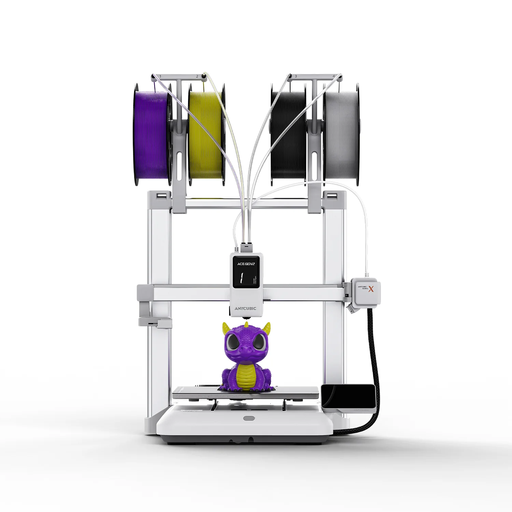
Why It Stands Out The Anycubic Kobra X is designed as an integrated system that combines high speed with native multi-colour printing. It is aimed at users who want to start directly with complex, colourful models without extensive modifications. The combination of a large build volume and intelligent monitoring functions makes it a tool for ambitious projects.
Technical Specifications:
Who Is It For? For makers, engineers, and creatives looking for a powerful, all-in-one package for producing functional prototypes, large models, or artistic objects with multiple colours, who also value efficiency and reliability.
The right filament is crucial for a high-speed printer. Specially formulated materials ensure clean extrusion and good layer adhesion even at high speeds.
| Feature | Creality Hyper PLA White | Creality Soleyin Ultra PLA Ocean Blue | | :--- | :--- | :--- | | Image | 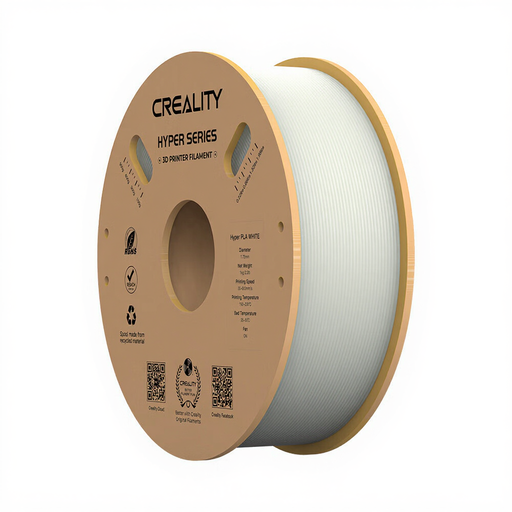 |
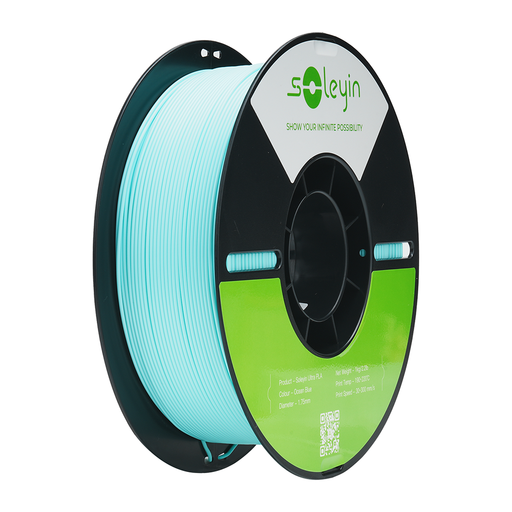 | | Speed | Optimised for 30–600 mm/s | Optimised for 30–300 mm/s | | Dimensional Accuracy | +/- 0.02 mm | +/- 0.02 mm | | Special Features | High fluidity and rapid cooling for extreme speeds. | Low warping and neat winding for high print reliability. | | Best For | Users who want to leverage their printer's maximum speed. | Users who prioritise high reliability and compatibility. |
Why They Stand Out Both filaments from Creality are specially developed for the demands of modern high-speed printers. The high dimensional accuracy of +/- 0.02 mm and the clean EPC Automatic Neat Winding Technology reduce the risk of clogs and tangles. The vacuum-sealed packaging with desiccant ensures that the material arrives in pristine condition.
Who Are They For? For all owners of FDM printers, especially high-speed models, who aim for consistent material quality and high success rates in their prints.
The selection presented here covers specific use cases. However, the market offers a variety of other models with different specialisations. If you would like to compare more devices, you can find a broader overview in our category.
Discover more models in our High-Speed Printers category.
Although many standard filaments may work, using filament specifically designed for high speeds is recommended for optimal results. High-speed filaments like Creality Hyper PLA have higher fluidity and an adapted cooling characteristic. This allows for clean extrusion and precise layer deposition even at speeds over 300 mm/s, reducing the risk of under-extrusion or messy surfaces.
An integrated system, like the one in the Anycubic Kobra X, is designed for multi-colour printing from the ground up. Hardware and software are coordinated, which typically leads to an easier setup and greater reliability. Add-on solutions (such as external colour changers) offer more flexibility as they can be compatible with various printers, but they often require more calibration effort and technical expertise to function smoothly.
It is extremely important. A perfectly calibrated first layer is the foundation for any successful print. For long-duration multi-colour prints that can take many hours, this first step is even more critical. An error in the first layer will inevitably lead to the failure of the entire print. Automatic levelling systems like the LeviQ 3.0 relieve the user of this error-prone manual task and ensure a consistently high success rate.