
Lieferung heute & morgen

Qualitätsgarantie

Willkommens-Angebote freischalten: KOSTENLOSE Lieferung | Bis zu 80 % RABATT | Kostenlose 30-Tage-JoyPlus-Testphase
App herunterladen
A multi-door refrigerator offers separate cooling and freezer compartments, flexible storage areas and often additional features such as No Frost, water dispensers or ice makers. This is practical for families and larger households—but a spacious cabinet alone does not guarantee that the appliance will suit your kitchen or shopping habits.
As a Joybuy Product Recommendation Officer, I filter the most important information from product data sheets and explain which criteria genuinely matter when making a purchase.
Manufacturers often quote the total capacity. What matters, however, is how that capacity is divided between the refrigerator and freezer compartments, as well as the number of drawers, glass shelves and door racks. A refrigerator-freezer with a total capacity of 600 litres may offer very different amounts of genuinely usable space depending on its design.
Therefore, check the following:
A No Frost refrigerator prevents ice from forming in the refrigerator and freezer compartments through automatic air circulation. This reduces the need for manual defrosting. Cleaning, checking the door seals and keeping the ventilation openings clear are still necessary.
With some compact appliances, No Frost applies only to the refrigerator compartment. One example is the Gorenje RB39EPW4: the refrigerator compartment defrosts automatically, while the 7-litre freezer compartment must be defrosted manually.
A refrigerator with a water dispenser can be supplied via a water tank or a fixed water connection. Tank models are more flexible when it comes to installation, but they require regular refilling and cleaning. For fixed water connections, you need to consider available space, hose routing and local installation options.
A refrigerator with an ice dispenser may also require additional maintenance. Before buying, check whether ice cubes, crushed ice and chilled water are actually available, and whether a water filter is included.
The European Union’s energy efficiency scale ranges from A to G. For running costs, the stated annual consumption in kilowatt-hours is also important. An energy-efficient refrigerator with a larger capacity may be cheaper to run than a smaller appliance with higher consumption.
Do not compare the efficiency class alone. Also consider:
The figures are based on standardised conditions. Actual consumption depends, among other things, on room temperature, how fully the appliance is loaded and how often the door is opened. You can find more models in the energy-efficient refrigerator category.
For an open-plan kitchen or an apartment with a nearby bedroom, the decibel rating is relevant. The difference between 32, 37 and 40 dB(A) can be noticeable in everyday use, particularly when the compressor starts frequently or the ice maker is active.
A low figure is not the only consideration, however. Also pay attention to the airborne acoustical noise emission class, the construction and whether the appliance is correctly aligned. Uneven floors can amplify vibrations.
A freestanding refrigerator requires sufficient clearance for heat dissipation and door movement. Before buying, measure:
A French-door refrigerator often requires less lateral swing space than a conventional side-by-side refrigerator because of its split upper doors. However, the lower freezer drawers may need more room to extend forwards.
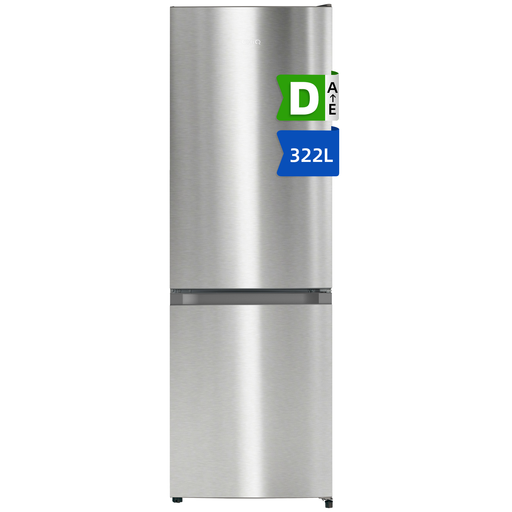
Why it fits the profile: With 226 litres of refrigerator capacity and 96 litres of freezer capacity, this model suits smaller families looking for a spacious yet comparatively compact refrigerator.
The product data clearly states the net capacity, annual consumption of 196 kWh and dimensions of 59.5 × 185.5 × 63.5 cm. Total No Frost reduces the need for defrosting.
Energy efficiency class D, 37 dB(A), fast-freezing function and climate classes N, SN, ST and T.
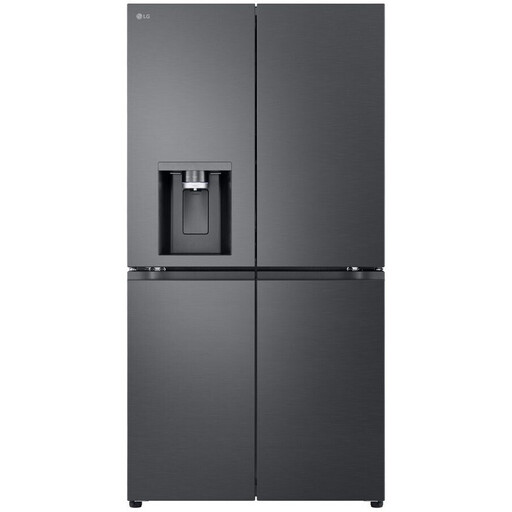
Why it fits the profile: With a total capacity of 645 litres, including 384 litres for refrigeration and 261 litres for freezing, this appliance is designed for large families and substantial weekly shops.
The product description distinguishes between refrigerator and freezer capacity. The water dispenser features Smart Fill, while No Frost eliminates the need for manual defrosting.
Energy efficiency class C, annual consumption of 230 kWh, 34 dB(A), crushed ice and compatibility with the LG ThinQ app.
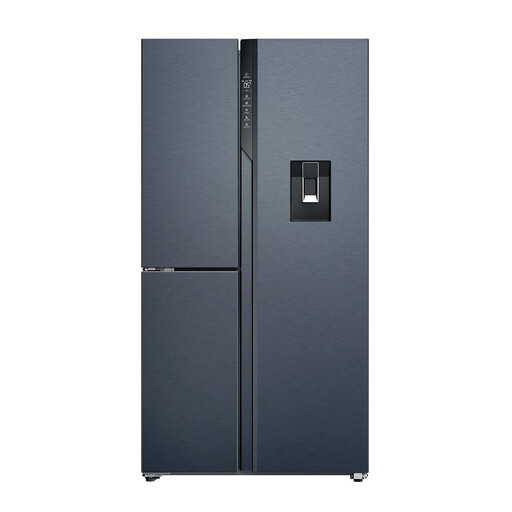
Why it fits the profile: This appliance is designed for larger households that need 573 litres of storage and a convertible zone for changing refrigeration or freezing requirements.
The Switch Zone can be adapted to your current needs. The water dispenser uses a tank, so a fixed water connection is not required.
573 litres, Total No Frost, 37 dB(A), water dispenser, Twist ice maker and annual consumption of approximately 302 kWh.
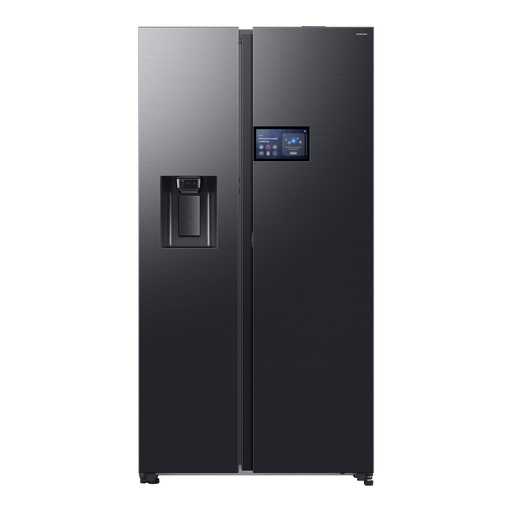
Why it fits the profile: For users who want more than generous storage—namely app control, ice and water dispensing, and flexible monitoring of energy consumption.
The water dispenser uses an integrated tank. The product data also lists the dimensions, capacity and energy efficiency class D separately.
621 litres, No Frost+, 220-litre freezer capacity, automatic ice maker and SmartThings connectivity.
Before connecting a large refrigerator, leave it standing upright for several hours in accordance with the manufacturer’s instructions so that the refrigerant can stabilise. The appliance must be placed on a level surface and connected to a grounded 220–240-volt socket. Extension leads and multi-socket adapters should be avoided wherever possible with high-powered appliances.
Keep ventilation openings clear and do not place the appliance directly next to radiators, cookers or in direct sunlight. The climate class indicates the ambient temperatures for which the model is designed. For cellars, utility rooms or garages, pay particular attention to the stated minimum temperature.
Our complete selection includes models for different households in Germany, categorised by energy efficiency, capacity, design and features.
That depends on shopping habits and the proportion of frozen food you store. For four or more people, models starting at around 400 litres are often worth considering. If you regularly stock up on provisions, also look for a sufficiently large freezer compartment and fully extendable drawers.
Multiply the annual consumption stated on the data sheet by your electricity price per kilowatt-hour. With annual consumption of 300 kWh and an assumed rate of €0.35 per kWh, the calculated cost is around €105 per year. The actual figure may vary.
No. A French-door refrigerator usually has wide refrigerator compartments at the top and freezer drawers at the bottom. In a side-by-side refrigerator, the refrigerator and freezer compartments are generally positioned next to each other. French-door models often provide wider shelf space, while side-by-side appliances offer quick access to both compartments.